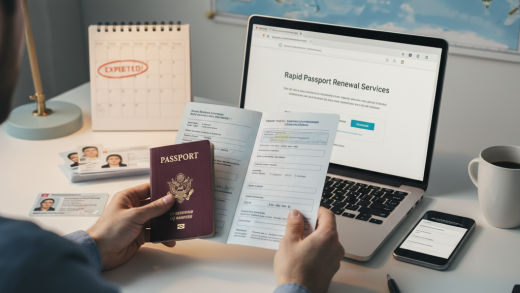

The cornerstone of your application is the official form itself. For all first-time applicants, this is the Form DS-11: Application for a U.S. Passport. You can download this form directly from the U.S. Department of State’s website or obtain a physical copy from a passport acceptance facility, such as a post office or county clerk’s office.
A critical instruction for Form DS-11 is to fill it out completely and accurately using black ink, but do not sign it. You must wait to sign the form in the presence of an authorized acceptance agent at the facility where you submit your application. Signing it beforehand will invalidate the form, and you will have to start over.
Next, you must provide undeniable proof of your U.S. citizenship. This is the most crucial piece of evidence in your application. The government needs to verify that you are legally entitled to a U.S. passport. There are several primary documents that are accepted for this purpose.
- It must be issued by the city, county, or state of birth.
- It must list your full name, date of birth, and place of birth.
- It must list your parent(s)’ full names.
- It must have the date filed with the registrar’s office (must be within one year of birth).
- It must bear the registrar’s signature.
- It must have the seal of the issuing authority.
Be aware that a ‘hospital birth certificate’ or a simple photocopy is not an acceptable form of proof. You must submit the original or a certified copy, which will be returned to you with your new passport, although it may arrive in a separate mailing.
If you were born abroad to U.S. citizen parents, you will use a different document. A Consular Report of Birth Abroad (FS-240) or a Certification of Birth Abroad (FS-545 or DS-1350) serves as your primary proof of citizenship.
For individuals who have become U.S. citizens through naturalization, your original Certificate of Naturalization is the required document. Similarly, those who derived citizenship through their parents will need to present their original Certificate of Citizenship.
Once you’ve established your citizenship, you must prove your identity. This requires presenting a valid, government-issued photo identification document. The acceptance agent needs to confirm that you are the same person who is applying for the passport.
- A valid, undamaged U.S. driver’s license.
- A valid, state-issued non-driver identification card.
- A valid U.S. military or military dependent ID.
- A valid federal, state, or city government employee ID card.
- A valid U.S. passport book or card (can be expired).
- A foreign passport (for non-U.S. nationals applying for a child).
The ID must contain your photo, signature, and full name. If you have an out-of-state ID, you may be required to present a second form of identification. It’s always a good idea to bring a backup ID, such as a student ID or social security card, just in case.
In addition to presenting your original ID, you must also provide a clear photocopy of the front and back of the document. The photocopy should be on plain white, 8.5″ x 11″ standard paper, and should not be double-sided. Some facilities may offer photocopying services for a fee, but it’s best to arrive prepared.
The passport photo has some of the most stringent requirements of the entire application. A non-compliant photo is one of the most common reasons for application rejection. The photo must be in color and have been taken within the last six months.
The photo must be 2×2 inches in size, with your head measuring between 1 and 1 3/8 inches from the bottom of the chin to the top of the head. The background must be plain white or off-white, with no patterns or shadows.
You must have a neutral facial expression or a slight, natural smile with both eyes open. As of 2016, eyeglasses are no longer permitted in passport photos, unless you have a signed doctor’s note stating they are medically necessary and cannot be removed.
You cannot wear a uniform, clothing that looks like a uniform, or camouflage attire. Head coverings are not allowed, except for religious or medical reasons, and you must provide a signed statement verifying the head covering is part of a recognized tradition or required for medical purposes. Even then, your full face must be visible.
While you can take the photo yourself, it is often easier and safer to have it taken professionally at a pharmacy, shipping center, or photography studio that offers passport photo services to ensure it meets all government specifications.
Applying for a passport involves two separate payments. It’s crucial to understand this to avoid issues at the acceptance facility. The first fee is the Application Fee, which is paid directly to the ‘U.S. Department of State’.
The second fee is the Execution Fee (or Acceptance Fee), which is paid directly to the acceptance facility (e.g., the post office or county clerk). This fee compensates them for their role in verifying your identity and documents.
Payment methods can be tricky. The Application Fee sent to the Department of State is typically payable by check (personal, certified, cashier’s, traveler’s) or money order. Credit card payments may be an option at some facilities, but you should never send cash. The Execution Fee paid to the facility often has more flexible payment options, including credit cards or cash, but you must check with the specific location beforehand.
As a first-time applicant, you are required to apply in person at a designated passport acceptance facility. You cannot mail your application. This in-person appearance allows an acceptance agent to witness your signature and verify your original documents.
For children under the age of 16, the process is more involved. The child must appear in person. Both parents or legal guardians must also appear and present their own government-issued IDs. If one parent cannot attend, they must provide a signed and notarized consent form (Form DS-3053).
For applicants aged 16 or 17, they are considered adults for application purposes but must show parental awareness. The teenager should apply in person, and it is recommended that at least one parent attend with them or provide a signed statement of consent.
- Form DS-11: Completed but unsigned.
- Proof of U.S. Citizenship: Original or certified document (e.g., birth certificate).
- Proof of Identity: Original, valid government-issued photo ID.
- Photocopy of ID: A clear, front-and-back copy on 8.5″ x 11″ paper.
- Passport Photo: One 2×2 inch color photo meeting all requirements.
- Two Separate Payments: One for the Application Fee and one for the Execution Fee, using acceptable payment methods.
Gathering these documents ahead of time is the key to a stress-free passport application. Double-check every item against the requirements on the U.S. Department of State’s official website, as regulations can change. With careful preparation, you’ll be one step closer to holding your new passport and unlocking a world of travel.