
EU Backs Schengen Visa Waiver Process for Five Gulf States, but Final Timeline Remains Unset
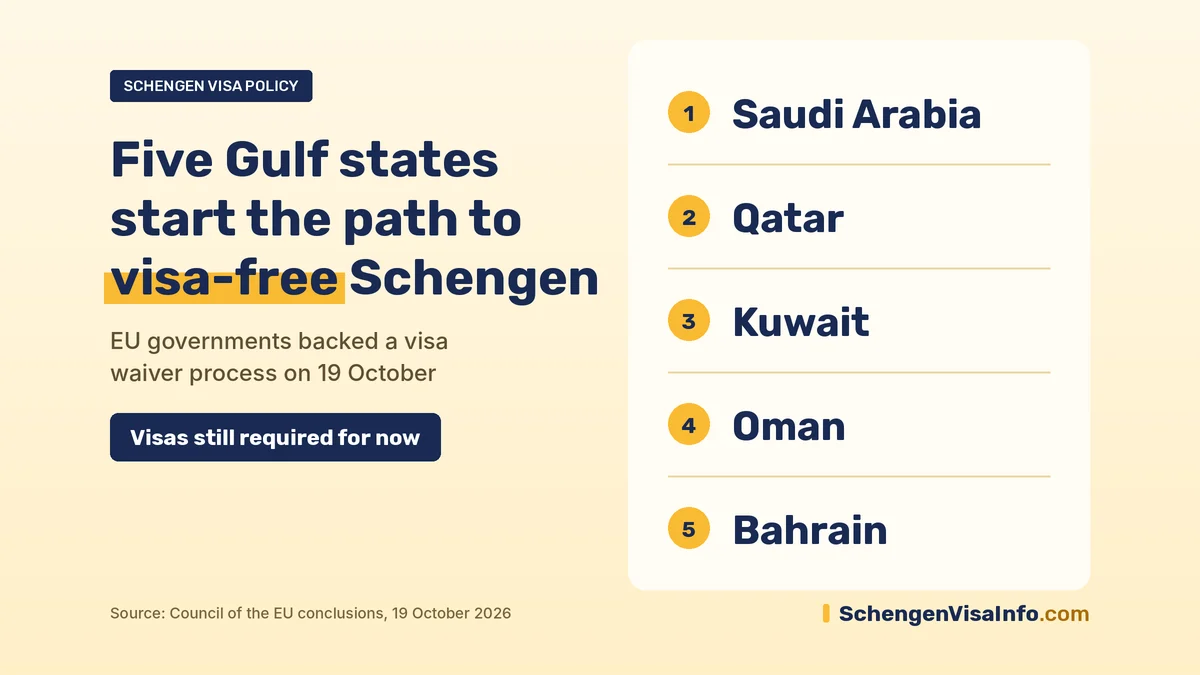
Citizens of Saudi Arabia, Qatar, Kuwait, Oman, and Bahrain still face mandatory short-stay visa requirements when traveling to the European Union’s Schengen Area, keeping the United Arab Emirates as the sole Gulf Cooperation Council (GCC) member whose citizens enjoy visa-free access. However, recent political maneuvers and administrative shifts signal a changing landscape for diplomatic relations and regional mobility between Europe and the Gulf.
The Council of the European Union has endorsed a formal procedure that could eventually pave the way for visa-free travel for passport holders across Saudi Arabia, Qatar, Kuwait, Oman, and Bahrain. In a series of conclusions adopted by EU governments, member states welcomed the European Commission’s initiative to open a dedicated visa waiver process with each of the five nations.
While the announcement marks a significant political milestone, European authorities have underscored that actual visa exemptions will not be granted until every established benchmark is fulfilled completely. At present, travelers from all five countries must continue to apply for standard short-stay Schengen visas before embarking on trips to Europe.
The Council’s green light materializes through five distinct legal texts, addressing Saudi Arabia, Qatar, Kuwait, Oman, and Bahrain individually. The documents instruct the European Commission to ensure close collaboration with both the Council and member states at every stage of the evaluation. Crucially, the possibility of lifting the visa obligation remains strictly contingent upon the complete fulfillment of all security, migration, and administrative benchmarks.
Although the EU has not yet detailed how these specific criteria will be measured or established a definitive timeline, the decision successfully aligns all five Gulf nations under a unified diplomatic framework. GCC Secretary-General Jasem Mohamed Albudaiwi noted prior to the announcement that while the states are commencing the process simultaneously, completion will depend on individual progress and preparation.
The developing policy shift was intended to take center stage at the second EU-GCC summit in Riyadh. However, the European Council confirmed the postponement of the summit, with local reports attributing the delay to regional security concerns, including Houthi attacks on Saudi Arabia and the temporary suspension of operations at King Khalid International Airport. A rescheduled date for the high-level meeting is expected to be announced when conditions permit.
For travelers planning trips to Europe in the near term, daily realities remain unchanged. Nationals of Saudi Arabia, Qatar, Kuwait, Oman, and Bahrain must still navigate the standard visa application procedures. Nevertheless, most applicants already benefit from some of the most favorable visa issuance policies the EU extends globally.
Under specific Commission decisions adopted over recent years—including rules enacted for Kuwait in September 2023 and extended to Saudi Arabia, Oman, and Bahrain in April 2024—eligible citizens applying from within their home countries can receive multiple-entry visas valid for up to five years, even on their initial applications. Qatari nationals have similarly benefited from adapted multiple-entry provisions since January 2022. These facilitations apply strictly to citizens applying within their home nations; third-country expatriates residing in the Gulf remain subject to standard regional rules. Furthermore, all visa holders are required to adhere to the strict 90/180-day rule governing duration of stay and will continue to be registered in the Entry/Exit System upon crossing external Schengen borders.
Demand for European travel from the Gulf has surged well past pre-pandemic levels, reflecting the deep economic and cultural ties binding the two regions. Consulates located across the five Gulf countries processed a staggering 881,901 visa applications in recent reporting periods, with Saudi Arabia accounting for nearly 63 percent of the total volume. France remains the primary destination of choice for regional applicants by a wide margin, handling over 40 percent of submissions originating from Saudi Arabia alone.
While refusal rates across the region remain relatively low compared to other global jurisdictions, European policy discussions have increasingly centered on using these metrics as indicators of readiness for broader visa liberalization. Emerging policy frameworks under consideration by the European Commission suggest that an indicative refusal threshold of less than three percent for nationals applying at their domestic consulates could serve as a key benchmark for future visa-free eligibility.
The path toward full visa liberalization requires navigating a meticulous series of regulatory evaluations, security assessments, and reciprocal diplomatic agreements. Even for well-prepared candidate countries, the process typically spans multiple years, requiring meticulous cooperation across law enforcement, document security, and border management sectors.
The current push builds upon previous legislative efforts, most notably the European Commission’s stalled April 2022 proposal to lift visa requirements for Qatar and Kuwait. That earlier initiative encountered significant political headwinds within the European Parliament, complicated further by broader institutional scrutiny and changing geopolitical dynamics. While the status of that initial legislative file remains open-ended, the recent Council conclusions provide a renewed and broader framework encompassing all five remaining visa-required GCC members.
If and when visa exemptions are ultimately finalized, travelers from these Gulf nations will eventually fall under the scope of the European Travel Information and Authorisation System, known as ETIAS, once the long-awaited digital border system becomes operational. Until then, diplomats and regional leaders continue to champion closer cooperation through high-level dialogues and rescheduled summits.
For the time being, citizens of Saudi Arabia, Qatar, Kuwait, Oman, and Bahrain are advised to proceed with standard visa applications ahead of their European travels, utilizing the five-year multiple-entry provisions where eligible while awaiting further developments from Brussels and their respective national authorities.
| Source | : | Open Passport |
| Author | : | Neng Nana |
| Editor | : | Open Passport Editorial Team |
