
EU Nations Face Scrutiny Over Stalled Returns as Senegal Records Lowest Compliance Rate
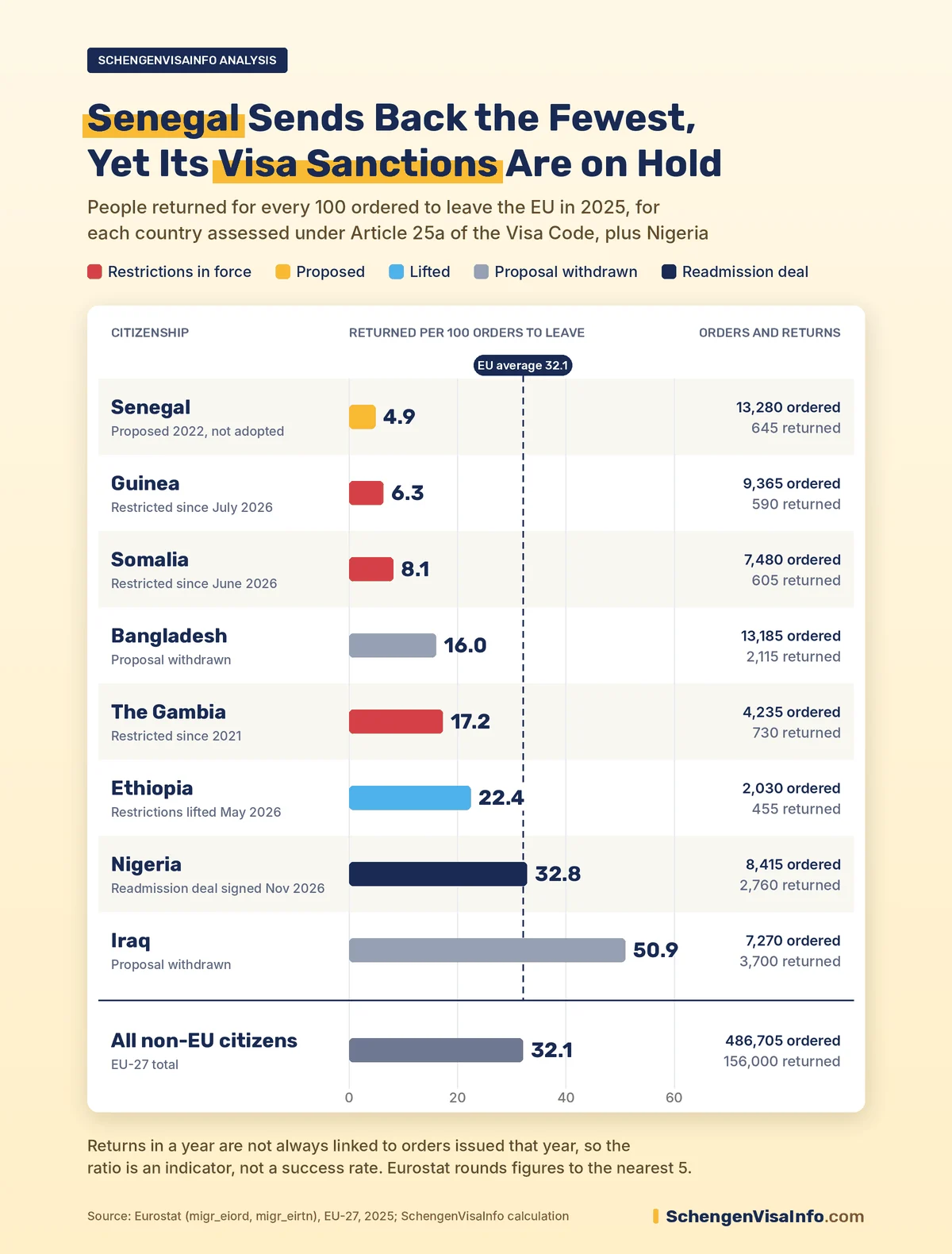
European Union member states successfully returned only five out of every 100 Senegalese citizens ordered to leave the bloc in 2025, marking the lowest cooperation ratio among all countries assessed by the European Commission for potential visa sanctions tied to migration returns. Despite this glaring disparity, a formal proposal to implement restrictive visa measures against Senegal has remained stalled on the desks of EU governments since November 2022.
The findings emerge from a comprehensive analysis of Eurostat data conducted by SchengenVisaInfo, shedding light on the mechanics and persistent bottlenecks of the European Union’s readmission policy under Article 25a of the EU Visa Code. Across all non-EU nationalities, the average return rate stood at approximately 32 per 100 orders to leave in 2025, highlighting a massive gap between judicial deportation orders and practical enforcement across the bloc.

While Senegal recorded the lowest return efficiency at 4.9 returns per 100 orders—coupled with a staggering 13,280 deportation orders issued last year—other nations evaluated by Brussels displayed similarly dismal figures. Guinea and Somalia, both of which faced punitive visa restrictions enacted earlier this year, successfully returned fewer than one in ten citizens ordered to leave. Specifically, Guinea managed roughly 6 returns per 100 orders, while Somalia achieved 8.1.
The imposition of these restrictions has generated diplomatic friction. Somali President Hassan Sheikh Mohamud forcefully rejected the accusations of non-cooperation during a public address earlier in the year, asserting that his government does not abandon its citizens. He maintained that his administration stands ready to accept any verified Somali nationals, while pointing out that verification challenges often arise when individuals without proper documentation falsely claim Somali nationality in Europe.
In contrast, nations that demonstrated improved readmission cooperation found themselves spared from punitive measures. Iraq, whose visa sanction proposal was officially withdrawn in November 2025 following reports of substantial and sustained improvements in cooperation from the European Commission, registered a return ratio of nearly 51 per 100 orders—well above the EU-27 average. Ethiopia, which successfully exited the EU’s visa restriction framework in May 2026, posted a return rate of 22.4 per 100, while Bangladesh recorded a rate of 16.

The timeline surrounding the European Union’s decision-making process under Article 25a reveals significant bureaucratic delays. While early applications of the regulation were processed relatively quickly—such as the measures taken against The Gambia, which saw higher visa fees approved within a month of the initial proposal in 2022—more recent cases have languished for extended periods. Somalia’s visa restrictions took 702 days to transition from a Commission proposal to a Council decision, and the long-pending Senegal file has now been stalled for over 1,400 days without a final verdict from EU member states.
Neither the European Commission nor the Council of the European Union has publicly clarified the specific geopolitical reasons behind the prolonged paralysis of the Senegal file. The situation is further complicated by the fact that Senegal represents a major visa market for the bloc, with local consulates receiving nearly 72,000 Schengen visa applications in 2025 alongside a high rejection rate exceeding 51 percent.
While some nations faced restrictions, others pursued bilateral cooperation. On November 10, 2026, European Commissioner for Internal Affairs and Migration Magnus Brunner and Nigerian Foreign Minister Bianca Odumegwu-Ojukwu signed a formal readmission agreement in Abuja. The accord establishes a structured framework for both sides to manage the return of individuals who do not or no longer meet the legal criteria to remain within their respective territories.

Nigeria’s return ratio in 2025 stood at 32.8 per 100 orders to leave, placing it close to the overall EU average and significantly higher than the countries currently subject to visa sanctions. Although the European Union initially warned Nigeria of potential visa restrictions as early as 2020, those punitive steps were ultimately avoided in favor of a negotiated partnership. However, the newly signed readmission deal does not immediately translate into visa facilitation for Nigerian travelers, who continue to navigate one of the toughest application environments in the world. Consulates in Nigeria processed over 113,000 applications in 2025, refusing nearly half of them.
Brussels is now actively working to streamline and accelerate the enforcement mechanisms governing migration returns. In September 2026, the Commission launched a call for evidence regarding a broader revision of the Visa Code, signaling that the current provisions of Article 25a are considered excessively narrow and sluggish. Policymakers are targeting a legislative overhaul in the first quarter of 2027 to establish a faster, more flexible array of restrictive measures, building momentum alongside the newly enacted Return Regulation, which formally integrates cooperation on returns into the bloc’s broader trade, development, and visa policies.
| Source | : | Open Passport |
| Author | : | Layla Zulfa |
| Editor | : | Open Passport Editorial Team |
