
Portugal Grants Record Number of Golden Visas in 2025 as US Investors Lead Post-Real Estate Era
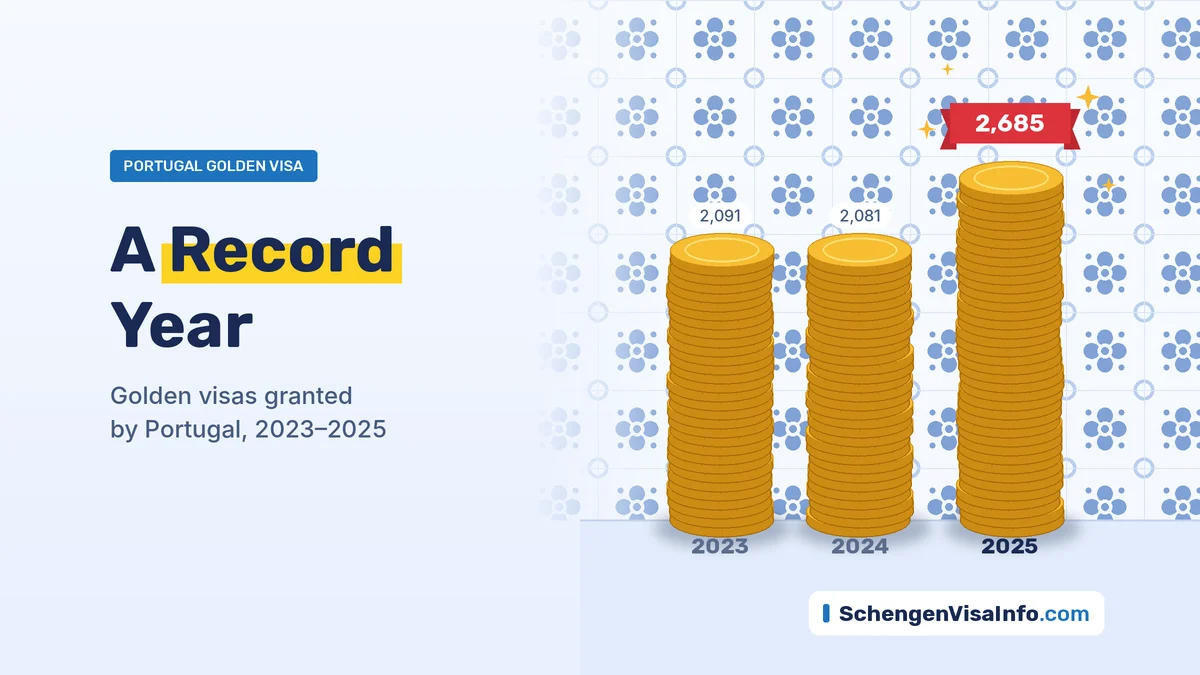
Portugal’s renowned Residence Permit for Investment (ARI) programme, widely known as the golden visa, achieved a historic milestone in 2025 by granting a record 2,685 permits. This figure represents the highest annual total since the initiative was first launched in October 2012, underlining the enduring global appeal of the residency-by-investment scheme despite major policy overhauls designed to cool the domestic housing market.
According to data compiled from the annual migration and asylum report by the Agency for Integration, Migration and Asylum (AIMA), and highlighted by local publications Público and ECO, the 2025 total marked a significant 29 per cent increase compared to the 2,081 golden visas issued in 2024. It also surpassed the previous high of 2,091 permits recorded in 2023.
The composition of successful applicants highlights a clear geographic shift that has been solidifying over recent years. For the fourth consecutive year, United States nationals received the highest number of golden visas, capturing 535 permits in 2025. American interest in European residency pathways has remained consistently robust, driven by a combination of lifestyle preferences, economic factors, and shifting political landscapes in North America. Following US citizens, the largest groups of beneficiaries came from China with 392 permits, the United Kingdom with 252, Türkiye with 188, India with 170, Russia with 160, Brazil with 154, and South Africa with 97.
Data from ECO indicates that between the programme’s inception in October 2012 and September 2023, authorities granted 12,718 golden visas. A further 5,536 permits have been issued since, bringing the cumulative total to 18,254. However, reporting transparency has shifted; AIMA’s current statistical framework no longer publishes detailed breakdowns of the total capital injected into the economy or the specific asset classes behind each individual permit—metrics that were previously released monthly by the now-defunct Immigration and Borders Service (SEF).
The landscape of eligible investments transformed dramatically in October 2023, when the Portuguese government officially removed the real estate acquisition route from the golden visa programme. This decisive policy change was introduced to alleviate a severe domestic housing crisis and soaring property prices, particularly in urban centres like Lisbon and Porto. Since the elimination of property-based applications, investor demand has pivoted decisively toward alternative qualifying pathways, such as non-real estate investment funds, job creation, scientific research, and cultural heritage preservation.
Cultural Heritage Option Gains Momentum
The cultural heritage investment pathway has emerged as one of the primary beneficiaries of the post-real estate era. In 2024, the cultural heritage option generated approximately 12 million euros in investments across Portugal, representing an extraordinary 165 per cent surge compared to 2023, which had registered 4.5 million euros. Although the Residency-by-Investment scheme was established in 2013, the specific cultural heritage avenue was formally introduced in 2020.
Through this option, international investors contribute financially to projects that help safeguard and preserve Portugal’s rich historical and artistic legacy. Data from the Centro Português de Fundações (CPF), cited by Imi Daily, indicates that cumulative investments channeled through the cultural pathway reached approximately 22.15 million euros since 2020. Legal experts note that this sector experienced rapid acceleration following the closure of the real estate route. In the first quarter of 2025 alone, the cultural pathway attracted 850,100 euros, successfully funding 38 distinct cultural preservation projects nationwide. Since the golden visa programme began in 2012, it has funneled more than 7 billion euros into the broader Portuguese economy.
US Interest Surges Amid Broader Expatriate Trends
The consistent dominance of US applicants has been closely linked to evolving socio-economic and political dynamics in the United States. Following recent presidential elections and shifting domestic conditions, advisory firms observed notable spikes in interest from American citizens seeking European residency. Estimates from the Association of Americans Resident Overseas indicated that by late 2023, at least 5.4 million Americans were living abroad, with many gravitating toward Western European nations such as Germany, France, Spain, and Portugal.
Portugal has remained particularly attractive due to its favorable climate, high standard of living, robust public safety, and accessible healthcare and education systems. While initial fears suggested that terminating the real estate option would cause a collapse in demand, the market demonstrated resilience. Fund investments, regulated by the Portuguese Financial Services Regulator (CMVM), quickly established themselves as promising financial instruments in a rising economy. Industry analysts have emphasized that successful applicants increasingly view these funds through a traditional financial lens, evaluating potential yields, risk profiles, and independent market viability rather than treating the investment merely as a mechanism to secure a visa.
Economic Impacts and Housing Market Realities
The sweeping legislative changes—which also included the phasing out of the Non-Habitual Resident (NHR) tax regime—sparked intense debate among economists, developers, and policymakers. In early 2023, the cancellation of prominent residential tourism projects worth roughly 800 million euros led to warnings from industry figures about potential losses in tax revenue and employment opportunities. Critics argued that abrupt policy shifts could harm tourism-dependent regions and high-end residential developments.
Conversely, analysis of the broader housing market revealed that domestic price trends were driven less by the golden visa scheme and more by a persistent structural shortage of new housing stock, robust international demand, and broader economic recovery. In late 2023, reports from financial institutions and property indexes indicated that home prices in Lisbon continued to climb, surging by nearly six per cent year-on-year to average over 5,400 euros per square meter. Despite regulatory changes, Portugal’s fundamental allure for international buyers remained largely unhindered.
As the golden visa programme enters its next phase, the transition away from real estate has successfully redirected tens of millions of euros into venture capital, regulated investment funds, and cultural restoration. With record-breaking participation levels led by North American, Asian, and European investors alike, Portugal’s residency-by-investment framework continues to evolve as a major contributor to the nation’s economic landscape.
| Source | : | Open Passport |
| Author | : | Ali Ikhwan |
| Editor | : | Open Passport Editorial Team |
