
EU Travel Authorisation ETIAS Loses Launch Date Yet Again Amid Ongoing Border Tech Delays
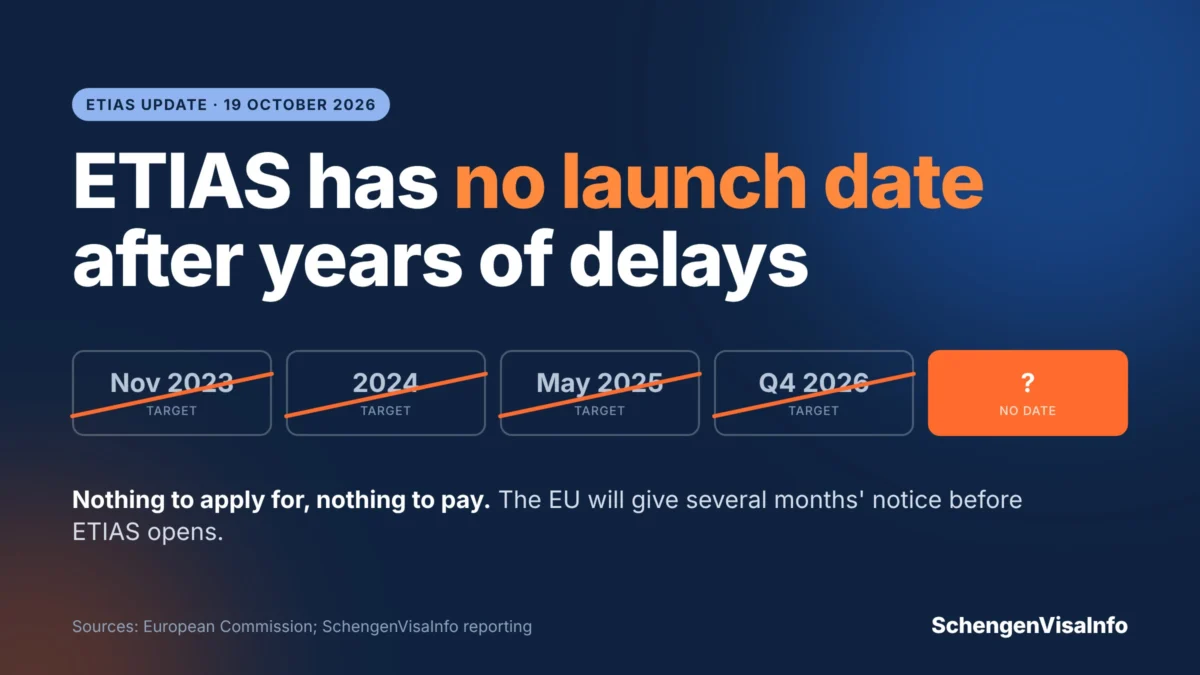
The European Union’s long-delayed electronic travel authorisation system for visa-free visitors has once again lost its target launch date, leaving travellers and the tourism industry without a definitive timeline for implementation.
Until the middle of this year, the European Commission maintained that the European Travel Information and Authorisation System, commonly known as ETIAS, would officially begin operating in the final quarter of 2026. However, that official timeline has now been completely removed. The European Commission’s designated ETIAS information page currently states only that the system is not yet in operation, that no applications are being collected, and that the EU will formally announce the start date several months prior to the actual launch. As of October 2026, no new date has been provided.
For travellers hailing from the United Kingdom, the United States, Canada, Australia, and dozens of other nations currently permitted to visit the bloc without a visa, the practical reality remains unchanged. There is currently nothing to apply for and no fees to pay. Authorities have reiterated a standing warning that any third-party websites soliciting payments for ETIAS applications at this time are entirely unofficial and potentially fraudulent.
Despite repeated inquiries from news organizations, the European Commission did not respond to requests for an updated timetable prior to publication.
What Changed?
The disappearance of the late-2026 launch window marks the latest chapter in a protracted saga of scheduling setbacks. In March 2025, the European Union’s Directorate-General for Migration and Home Affairs stated publicly that ETIAS would debut in the final quarter of 2026. That schedule aligned closely with an interoperability roadmap endorsed by the EU Council on March 5, 2025. Under that framework, the ETIAS requirement was expected to become mandatory for most travellers starting around April 2027, following a mandatory six-month transitional grace period.
By July 2026, however, references to the final quarter of 2026 quietly vanished from official EU digital channels without the accompaniment of a formal press release or public announcement. Reports from financial and political media outlets indicated that eu-LISA, the specialised EU agency responsible for building and maintaining the massive IT architecture behind the project, concluded that a 2026 rollout was no longer feasible. At least one EU official privately described the previous timeline as entirely illusory. While eu-LISA’s management board was widely anticipated to review and approve a revised strategic plan in September, no updated launch date has been published or endorsed since.
The lack of a concrete schedule was further underscored in October 2026, when ABTA, the prominent UK travel trade association, confirmed to delegates at its annual convention that ETIAS currently possesses no official launch date whatsoever.
Why It Keeps Slipping
The ongoing delays surrounding ETIAS are deeply intertwined with the broader technological overhaul of the EU’s external borders. Specifically, ETIAS cannot function independently; it relies directly on the Entry/Exit System, known as the EES, which serves as the automated biometric border register designed to replace traditional physical passport stamps.
The deployment of the EES itself faced years of cascading setbacks before being rolled out gradually starting in October 2025 and eventually reaching full operational status in April 2026. The introduction of the biometric border checks caused substantial logistical friction, resulting in extensive queues and wait times at several major European airports during the subsequent summer travel season. To mitigate severe congestion, EU member states were temporarily authorized under emergency legal provisions to pause the mandatory fingerprinting steps at heavily impacted border crossings until early September.
Although the European Commission has not issued a formal, comprehensive explanation for the latest ETIAS delay, industry analysts and reporting from earlier in the year heavily link the postponement to the operational strain caused by the EES rollout, alongside persistent, complex technical hurdles in finalising the ETIAS software architecture.
Years of Moving Targets
The history of ETIAS is characterised by a continuous series of postponed deadlines stretching back nearly a decade. When the ETIAS Regulation was formally adopted by the European Union on September 12, 2018, initial projections anticipated a launch around 2021.
As technical complexities mounted, that target shifted repeatedly. By 2022, the launch window had been pushed to November 2023, following earlier internal adjustments pointing toward late 2022 and mid-2023. In February 2023, the European Commission’s website quietly adjusted the timeline away from November 2023, setting off a wave of reporting regarding further delays. By October 2023, the EU provided its first formal confirmation that the system would not launch before May 2025 at the earliest.
Subsequent adjustments pushed the target further into early 2025, with official notices stating the system would not start in the first half of the year, before the timeline was once again anchored to late 2026 in March 2025, only to be wiped from official schedules entirely in July 2026.
When Could ETIAS Actually Affect Your Trip?
Given the repeated schedule adjustments, industry experts advise travellers to look far beyond any preliminary headline dates when planning future journeys to Europe. Even after the European Commission formally establishes and announces a definitive launch date, the underlying ETIAS regulations mandate a transitional period of at least six months during which the travel authorisation remains entirely optional. Furthermore, the Commission retains the legal authority to extend this transitional window if operational readiness requires it.
Following the transitional phase, the framework incorporates an additional grace period. Under this rule, travellers embarking on their first journey to the bloc after the transition period concludes are still permitted to enter without holding an approved ETIAS document.
Consequently, if the Commission were to announce an imminent launch date, the practical reality is that regular visitors would not face the risk of being turned away at the border for lacking an ETIAS until many months after that initial announcement. Travel authorities continue to advise the public to disregard unofficial rumours, avoid making payments to unauthorized third-party brokers, and wait for official announcements through the European Union’s verified digital channels. When the system eventually goes live, eligible travellers will be given ample notice to complete their applications through the official EU website or dedicated mobile application for a standard fee of twenty euros.
What Has Not Changed
While the operational timeline remains in a state of flux, the fundamental regulatory framework governing ETIAS has long been finalized. Once the system finally becomes operational, citizens and nationals from fifty-nine visa-exempt countries and territories will be required to obtain the electronic authorisation prior to undertaking short-term visits to thirty European nations, encompassing the twenty-nine member states of the Schengen area alongside Cyprus.
The authorisation will carry a standard fee of twenty euros, though exemptions will apply to applicants under the age of eighteen and those aged seventy and above. Once issued, each authorisation will remain valid for a period of three years, or until the traveller’s passport expires, whichever comes first. European authorities have consistently stated that the vast majority of applications are expected to be processed and approved within a matter of minutes. In the meantime, travel industry bodies and EU agencies continue to direct the public to official resources for updates regarding both the future ETIAS framework and the currently operational Entry/Exit System.
| Source | : | Open Passport |
| Author | : | Nila Kartika Wati |
| Editor | : | Open Passport Editorial Team |
