
HouseCarers Review: Costs, Limitations, and Fit for Digital Nomads

House-sitting has long been championed as one of the ultimate hacks for budget-conscious travelers, offering rent-free accommodation in exchange for looking after a homeowner’s property and pets. Among the array of platforms facilitating these exchanges, HouseCarers positions itself as a lower-cost option. However, a modest annual fee does not make a house sit automatic, nor does it strip away the considerable responsibilities involved. An independent desk review of the platform, based on HouseCarers’ pricing, registration pages, frequently asked questions, terms of service, privacy policies, and verification protocols, reveals a nuanced picture for remote workers navigating the global nomad lifestyle.

The core verdict regarding HouseCarers is that it can serve as a viable tool for a flexible nomad who genuinely enjoys animal care and can adapt their travel calendar around a homeowner’s exact specifications. Conversely, it proves to be a poor fit for anyone requiring guaranteed accommodation, a fixed city on rigid dates, or a quiet, uninterrupted workspace that has not been explicitly confirmed in writing prior to commitment.
Understanding the fundamental mechanics of the platform helps clarify what HouseCarers is and what it is not. At its core, HouseCarers operates purely as a matching platform rather than an agency, employer, or travel service. Homeowners publish house-sitting opportunities and search through sitter profiles, while sitters create profiles, select preferred geographic regions and pet-care preferences, receive matching alerts, and communicate through the site’s internal messaging system. The platform does not employ the sitters, book transport, physically inspect every property, or promise that any given application will be accepted.

The site’s established model relies on rent-free accommodation in exchange for house and pet care, with the platform noting that the vast majority of sitters do not charge a fee for their services. HouseCarers does not position itself as a job marketplace, a distinction of paramount importance for digital nomads. While securing a house sit can drastically reduce accommodation expenditures, it represents an exchange of responsibilities rather than a hotel booking. Furthermore, participating in an unpaid house-sitting arrangement does not automatically constitute lawful paid work or tourism under every destination’s immigration framework, requiring nomads to navigate legal nuances carefully.
Financial considerations on HouseCarers center primarily around the sitter membership fee. Official registration pages list full sitter membership at fifty United States dollars, providing up to twelve months of profile advertising alongside a one-month bonus period. The platform’s informational guides and frequently asked questions echo this cost, citing fifty United States dollars per year. Because promotional wording and fee structures can occasionally shift, users are advised to carefully review the checkout screen before finalizing payment and retain a record of the terms displayed.

Unlike platforms that levy commission charges per booking or placement fees, HouseCarers does not include a separate placement charge in its official fee schedule. A scenario involving two successful house sits over the course of a membership year would still only incur the initial fifty United States dollar platform fee. However, this arithmetic excludes the secondary expenses inherent to travel, such as transportation to and from the property, groceries, local transit, travel insurance, visa fees, emergency backup accommodation, and any out-of-pocket costs arising from an agreed-upon pet care plan. Moreover, the membership fee does not translate into financial savings unless a user successfully secures suitable sits that genuinely replace accommodation costs they would have otherwise incurred.
While homeowners are permitted to register and advertise properties for free, with an optional twenty-five United States dollar premium membership available to them, the platform’s utility for remote workers hinges heavily on the tools provided by a full sitter membership. Purchasing the full sitter membership enables users to apply for an unlimited number of posted house sits, respond directly to homeowner messages, display direct contact details after initial communication through the secure system, receive reciprocal reviews, incorporate personal references, maintain a photo gallery and availability calendar, and utilize identity-verification features. Paid profiles may also benefit from priority or featured placement within certain sections of the directory.

These features significantly enhance the digital tools available to a traveler, but they do not guarantee that a homeowner will select a particular candidate, that a listing’s description is entirely accurate, or that a destination possesses sufficient housing supply to match a nomad’s desired dates. HouseCarers’ terms explicitly state that the ultimate choice of sitter remains entirely at the discretion of the homeowner.
The matching process itself places a high degree of onus on both parties. HouseCarers stipulates that homeowners are responsible for verifying a candidate’s identity and qualifications, but sitters are strongly advised to apply the exact same diligence in reverse. Best practices for remote workers include requesting a live video call with the homeowner, confirming property ownership or management status, discussing every detail of an animal’s daily routine, and documenting the final agreement in writing. While digital badges and peer reviews provide helpful context, they cannot eliminate all operational risks.
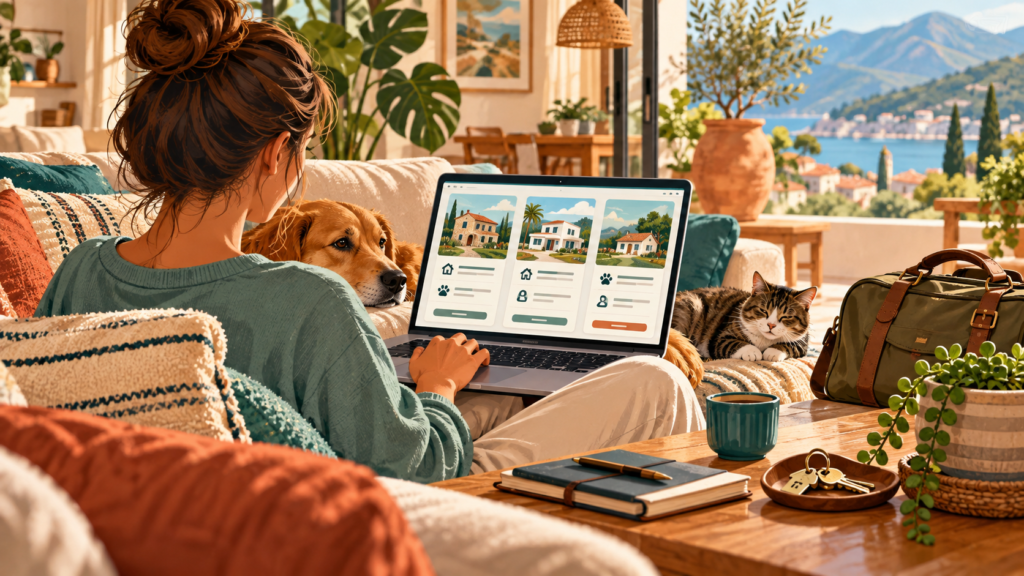
For digital nomads, one of the most critical evaluations involves assessing whether a property’s responsibilities align with professional obligations. The central question extends far beyond whether a home is aesthetically pleasing or located in a desirable city; remote workers must determine if the care schedule is compatible with their working hours. Individuals managing heavy meeting schedules or strict corporate deadlines should exercise caution when considering animals that demand constant supervision or frequent medication. Similarly, a remote sit located in a rural or isolated area can quickly turn into a poor financial trade-off if it necessitates an expensive rental car or exposes the worker to an unreliable internet connection.
Privacy, security, and verification mechanisms are integral components of the HouseCarers ecosystem. The platform initiates communication through a secure internal messaging system, and its privacy policies dictate that a sitter’s direct contact details are revealed only to logged-in homeowners after initial dialogue has occurred through the site. Access to references is also restricted in various areas of the service to safeguard referee information. Although the platform offers photo-identification verification and digital profile badges, its operational guidelines emphasize that members retain personal responsibility for vetting one another. Users are advised to review the prevailing privacy policy before submitting sensitive identity documents, maintain robust account security practices, and refrain from sharing private personal data on public profile pages. Furthermore, nomads should never transfer funds, passport scans, or financial details to homeowners via unverified external channels simply because an attractive listing appears on the platform.

Availability remains perhaps the most significant variable for travelers relying on HouseCarers. House-sitting inventory is strictly dictated by date and geographic location. A platform can boast a global footprint while simultaneously offering very few listings in a specific city, month, or pet category required by a nomad. Users must search their targeted destinations and date windows prior to committing financially, and they should re-verify availability close to their departure dates, as listings can be filled, withdrawn, or modified at short notice.
Evaluating who HouseCarers may suit involves identifying specific travel profiles. The platform tends to be a reasonable match for individuals with high schedule flexibility, demonstrable house and pet care experience, a tolerance for managing last-minute travel adjustments, and a desire to spend extended periods living like a local in residential neighborhoods. Conversely, digital nomads who require guaranteed housing, fixed travel itineraries in major tourist hubs without flexibility, quiet workspaces backed by contractual guarantees, or zero responsibility outside of paying rent would likely find a traditional rental or hotel to be a far more suitable arrangement.

Ultimately, HouseCarers functions best as an inexpensive matching directory rather than a comprehensive accommodation subscription. The nominal annual membership fee can prove highly attractive to remote workers who possess genuine care experience and adaptable travel plans. However, prospective users must remain mindful of the inherent risks, including uncertain local inventory, homeowner selection preferences, demanding animal routines, and cancellation exposure. Thoroughly researching availability before paying, documenting responsibilities in writing, verifying remote work viability, and maintaining a robust emergency travel budget remain essential practices for any digital nomad considering the platform.
| Source | : | Open Passport |
| Author | : | Reynand Wu |
| Editor | : | Open Passport Editorial Team |
