
Portugal Grants Record Number of Golden Visas in 2025 as US Investors Lead Post-Real Estate Shift
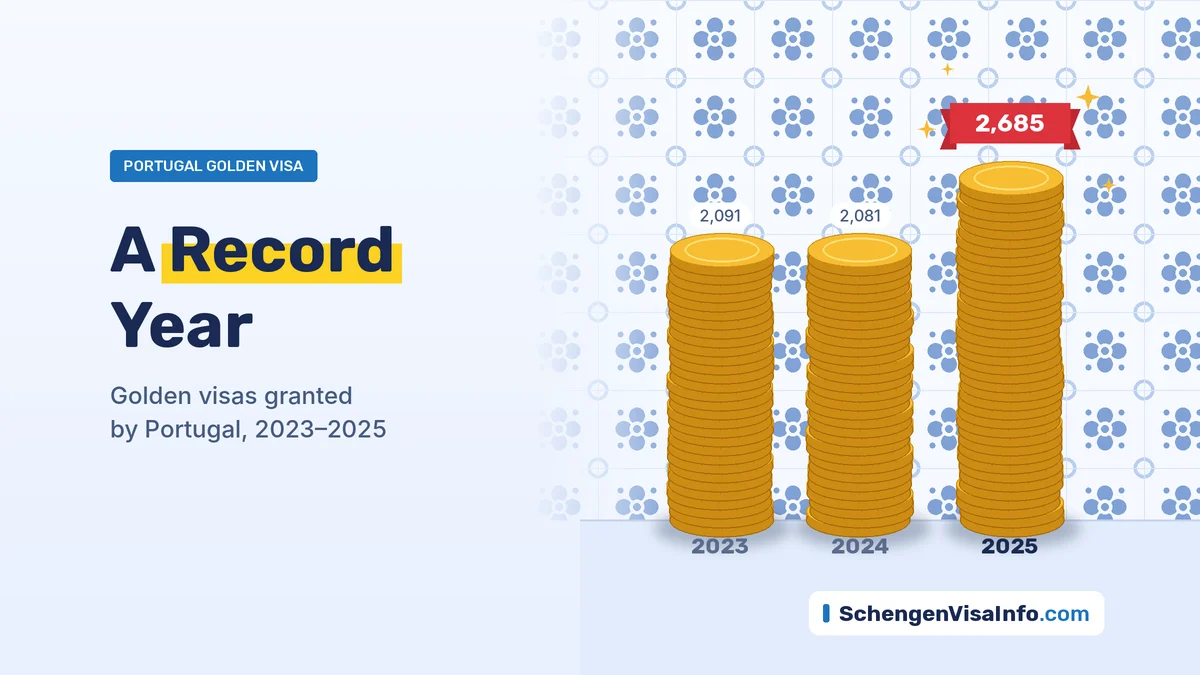
Portugal granted a record 2,685 golden visas in 2025, marking the highest annual total since the residency
-by-investment programme was launched in October 2012. Officially known as the Residence Permit for Investment (ARI), the scheme saw a surge of interest despite sweeping government reforms that eliminated the historically dominant real estate acquisition route.
The figures, released in the annual migration and asylum report by the Agency for Integration, Migration and Asylum (AIMA) and cited by Portuguese media outlets Público and ECO, represent a roughly 29 percent increase compared to the 2,081 golden visas granted in 2024. The 2025 total also surpasses the previous record of 2,091 permits issued in 2023.
US nationals claimed the largest share of the permits for the fourth consecutive year, receiving 535 golden visas. American investors were followed by citizens from China with 392 permits, the United Kingdom with 252, Türkiye with 188, India with 170, Russia with 160, Brazil with 154, and South Africa with 97.
According to ECO, a total of 12,718 golden visas were issued between the programme’s inception in October 2012 and September 2023. An additional 5,536 permits have been granted since the rules changed, bringing the cumulative total to 18,254. However, the latest AIMA reports no longer provide granular data on the total capital raised or the specific investment categories tied to each permit, details that were previously published monthly by the now-defunct Immigration and Borders Service (SEF).
Portugal Sees Increased Interest in Cultural Heritage Golden Visa, Records €12 Million in Investments
The restructuring of the golden visa framework has redirected foreign capital toward alternative economic sectors, most notably cultural heritage preservation. In 2024, the cultural heritage option of the programme generated approximately €12 million in investments, representing a 165 percent increase compared to the €4.5 million registered in 2023.
While Portugal’s residency-by-investment scheme originated in 2013, the cultural heritage pathway was officially introduced in 2020 to channel funds into preserving the nation’s historical assets. The surge in demand became particularly pronounced after the government terminated real estate investments to combat a severe national housing crisis.
Data from the Centro Português de Fundações (CPF), cited by legal professionals, highlights that the cultural investment pathway experienced exceptional growth through 2024 and 2025, accelerated directly by the removal of property-based routes. In the first quarter of 2025 alone, the cultural pathway attracted €850,100, funding 38 distinct cultural projects across the country. Since its inception, the cultural heritage option has accumulated roughly €22.15 million in total investments. Overall, since the programme began in 2012, it has injected more than €7 billion into the Portuguese economy.
Interest in Portugal’s Golden Visa Spikes Among US Nationals Following Presidential Election
The steady influx of North American applicants has been further catalysed by socioeconomic and political developments in the United States. Following successive US presidential elections, legal and advisory firms reported a sharp spike in inquiries from American citizens seeking European residency as an alternative lifestyle or contingency plan.
While political shifts under administrations led by Donald Trump motivated some applicants, broader social and economic factors also played a significant role. According to estimates from the Association of Americans Resident Overseas, at least 5.4 million Americans were living abroad, with substantial populations settling in European nations such as Germany, France, Spain, and Portugal. Portugal remains one of the most sought-after destinations due to its favourable climate, security, robust healthcare and education systems, and competitive residency pathways.
More Than 18,000 Foreign Families Have Benefited From Portugal’s Golden Visa So Far
By mid-2024, data indicated that more than 18,000 foreign families had benefited from Portugal’s golden visa framework. Alongside the Non-Habitual Residents (NHR) tax regime, residency by investment emerged as a primary asset class for global mobility. Financial analysts emphasised that prospective investors increasingly evaluated these programmes through a rigorous commercial lens, advising clients to treat them as independent financial decisions rather than mere visa vehicles.
Despite the elimination of real estate options, regulated investment funds—supervised by the Portuguese Financial Services Regulator (CMVM)—retained strong momentum. Financial experts noted that multimarket investment funds and venture capital initiatives focused on technology firms and startups offered viable pathways in a growing economy, attracting hundreds of participants across dozens of nationalities.
Brazilians & North Americans Lead Investments in Portugal in Exchange for Golden Visas
By mid-2024, consultations regarding the golden visa programme quadrupled compared to the same period in the previous year, driven largely by senior executives, families, and retirees from Brazil and North America. Although initial regulatory changes caused temporary confusion among international clients trying to understand how to navigate the post-real estate landscape, interest quickly rebounded.
Investors gravitated toward capital transfers of at least €500,000 into investment funds allocating a minimum of 60 percent of their assets to shares and bonds of Portuguese companies, or supporting research, job creation, and cultural initiatives.
Portugal’s Housing Market Unimpacted by Golden Visa Program Changes
The termination of the real estate golden visa route and the phasing out of the NHR tax regime ultimately failed to cool down Portugal’s domestic housing market, particularly in Lisbon. Property prices in the capital continued to outpace broader European averages, driven by structural housing shortages rather than foreign investment alone.
According to Bloomberg analyses and local real estate indices, Lisbon home prices surged by nearly 6 percent year-on-year, reaching averages exceeding €5,400 per square meter. Analysts attributed the sustained price pressure to a severe lack of new construction, with market demand from international professionals and expatriates continuing to outstrip available inventory despite a slowdown in raw sales volume.
Even as the government enacted legislative packages like "More Housing" to improve affordability for local residents, international interest persisted. Factors such as personal safety, political stability, mild weather, and high quality of life kept foreign demand resilient, with prospective buyers absorbing higher entry costs or shifting their focus to commercial enterprises, private equity funds, and regional developments outside the primary metropolitan hubs.
| Source | : | Open Passport |
| Author | : | Nana |
| Editor | : | Open Passport Editorial Team |
