
EU Orders for Americans and Britons to Leave Surge in 2025, Led by the Netherlands
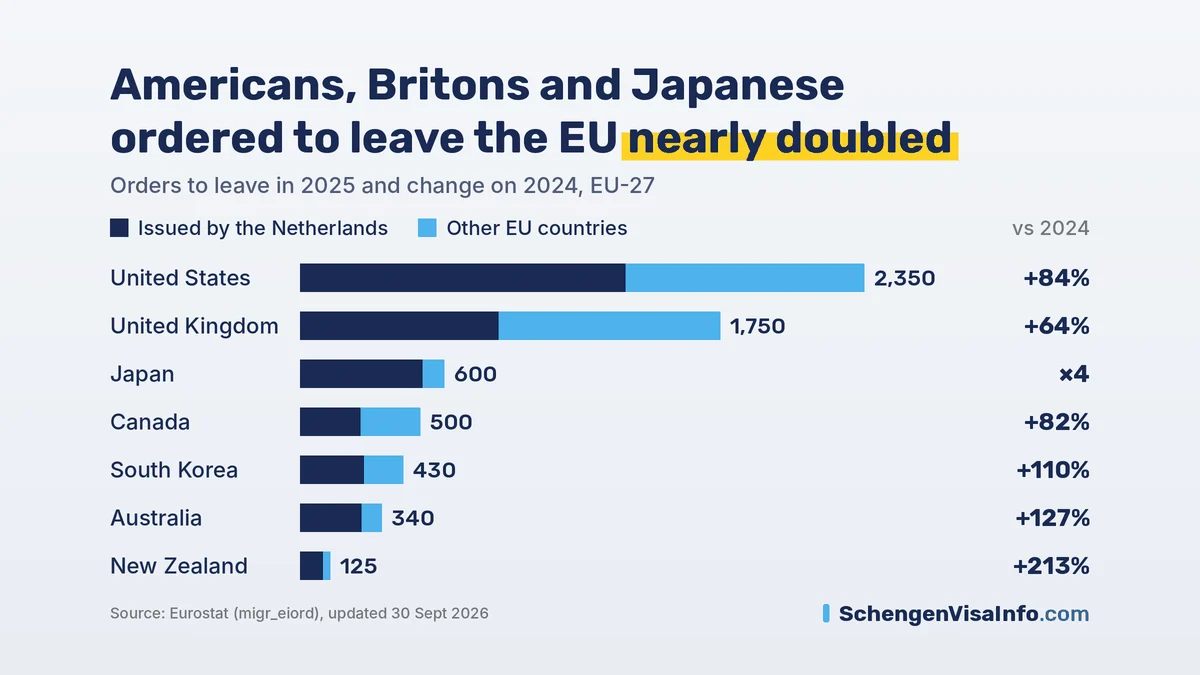
European Union member states ordered significantly more citizens from wealthy, visa-free Western nations to leave their territories in 2025, marking a sharp departure from broader EU-wide migration enforcement trends. Newly analyzed official Eurostat figures reveal that EU countries issued orders for 2,350 Americans and 1,750 Britons to depart during 2025, representing staggering year-on-year increases of 84 percent and 64 percent, respectively.
The upward trajectory was even steeper for citizens of several other developed nations. Orders targeting individuals from Japan, Canada, Australia, New Zealand, and South Korea accelerated at a pace nearly twenty times faster than the overall European average. When combined, these seven prominent visa-free nationalities received a total of 6,095 return decisions in 2025, nearly doubling the 3,165 orders recorded for the same group in 2024.
Despite the dramatic increase among these specific nationalities, overall EU enforcement remained largely static. Across the entire bloc, the total number of orders to leave—formally known as return decisions under European Union law—inched up by just 4.7 percent in 2025 to reach 486,705. While the broader metric barely moved, the subset of visa-free Western travelers experienced an unprecedented surge, driven overwhelmingly by enforcement actions taken within a single member state.
The Netherlands Stands Apart
The vast majority of these return decisions can be traced directly to Dutch authorities. The Netherlands ordered 3,555 citizens from these seven targeted countries to leave in 2025, a volume that outstripped the combined totals of every other EU member state put together.
The Dutch dominance across the demographic breakdown is striking. The Netherlands alone issued 1,355 orders to American citizens in 2025, nearly triple its total from the previous year and vastly outdistancing Sweden, which placed a distant second across the EU by issuing 285 orders to U.S. nationals. No other European Union country issued more than 125 orders to Americans during the same period.
This heavy concentration extends across nearly all of the analyzed nationalities. Dutch authorities accounted for roughly 85 percent of all return decisions issued to Japanese citizens within the EU, three-quarters of the orders given to Australians and New Zealanders, and nearly half of those directed at British nationals. According to historical tracking, the Netherlands has consistently ranked as the primary EU nation for issuing return decisions to Americans, Japanese, Canadians, Australians, and South Koreans in each of the past seven consecutive years.
Within the broader landscape of Dutch immigration enforcement, American nationals now occupy a notable position. Out of the 31,230 total return decisions issued by the Netherlands in 2025, only three nationalities faced higher numbers: citizens of Türkiye at 3,095, India at 2,630, and China at 1,405. Meanwhile, British nationals ranked tenth overall in the Netherlands, accounting for 825 of the total departure orders.
Understanding the Statistics and Context
The recent surge represents, in part, a statistical rebound following the disruptions of the COVID-19 pandemic. Orders directing these specific nationalities to leave had fallen steadily during the health crisis, reaching a cyclical low point in 2024. Although the 2,350 departure orders handed to Americans in 2025 remain slightly below the pre-pandemic peak of 2,505 recorded in 2019, the year still represents the highest volume for U.S. citizens since that time. For Japanese, Australian, and New Zealand travelers, the 2025 figures represent the highest totals recorded since 2020.
Official Eurostat data does not document the specific infractions that trigger individual return decisions. Consequently, the figures do not definitively indicate whether these travelers overstayed the permitted 90-day visa-free limit, engaged in unauthorized employment without a proper work permit, or experienced a formal refusal on a pending residence application. Previous investigative reporting by DutchNews.nl into British departure figures highlighted all three possibilities as common drivers, but Dutch authorities have not released a detailed categorization of the underlying causes.
Citizens of these seven advanced economies enjoy the privilege of visiting the Schengen area without a visa for up to 90 days within any rolling 180-day period. Under European Union legal frameworks, an order to leave dictates that a national authority has determined an individual is residing or remaining in the country unlawfully and is legally required to depart.
Demographic Profiles of Those Affected
The demographic makeup of the individuals receiving these departure orders deviates somewhat from traditional expectations surrounding EU immigration enforcement. Across the broader spectrum of all nationalities, the vast majority of return decisions—roughly 83 percent in 2025—were issued to men, with 60 percent concentrated among young adults aged 18 to 34.
British nationals closely mirrored the broader gender distribution, with men accounting for 73 percent of the 1,750 departure orders issued to UK citizens. However, the data highlights that women, older travelers, and children also form components of the broader group receiving these administrative notices, reflecting the diverse nature of long-term tourism, family stays, and digital nomad lifestyles common among travelers from these wealthy nations.
What an Order to Leave Means for Travellers
An order to leave functions as an administrative decision rather than an immediate physical deportation. According to the Royal Netherlands Marechaussee, a return decision obligates the recipient to exit both the Netherlands and the broader European Union, European Economic Area, and Switzerland within a designated timeframe, which is typically set at 28 days.
In certain cases, that departure window can be reduced to zero. When a zero-day departure period is applied, travelers frequently receive a formal entry ban alongside the return order. These entry bans are logged directly into the Schengen Information System, ensuring they appear immediately the next time the individual attempts to cross an external Schengen border or submits an application for an official visa.
The Changing Landscape From 2026
The vast majority of the return decisions issued in 2025 took place before the full implementation of the European Union’s modernized Entry/Exit System, known as the EES. The automated border management system officially commenced operations on October 12, 2025, and rolled out progressively before achieving full mandatory registration across all designated border crossing points by April 10, 2026.
The EES digitally tracks every single entry and exit made by non-EU nationals, automatically calculating their remaining authorized days and effectively replacing traditional physical passport stamps. By removing manual oversight, the system makes overstays and unauthorized durations significantly easier for border control authorities to detect. Analysts anticipate that the full-year figures for 2026, which Eurostat is scheduled to release in the autumn of 2027, will provide the first comprehensive look at migration enforcement patterns under the fully operational electronic border regime.
| Source | : | Open Passport |
| Author | : | Ammar Sabilarrohman |
| Editor | : | Open Passport Editorial Team |
