US International Student Enrollments Suffer Third Consecutive Year of Decline Amid Policy Pressures
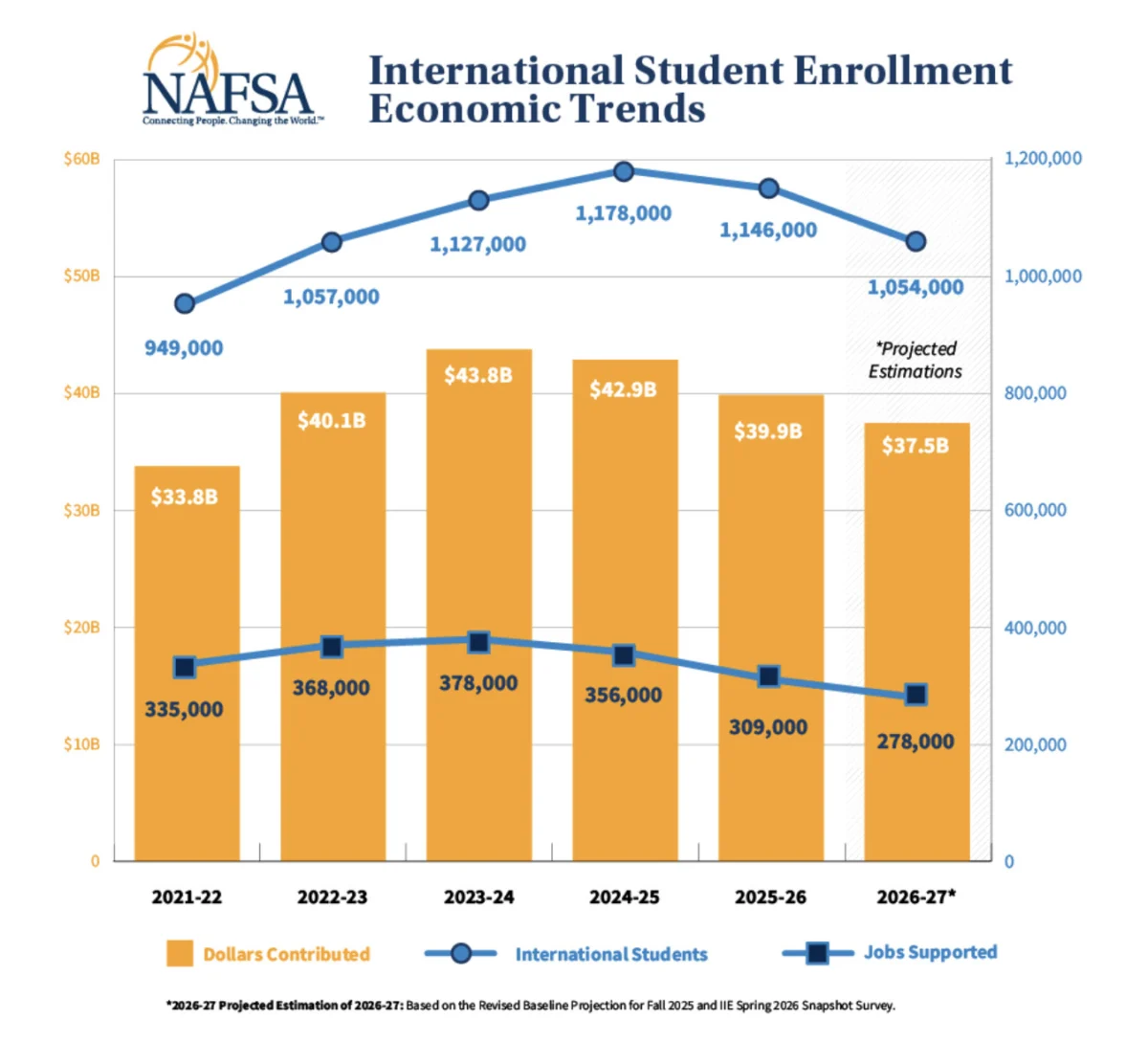
The economic impact projections released jointly by NAFSA and JB International have painted a sobering picture of America’s higher education landscape, drawing on fresh data from the Institute of International Education’s Fall Snapshot survey. The figures reveal a striking 15% drop in new international student enrollments this semester, marking the third consecutive year of declining numbers for newcomers arriving on US campuses.
During a webinar held this week to unpack the underlying trends shaping the data, higher education and policy experts pointed squarely at shifting federal policies under the second Trump administration as the primary driver of the downturn.
"Two years into the current Trump administration and we are really seeing the effects of what started in January 2025," said Rachel Banks, NAFSA senior director of public policy and legislative strategy.
Reflecting on the timeline of the crisis, Banks noted that while the initial blow in the fall of 2025 was severe, the broader fallout is now compounding.
"In the fall of 2025, the decline wasn’t as significant as what we had feared given the unprecedented volume of visa revocations and the visa interview pause for three and a half weeks during peak visa application season," Banks said. "Fast forward another academic year, we’re continuing to see significant declines and it’s really hard to ignore what’s happening policy wise."
Banks specifically highlighted ongoing logistical and administrative barriers to visa processing—a challenge cited by nearly nine in ten institutions as a primary catalyst for enrollment declines in the IIE Fall Snapshot survey. For the second consecutive year, the administration has allegedly failed to prioritize student and exchange visitor visa processing during the crucial peak window.
Compounding these processing hurdles is the administration’s expanded travel ban, which continues to bar prospective students from nearly 40 nations. Unlike policies during Donald Trump’s first term, current rules do not exempt students and exchange visitors from the restriction. This inclusion heavily impacts nations like Iran, a traditional and vital source of postgraduate STEM students, and Nigeria, which had been rapidly ascending as an important source of global academic talent.
Despite the unrelenting stream of negative sector news since the return of the Trump administration, Boston College professor Chris Glass emphasized that underlying global student demand remains robust.
"Institutions are clear: the obstacle is access, not demand," Glass told The PIE News.
Referring directly to the IIE survey metrics, Glass elaborated on the primary roadblocks identified by universities. "Among those reporting declines, 88% cite the visa process and 70% cite travel restrictions. Fewer cite competition from other countries or cost. The top reasons are barriers to entry, not loss of interest," he said.
The Changing Landscape of Optional Practical Training
Alongside the 15% fall in new international student enrollments this semester, IIE Open Doors data for the 2025-26 academic year found that international enrollments excluding Optional Practical Training were down 8% compared to the previous year.
However, a 14% rise in OPT participants during 2025-26—who are factored into official government student totals—meant that overall student numbers dropped by 32,000 last year, culminating in an overall 3% decline.
The latest figures, however, have registered a 6% drop in OPT participation this fall. According to Glass, this shift suggests that "the turn has started" following last year’s peak.
The consequences of this shifting pipeline are far-reaching. Glass warned that domestic employers stand to lose critical early-career STEM workers, while universities lose a key element that makes a US master’s degree attractive to international scholars. Data indicates that 95% of institutions believe prospective students would look to alternative study destinations abroad if the post-study work stream were eliminated.
These trends reflect a barrage of administrative pressure directed at higher education institutions since the start of the second term, including repeated threats of fresh OPT and H-1B visa fees. Currently, the administration is actively considering a proposed $70,000 charge levied on universities for each individual OPT recommendation. Glass cautioned that if this proposal is finalized, the current academic year’s 6% decline would ultimately look "small" by comparison.
Such prohibitive policies would disproportionately impact India’s student cohort, 54% of whom are graduates currently working in the US via OPT, according to Open Doors data. Meanwhile, while India continues to lead the count on raw numbers, China remains the single largest sender of international students to the United States, accounting for approximately 193,000 enrolled students in the 2024-25 academic year.
Economic Impact and Local Repercussions
Zuzana Cepla Wootson, deputy director of federal policy at the Presidents’ Alliance, described the continued enrollment declines as a "serious warning sign" of growing systemic uncertainty. She pointed to barriers spanning every stage of the international student journey, from initial visa applications to postgraduate professional opportunities.
Notably, recent analysis from the Presidents’ Alliance reveals a stark contrast between administrations. While the total number of international students in the United States fell by a marginal 0.3% during Trump’s first term, levels have plummeted by 6.7% from October 2024 to the same month this year during his second term.
These downward trends are translating into tangible financial losses across the country. Alongside a projected $2.6 billion contraction in economic output, forecasts predict the loss of 31,000 jobs this year, with higher education stakeholders highlighting the detrimental impact on domestic students and surrounding American communities.
"All Americans will feel the effects as international students’ tuition payments, local spending, and contributions to US excellence in research and innovation diminish," noted NAFSA executive Esther Brimmer.
Data compiled by NAFSA and JB International shows that international students contributed $39.9 billion to the US economy and supported 309,000 jobs in the 2025-26 academic year. This represents a 7% decline in overall spending and the loss of more than 46,000 jobs compared to the previous academic year, marking the second consecutive year of economic contraction following three years of growth and a peak of $43.8 billion in economic contributions during 2023-24.
JB International founder Jason Baumgartner explained that the decline in economic contributions is driven not only by falling overall student numbers, but also by changes in how different cohorts fund their time in the United States. While most undergraduate students are self-funded and pay full tuition, the proportion of international students on OPT has risen in recent years to comprise 29% of the total. This dynamic means a growing proportion of international students are no longer contributing directly to campus tuition, housing, or dining revenue.
Victories Amid Ongoing Headwinds
Despite the sobering statistical data, higher education advocates have welcomed recent legal victories. Rachel Banks highlighted a "tremendous litigation victory" after a federal judge vacated the Department of Homeland Security’s controversial final rule aiming to end Duration of Status. This decision successfully preserves the longstanding system that permits international students to remain in the US for the duration of their academic programs.
This legal win coincides with encouraging signs from admissions platforms. New data from the Common App demonstrated a surprising rebound in international applications to US colleges, which are up 9% compared to the same time last year. Additionally, education platform Studyportals recorded a notable surge in global interest for the US as a study destination—rising 40% following the Democrats’ sweeping midterm election victories.
The higher education sector also welcomed another recent court judgment blocking DHS efforts to dramatically limit Curricular Practical Training opportunities for international students undertaking internships as part of their curriculum.
Nevertheless, Banks warned that uncertainty surrounding duration of status had already taken its toll on this year’s enrollment figures. She emphasized that sustained headwinds remain, including the proposed $70,000 OPT fee—a policy that independent experts have warned would "decimate" the international talent pipeline.
Looking toward the future, Glass predicted that the repercussions of these policies will be felt "at least through the end of the decade," noting that new enrollments fell by 18% last year and another 15% this year. While the greatest volatility remains concentrated in one- to two-year graduate programs—where student numbers declined by 15% last year—he warned that OPT participation could fall by as much as a third by 2028 even if new enrollments stabilize.
"A one year decline is not a one year problem," higher education advocates told webinar delegates, urging institutions to actively diversify their recruitment strategies and focus efforts on emerging markets such as Vietnam, which experienced enrollment gains last year.
"The consequences can last well beyond one academic year," Wootson added, reiterating warnings of compounding losses for business, entrepreneurship, and innovation, alongside the broader negative impacts on local campus economies and the wider US workforce.
| Source | : | Open Passport |
| Author | : | Nana Muazin |
| Editor | : | Open Passport Editorial Team |
