
Tens of Thousands of Travelers Denied Entry to the European Union Over 90-Day Limit
Before planning your next extended getaway to Europe, you might want to carefully calculate how many days you have already spent within the region over the past six months. Fresh data highlights a growing enforcement trend at Europe’s external borders, where border guards are cracking down on travelers who fail to keep track of their short-term stays.
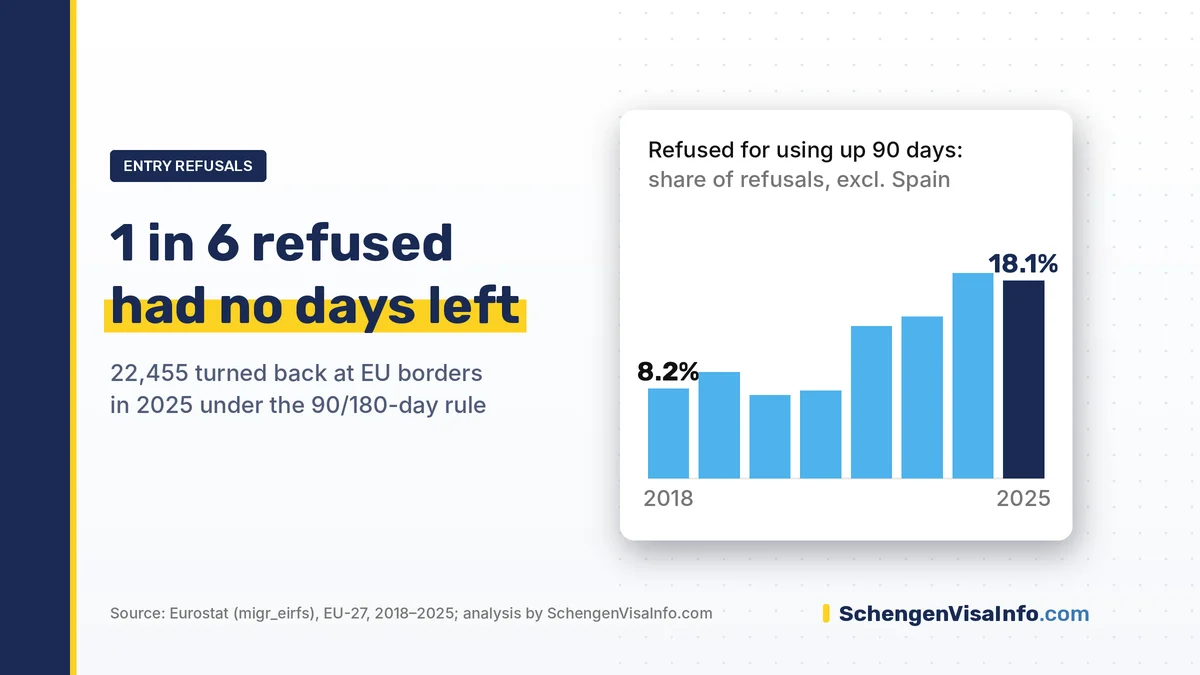
According to an analysis of Eurostat data by SchengenVisaInfo.com, border guards at the European Union’s external borders refused entry to 22,455 people in 2025 because they had already exhausted their authorized 90-day allowance. That figure accounted for roughly 16.9 percent of all 132,600 entry refusals recorded that year, making the 90-day limit the second most common reason travelers were turned away from the bloc, sitting just behind doubts regarding the genuine purpose of a traveler’s trip.
What the Rule Says
For travelers who do not hold a formal residence permit or a long-stay visa, the regulations are strict. Non-EU visitors can spend a maximum of 90 days within the Schengen Area in any rolling 180-day period. This foundational guideline is established by the Schengen Borders Code, which regulates intended stays on the territory of member states for a duration of no more than 90 days in any 180-day timeframe. Crucially, the calculation counts both the day of arrival and the day of departure as full days of stay.
Furthermore, this limit is shared collectively across all participating Schengen countries. Spending ten days in Italy and another ten days in Croatia means a traveler has accumulated twenty days on the exact same regulatory clock. If a border guard discovers that an individual has run out of allowable days, they possess the authority to refuse entry outright, even if the traveler’s passport and visa remain completely valid and the journey itself is entirely ordinary. In official Eurostat reporting, this particular infraction is categorized under the specific reason code indicating that a person has already stayed for three months within a six-month period.
How Fast Has This Grown?
In absolute terms, refusals enforced under the strict 90/180-day rule have climbed steadily over recent years. Statistics show that such refusals rose from 18,530 in 2018 to a peak of 22,590 in 2024, before experiencing a minor dip of 135 cases last year. However, their proportionate share of all overall entry refusals grew at a much faster pace, largely because refusals linked to other categories began to fall sharply after 2019.
An examination of historical figures illustrates this upward trajectory. In 2018, overstay-related refusals accounted for just 4.1 percent of the total EU aggregate. By 2022, that share had jumped to 13.5 percent, climbing further to 14.3 percent in 2023, and reaching 18.2 percent in 2024 before settling at 16.9 percent in 2025.
Spain historically played a notable role in skewing the broader EU-wide refusal totals due to high volumes of documentation-related rejections in earlier years. When Spain’s data is factored out of the equation, a clear and steady upward climb emerges across the remaining member states, growing from an adjusted 8.2 percent in 2018 to roughly 18 percent by 2024 and 2025.
The rule’s rising prominence in the official refusal rankings is equally striking. Back in 2018, exceeding the short-stay limit was only the sixth most common reason for an entry refusal. By 2024, it had climbed to third place, and by 2025, it secured the second position, trailing only refusals tied to an unjustified trip purpose. In doing so, it surpassed refusals for lacking a valid visa or residence permit.

Who Is Being Caught Out?
The travelers most frequently caught out by the rule are predominantly citizens coming from countries situated close to the European Union’s eastern and southeastern borders. Because these populations enjoy visa-free travel privileges to the EU, they frequently cross international borders multiple times throughout the year for family, business, or leisure.
Ukrainian nationals, in particular, represented a significant share of these enforcement actions, accounting for 54.3 percent of such refusals in 2025. The number of Ukrainian citizens turned away under this rule has more than doubled since 2019. Conversely, Serbian nationals experienced a different trend; once holding the second-highest position on the refusal list in 2019, they dropped to fourth place by 2025, recording fewer than half as many refusals as they did six years prior. Other nationalities frequently appearing in the statistics include travelers from Albania, Moldova, and Bosnia and Herzegovina.
When looking at where these refusals are actively taking place, Poland reported the highest volume among member states, issuing 12,120 of the refusals, followed by Romania, Croatia, and Italy. Analysts note that these national figures reflect the reporting of individual countries to Eurostat and are heavily influenced by the sheer volume of traffic moving across specific frontiers. A particularly busy border crossing naturally yields a higher number of total refusals, even if the border personnel stationed there are applying the rules no more strictly than their counterparts elsewhere in the bloc.
What the Entry/Exit System Shows So Far
The traditional Eurostat figures largely predate the full implementation of the European Union’s modern Entry/Exit System, known as the EES. This technological upgrade modernizes external border management by replacing traditional manual passport stamps with a centralized digital record for every incoming and outgoing non-EU traveler. Because the automated system calculates the exact number of days a traveler has accumulated, border guards no longer need to manually flip through passport pages and count stamps to identify an overstay.
Early operational data suggests that overstaying remains a prominent issue under the digital framework as well. The European Commission’s State of Schengen Report noted that thousands of travelers were denied entry specifically for having overstayed their authorized duration in the Schengen area during the initial rollout phases. Similarly, quarterly reports published by eu-LISA, the agency responsible for managing large-scale IT systems in the area of freedom, security, and justice, confirmed that exceeding the three-month limit in a six-month period consistently ranks as a leading driver for denied entries under the new digital infrastructure.
How to Avoid Being Refused
Travelers seeking to avoid unexpected border complications are advised to meticulously calculate their cumulative days abroad prior to embarking on any journey to Europe. Every single day spent within the wider Schengen Area during the preceding 180 days counts toward the threshold, including the exact dates of arrival and departure.
While time spent residing legally under a valid long-stay visa or a residence permit is excluded from this calculation, short-term tourism and business trips quickly accumulate. For travelers who find themselves operating close to the regulatory limit, experts recommend carrying physical or digital evidence of earlier entries and exits—such as boarding passes, accommodation receipts, or travel tickets—to help clarify their travel history if questioned by border officials, particularly for transit movements occurring across borders that may not be fully digitized.
| Source | : | Open Passport |
| Author | : | Ali Ikhwan |
| Editor | : | Open Passport Editorial Team |
