
Montenegro Ends Visa-Free Access for Five Nations to Align with EU Policy
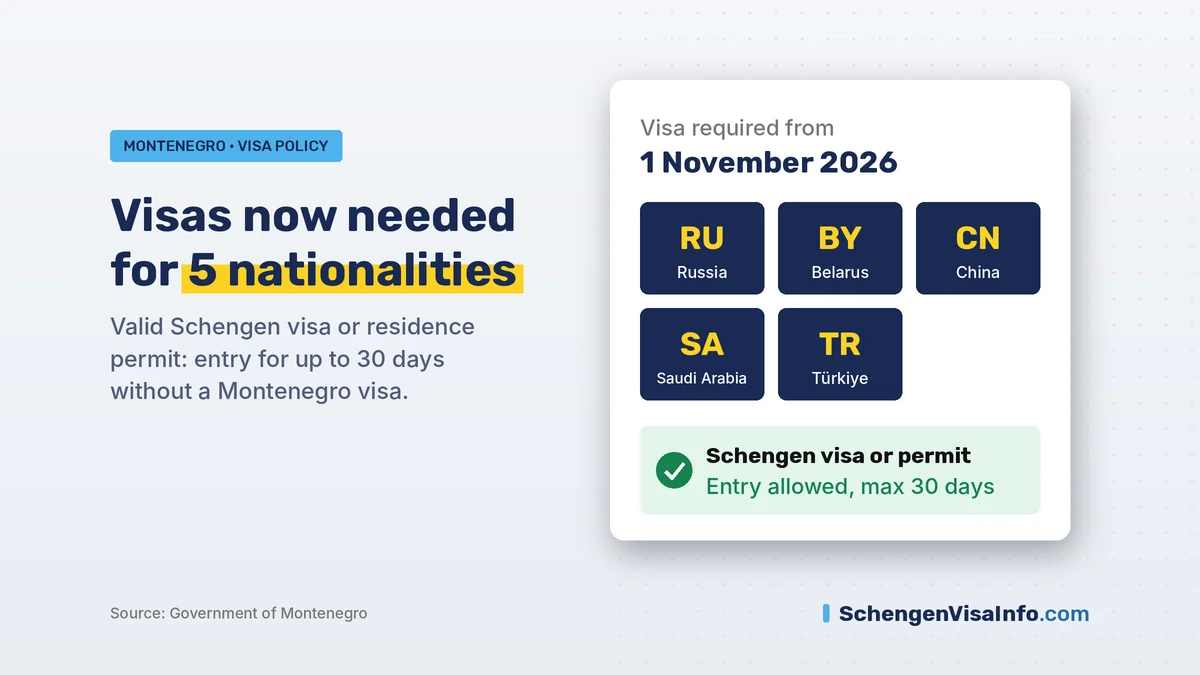
Citizens of Russia, Belarus, China, Saudi Arabia and Türkiye officially require a visa to enter Montenegro following a significant shift in the nation’s immigration policy. The Montenegrin government ended visa-free access for nationals from these five countries to bring its national visa framework into alignment with the European Union’s broader visa policy, marking a pivotal step in the Balkan country’s ongoing journey toward EU accession. Despite the removal of blanket visa-free entry, travellers from these five affected nations who hold a valid Schengen visa or a residence permit issued by a Schengen-associated country retain the privilege of entering Montenegro without a separate national visa for stays of up to 30 days.
What Has Changed
The sweeping regulatory shift stems from a decree adopted by the Government of Montenegro on 23 July 2026, which amended the existing Decree on the Visa Regime. The text was published in the Official Gazette of Montenegro on the following day, officially setting 1 November 2026 as the date when citizens of Russia, Belarus, China, Saudi Arabia and Türkiye would lose their previous visa-free privileges. To streamline the legal framework, the government subsequently adopted a new, consolidated Decree on the Visa Regime on 26 October, which was published in Official Gazette No. 158/2026. This comprehensive document officially replaced all previous decrees and their amendments, taking full legal effect on 1 November.
The Ministry of Foreign Affairs of Montenegro quickly updated its diplomatic and consular web portals to reflect the new realities. Official communications targeting Russian and Turkish citizens explicitly noted that while visa-free entry remained permissible through October 31, a formal visa would be mandatory starting November 1. In a definitive statement released on the eve of the policy change, the ministry underscored the mandatory nature of the update, emphasizing that an appropriate visa must now be acquired in advance of any planned arrival.
Government officials have consistently linked this regulatory overhaul to Montenegro’s strategic aspirations for European Union membership. Aligning the national visa regime with the EU’s common visa list is viewed as a fundamental obligation on the path to accession. Because nationals of Russia, Belarus, China, Saudi Arabia and Türkiye are required to hold visas when crossing into the Schengen Area, Montenegro is expected to mirror these requirements in full prior to completing its integration process into the bloc.
Can I Still Enter Montenegro With a Schengen Visa?
Even with the termination of direct visa-free entry, travellers from the affected countries retain a practical alternative if they possess specific travel documentation. The longstanding exemption for holders of valid Schengen visas remains active, applying to nationals of the five targeted nations in the exact same manner as it does for other global travellers who would otherwise require a Montenegrin entry permit.
According to guidelines issued by the Ministry of Foreign Affairs, individuals holding a valid travel document accompanied by an appropriate Schengen visa or residence permit are permitted to enter, transit through, and remain within Montenegro for a maximum duration of 30 days. Furthermore, the ministry’s updated directives extend this privilege to valid visas and residence permits issued by several other developed nations, specifically Australia, Canada, Japan and New Zealand.
This 30-day allowance, however, is subject to a strict qualifying condition regarding the expiration date of the underlying travel authorization. If a traveller’s Schengen visa or qualifying residence permit expires in fewer than 30 days, the individual must depart Montenegro before that expiration date arrives. For instance, a Turkish citizen whose Schengen visa lapses 12 days after crossing the Montenegrin border is legally permitted to stay for only those 12 days rather than the full 30-day window. The same principle applies universally to residence permits and alternative national visas.
Immigration authorities have stressed that possessing a Schengen visa does not automatically render it a valid entry document for Montenegro under independent legal frameworks. Because Montenegro remains outside both the European Union and the Schengen Zone, the 30-day allowance operates entirely as a national policy managed under sovereign rules. Consequently, days spent visiting Montenegro do not accumulate toward or affect an individual’s permitted duration of stay under the separate Schengen 90/180-day rule. Final authority regarding entry rests entirely with Montenegrin border control officers, positioning Montenegro alongside a select group of non-Schengen destinations that maintain provisions for accepting Schengen documentation under specific, regulated terms.
Who Is Affected and What Changes for Each Country
The practical impact of the policy change varies significantly depending on the nationality of the traveller. For Russian citizens, who previously enjoyed unrestricted visa-free stays of up to 30 days, the new rule means an absolute requirement to secure a visa prior to travel, unless they qualify under the Schengen exemption. Belarusian citizens face an identical transformation, moving from a straightforward 30-day visa-free regime to a mandatory visa requirement. Saudi Arabian nationals, who similarly enjoyed 30 days of visa-free access prior to November, must now apply for entry clearance in advance.
For Turkish citizens, the transition marks the end of a popular tourist and business corridor that permitted 30 days of visa-free entry. Meanwhile, the adjustments for Chinese citizens introduce a more nuanced shift. Prior to October, Chinese travellers could enter Montenegro without a visa exclusively if they were travelling as part of organized tour groups or holding public affairs and business passports. Ordinary Chinese passport holders travelling independently already faced a visa requirement prior to the recent reforms, meaning the latest decree primarily alters the landscape for group tourism operators rather than individual leisure travellers. Despite these diverse starting points, the overarching safety net of the Schengen visa and residence permit exemption remains universally applicable across all five nationalities.
What If I Was Already in Montenegro?
Addressing the status of individuals who crossed the border prior to the regulatory shift, the Ministry of Foreign Affairs established clear transitional guidelines to manage visitors already residing in the country when the new rules took effect.
How to Apply for a Montenegrin Visa
For those who lack a qualifying Schengen visa or alternative residence permit, securing permission to enter requires applying through official diplomatic channels. Visa applications must be submitted directly at Montenegrin embassies and consulates abroad or, where available, through designated external service providers such as VFS Global application centres. The Ministry of Foreign Affairs has issued explicit warnings that visa applications cannot be initiated from within Montenegrin territory. Before starting the application process, travellers are strongly advised to consult the Ministry of Foreign Affairs website to review the specific documentation requirements mandated for their respective nationalities.
Belarus and Russia Respond
The policy shift has prompted varying diplomatic and reciprocal responses from the affected governments. Belarus was the first to react; the Montenegrin Ministry of Foreign Affairs confirmed receiving an official note from the Belarusian embassy stating that Montenegrin citizens would likewise face a visa requirement to enter Belarus beginning 1 November 2026.
Russia’s response arrived subsequently through diplomatic channels. According to reports from Izvestia, the Russian embassy in Podgorica announced that Montenegrin citizens will need to obtain visas starting 30 December 2026. This change coincides with the official expiration of Russia’s obligations under a 2008 bilateral agreement governing mutual travel, which is set to lapse following Montenegro’s formal notice of termination.
Conversely, China has not introduced corresponding restrictions for Montenegrin passport holders. The Chinese embassy in Podgorica confirmed that Montenegrin citizens may continue to travel to China without a visa through 31 December 2026. Meanwhile, Montenegrin nationals were already required to obtain visas for travel to Saudi Arabia, while Türkiye has not yet announced any reciprocal measures. The Montenegrin foreign ministry has advised its citizens to closely monitor official notices issued by Turkish authorities regarding any potential future policy updates.
What Happens Next
As international travel patterns adjust to the new regulatory environment, visitors from Russia, Belarus, China, Saudi Arabia and Türkiye planning upcoming trips to Montenegro must carefully verify their documentation status well in advance of departure. Travellers must confirm whether they hold an active Schengen visa, an approved residence permit, or another recognized entry credential, and they must ensure that these documents will remain valid for the entirety of their planned stay. Individuals lacking these exemptions are required to submit formal visa applications abroad before finalizing their travel itineraries.
For citizens of Montenegro, attention now turns toward upcoming policy deadlines, most notably 30 December 2026, when Russia’s newly announced visa requirements take effect. Montenegrin travellers must also keep a close watch on shifting regulations concerning China, given that current visa-free entry privileges for travel to the East Asian nation are scheduled to remain active only until the end of December 2026.
| Source | : | Open Passport |
| Author | : | Dwi Wanna |
| Editor | : | Open Passport Editorial Team |
