
Schengen Visa Discrepancy: Russian Applicants Face Far Fewer Rejections Than Citizens of NATO Ally Türkiye
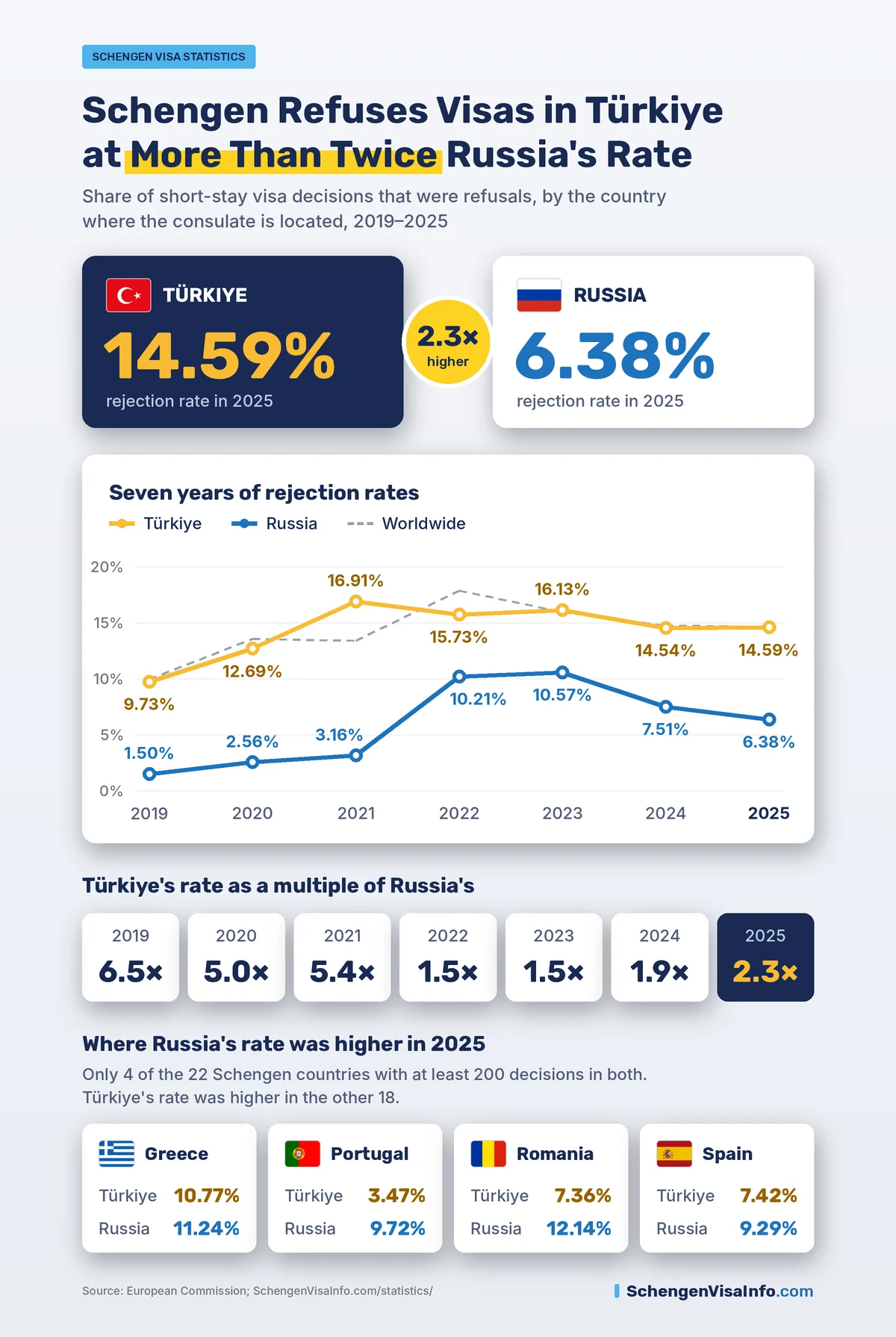
Despite being entangled in the largest armed conflict in Europe since the Second World War, facing 22 sweeping packages of European Union sanctions, and navigating severe national visa bans or entry restrictions across Czechia, Poland, Finland, and the Baltic states, Russian citizens encountered a remarkably low visa refusal rate of just 6.38% at Schengen consulates throughout 2025.
In sharp contrast, Türkiye—a steadfast NATO ally since 1952 and an official EU candidate country since 1999—endured a Schengen visa refusal rate of 14.59% over the same period, according to comprehensive European Commission figures analyzed by SchengenVisaInfo.com. This disparity means that applicants in Türkiye were rejected 2.3 times more often than those applying from within the Russian Federation.
The quantitative gap is particularly stark when examining individual member states. Germany alone rejected 46,008 visa applications submitted from Türkiye in 2025, a figure higher than the total number of rejections issued by all Schengen zone countries combined for applications originating in Russia, which stood at 42,953. As diplomatic tensions persist, this statistical divide continues to widen.
The Numbers: 183,196 Refusals in Türkiye Versus 42,953 in Russia
Official short-stay visa statistics for 2025 position Türkiye as the second most popular country globally for Schengen visa applications, with a staggering 1,268,376 submissions lodged at various diplomatic missions. Of these, 1,072,328 visas were granted, while 183,196 applications met with refusal.
Conversely, consulates operating within Russia processed 679,425 applications, issuing 630,605 visas and rejecting 42,953. While Turkish applicants submitted roughly 1.9 times the volume of applications processed in Russia, they accumulated 4.3 times as many rejections.
Türkiye’s rejection rate hovers near the global average, sitting within a tenth of a percentage point of worldwide figures. The true anomaly lies in Russia’s exceptionally low refusal rate. Russian applicants were turned down less than half as often as the average applicant worldwide, running counter to the European Commission’s 2022 guidelines instructing diplomatic missions to adopt a "very strict approach" toward Russian tourist travel.

The War Narrowed the Gap, But It Is Widening Again
Applicants in Türkiye have historically faced higher rejection rates than their Russian counterparts in every recorded year since at least 2014. Prior to the full-scale invasion of Ukraine, the discrepancy was immense. In 2021, the rejection rate in Türkiye was more than five times higher than that recorded in Russia.
The outbreak of war temporarily altered this dynamic. Following the EU’s decision in September 2022 to fully suspend its visa facilitation agreement with Moscow, visa refusals in Russia more than tripled. Throughout 2022 and 2023, the rejection rate in Türkiye was only about one and a half times that of Russia.
However, that statistical convergence has since unraveled. The refusal rate within Russia dropped to 7.51% in 2024 and further declined to 6.38% in 2025, while Türkiye’s rate remained largely static. Simultaneously, application volumes inside Russia rebounded, rising by 30.6%, with issued visas increasing by 37.3%.
The Countries That Shut the Door on Russians
Russia’s low aggregate refusal rate is particularly striking given that a significant number of Schengen member states have implemented measures far more restrictive than standard EU policy. These nations have suspended tourist visas entirely, barred Russian travelers at their external borders, or closed crossing points altogether.
Czechia halted the acceptance of visa applications from Russian citizens on the exact day the invasion commenced. In February 2024, the Czech government extended this ban indefinitely, maintaining narrow exceptions strictly for humanitarian situations. Since October 2022, Prague has also refused entry to Russian nationals holding tourist visas issued by any other Schengen area state, resulting in fewer than 200 visa decisions processed by Czech consulates inside Russia during 2025.
Similarly, Estonia, Latvia, Lithuania, and Poland closed their external borders to Russian tourists holding valid Schengen visas issued by third countries starting in September 2022. Finland implemented equivalent restrictions shortly thereafter, ultimately shutting its entire land frontier with Russia by late 2023 over security concerns regarding migration flows. Finland’s government extended these border closures through mid-2026.

Consequently, while the diplomatic missions of Finland and the Baltic states processed over one million visa applications in Russia back in 2019, that figure plummeted to a mere 9,433 applications by 2025. Other nations enacted targeted limitations: Denmark halted standard visa processing in Russia in May 2022, Belgium suspended tourist visa issuance in July of that year, and Norway instituted an entry ban for Russian tourists in May 2024.
At the broader EU level, Russian nationals lost access to the visa facilitation agreement and became subject to restrictions on multiple-entry Schengen visas. Despite these hurdles, major Western European destinations including Italy, France, Spain, and Greece continued to issue over half a million visas within Russia in 2025, maintaining refusal rates ranging between 3.47% and 11.24%. Türkiye, by contrast, faces none of these national bans, yet its applicants encounter significantly higher rejection barriers.
Same Consulates, Very Different Odds
A common assumption is that this disparity stems from applicants applying to entirely different member states. Indeed, application patterns differ: approximately 80% of applicants in Russia direct their requests to Italy, France, Spain, and Greece. In Türkiye, Greece remains a leading destination, but Germany accounts for 17.2% of submissions and maintains a much higher refusal rate.
However, data modeling demonstrates that destination distribution accounts for very little of the overall gap. When SchengenVisaInfo applied each member state’s 2025 Russian refusal rate to the volume of decisions made in Türkiye, the projected overall rejection rate for Turkish applicants would have dropped to roughly 6.6%. Conversely, applying Türkiye’s rejection rates to Russia’s application volume would have driven the Russian refusal rate up to approximately 13.1%. The variance stems from how individual consulates evaluate candidates rather than the geographic distribution of applications.
Germany recorded the highest overall refusal rate among major destinations, rejecting 21.17% of applications processed in Türkiye compared to just 4.01% in Russia. Germany’s 46,008 rejections in Türkiye surpassed the total refusals issued by all 26 Schengen countries operating inside Russia combined.
Conversely, several southern European nations run counter to this trend. Greece, Spain, Portugal, and Romania actually registered slightly lower refusal rates for applicants in Türkiye than for those in Russia, while Switzerland maintained nearly identical rates across both jurisdictions.

Why Are Applicants in Türkiye Refused More Often?
While diplomatic missions do not publicly publish individualized reasons for rejections by nationality, the overarching Schengen Visa Code mandates that consular authorities pay particular regard to whether an applicant poses a risk of irregular migration, presents a security threat, or intends to depart the territory prior to visa expiration.
Migration data indicates that Turkish nationals submitted 24,240 primary asylum claims across the EU in 2025, making them the fifth-highest nationality for asylum applications, down from 46,830 in 2024. Nearly half of these asylum applications were lodged in Germany, which serves as the primary destination for Schengen migrants and the country where Turkish applicants face the highest rejection rates. By comparison, Russian nationals submitted 7,795 asylum claims over the same period.
Economic pressures also influence outcomes. Sustained inflation in Türkiye has altered the financial profile of many applicants. Representatives from European diplomatic missions have noted that economic deterioration has reduced the number of applicants who comfortably meet financial self-sufficiency thresholds, even though official baseline criteria remain unchanged.
For Russia, the drastic reduction in total application volume since 2022—with visa issuance remaining down by roughly 84.5% compared to pre-pandemic 2019 levels—has concentrated applications primarily among southern European nations that continue to issue large numbers of visas. This smaller, more selective pool of applicants naturally yields a lower overall rejection rate.
What Turkish Officials and the EU Say
Beyond rejections, prospective travelers in Türkiye frequently struggle to secure initial visa appointments. Thomas Hans Ossowski, the EU’s ambassador to Türkiye, acknowledged the systemic strain in mid-2025, noting that applicants often face months of waiting to secure an appointment slot.
This scarcity has fueled a thriving secondary black market. Industry bodies, including the Association of Turkish Travel Agencies (TÜRSAB), report that automated software bots routinely harvest appointment slots for resale, with middlemen charging exorbitant fees ranging from hundreds to thousands of euros. Service providers like VFS Global have attempted to mitigate these issues through enhanced digital waiting rooms and IP restrictions.

European diplomats maintain that consular decisions remain strictly non-political, attributing rejections primarily to incomplete documentation or fraudulent submissions rather than nationality-based bias.
German foreign policy representatives acknowledge the unprecedented demand for visas in Türkiye, noting that long-term relief can ultimately be achieved only through comprehensive visa liberalization. Although Türkiye has advanced through numerous technical benchmarks of the EU visa-free roadmap initiated over a decade ago, outstanding legislative adjustments regarding anti-terrorism laws, data protection guidelines, and judicial cooperation remain prerequisites for final implementation.
As diplomatic channels continue high-level dialogues to address bureaucratic bottlenecks, the underlying statistical divide between consular practices in Ankara and Moscow remains a central point of contention in broader European foreign policy discussions.
| Source | : | Open Passport |
| Author | : | Basiran |
| Editor | : | Open Passport Editorial Team |
