
EU Schengen Visa Online Platform Faces Further Delays as Launch Date Slips Toward 2030
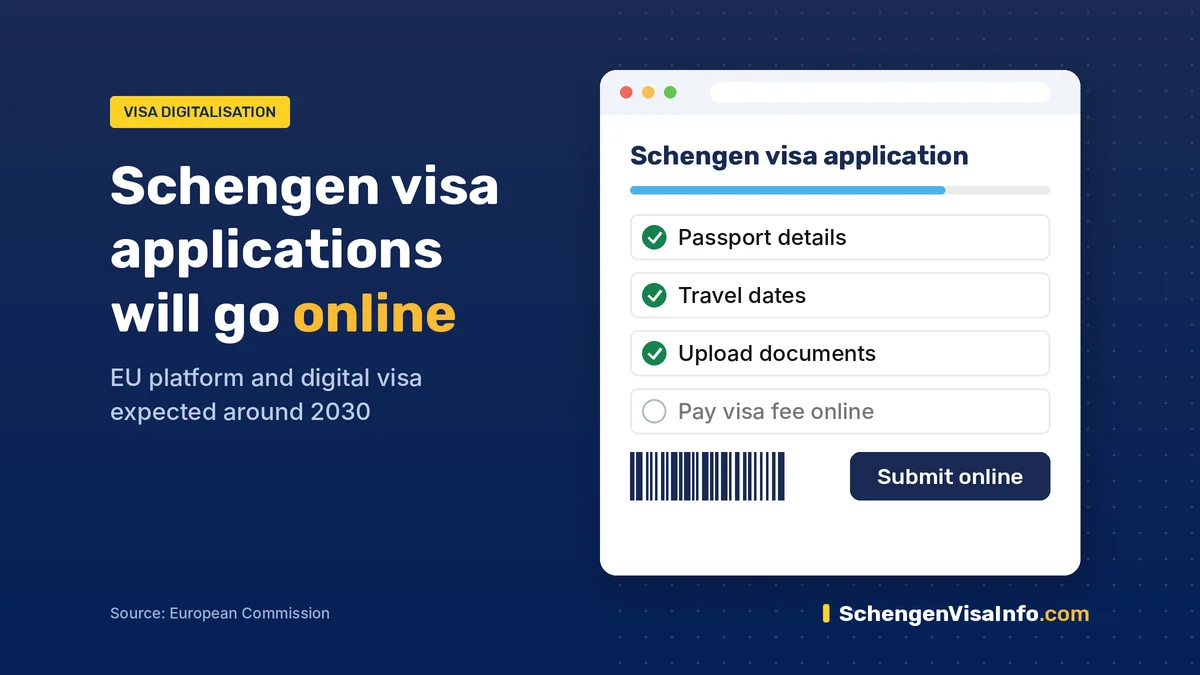
The European Union’s long-anticipated single online platform for Schengen visa applications is not expected to start operating until around 2030, according to the latest assessments from the European Commission.
Three years after the EU formally adopted the regulatory framework in November 2023 to digitize the application process, a definitive launch date has yet to be fixed. Once the centralized platform finally opens its digital doors, individual Schengen member states will be granted up to seven years to transition away from their legacy systems. This extended rollout means that travelers may still find themselves filing traditional paper applications well into the 2030s, contrary to early public assumptions that a complete paperless transition would happen overnight.
Where the Online Visa Platform Stands Today
The legislative journey toward a digital Schengen visa began when the Council of the European Union gave its final approval to a comprehensive digitalization package on November 13, 2023. The main regulation was subsequently published in the Official Journal on December 7, 2023, accompanied by a second regulation amending the EU’s legal framework governing visa formats to allow for digital issuance.
However, passing the legislation proved to be the straightforward part of the endeavor. The overarching infrastructure, designated as the EU Visa Application Platform (EU VAP), must be engineered completely from scratch. The core regulation stipulates that the rules apply exclusively from the date determined by the European Commission once the technological system is fully realized. Under Article 7 of Regulation 2023/2667, the Commission is legally authorized to set this launch date only after all necessary implementing and delegated acts are fully established, and eu-LISA—the European Union Agency for the Operational Management of Large-Scale IT Systems in the Area of Freedom, Security and Justice—certifies the successful completion of comprehensive system tests.
The European Commission currently maintains that the platform is expected to begin operations around 2030, a projection that remains contingent upon the broader roadmap governing the EU’s interconnected border IT systems. Meanwhile, internal planning documents from eu-LISA have occasionally presented a more ambitious horizon. The agency’s Single Programming Document for 2026–2028, formally adopted by its Management Board in July 2026, categorizes the platform as actively under development with a targeted operational year of 2028. The agency noted that additional human resources and financial allocations have been secured to drive development forward as of 2026 and to provide ongoing maintenance starting in 2028. Financial provisions within the document outline substantial budgetary commitments, reflecting the complex technical nature of merging the platform with the existing Visa Information System (VIS). When the eu-LISA Management Board convened in Strasbourg to review the implementation of critical EU IT architectures, the technological roadmap was scrutinized, though no official acceleration of the public launch timeline was announced.
A History of Shifting Timelines
The project timeline has encountered multiple adjustments since the European Commission initially floated the concept. When the proposal was first introduced in April 2022, the Commission envisioned an operational launch by 2026, with all member states fully integrated by 2031. By December 2023, following legislative negotiations, the Commission adjusted its public estimate to around 2030, linking the rollout to the broader interoperability roadmap of European border databases. Although eu-LISA’s programmatic documents pointed toward a 2028 operational target, neither milestone carries binding legal force. Given the historical precedent of scheduling slips that have affected other major European border IT initiatives, such as the repeatedly delayed ETIAS, observers and institutional analysts continue to treat these projections with cautious pragmatism.
The Reality of a Seven-Year Transition Window
Public reports at the time of the regulations’ initial adoption suggested that traditional paper-based consular procedures would be entirely phased out by 2030. However, the final legal text affords significantly more flexibility to national administrative bodies. Article 7 of Regulation 2023/2667 permits any member state to defer adoption of the platform for up to seven years from the official date of entry into operation, though individual countries retain the option to migrate earlier if their domestic infrastructure permits.
Consequently, if the platform successfully launches around 2030 in line with the Commission’s expectations, individual Schengen countries could legally maintain their current localized application frameworks until approximately 2037. Even after the transition period concludes, paper-based procedures will not vanish entirely, as provisions will remain in place to accommodate exceptional circumstances. This extended horizon represents a notable departure from the Commission’s initial 2022 proposal, which anticipated a five-year transition period following a 2026 launch.
What Will Change for Visa Applicants
When the digital platform eventually opens to the public, the mechanics of securing a short-stay visa to travel within the Schengen Area will undergo a profound transformation. Rather than navigating a patchwork of disparate national websites, applicants will utilize a single, centralized EU web portal or mobile application regardless of which specific member state they intend to visit. Users will establish a secure account, complete the electronic application form, and upload digital copies of their supporting credentials, including passport scans. The data requested will closely mirror traditional paperwork, covering personal identification, passport details, occupational background, travel itineraries, accommodation arrangements, and financial proof, with finalized technical standards to be defined in forthcoming implementing acts.
To alleviate confusion regarding bureaucratic jurisdiction, the platform will incorporate an automated pre-check mechanism designed to determine which member state holds responsibility for processing a given application based on the duration of stay and the primary port of entry. While applicants retain the right to request that a file be redirected to a different country if that specific destination constitutes the primary purpose of the journey, consular authorities will retain the final manual authority to verify their competence. This feature is intended to curb the phenomenon of forum shopping, where travelers intentionally apply through consulates offering shorter processing times rather than the country they genuinely plan to visit.

Financial transactions will also be centralized through the platform’s secure payment gateway, allowing applicants to remit visa fees directly to the responsible member state using electronic payment methods, with in-person cash or card payments restricted to scenarios where digital settlement is unachievable. The implementation of the platform does not alter the underlying cost of entry; standard Schengen visa fees for adults remain fixed at 90 euros, while children aged six to 11 are charged 45 euros, following adjustments enacted in mid-2024.
For a significant majority of travelers, particularly frequent visitors whose biometric data remains valid within the system, the digital overhaul will eliminate the necessity of physical visits to consulates or external visa application centers. Nevertheless, in-person appointments will remain mandatory under specific circumstances, such as for first-time applicants, individuals whose biometric data has expired, or those holding new travel documents. External service providers will continue to operate in tandem with the digital ecosystem to handle necessary biometric collections and physical appointments.
Perhaps the most visible change for travelers will be the replacement of the traditional physical visa sticker. Once approved, visas will be issued entirely in a digital format as an encrypted, cryptographically signed record within the Visa Information System, relieving travelers of the requirement to surrender their physical passports for a sticker to be printed. However, physical stickers will not disappear immediately, remaining in use for non-digital issuances and for member states still operating within their transitional grace periods.
Strategic Objectives and Institutional Perspectives
The European Union has consistently emphasized that full digitalization aims to streamline the administrative burden for both travelers and national consulates while cutting operational costs. The replacement of physical stickers with cryptographically secured digital records fundamentally neutralizes the risk of document forgery and theft. Furthermore, the introduction of automated consular competence checks is expected to enforce regulatory compliance across external borders.
These administrative reforms arrive as travel demand continues to recover toward historical benchmarks. Schengen consulates processed approximately 12 million short-stay visa applications in 2025, resulting in the issuance of nearly 10.3 million visas, compared with pre-pandemic figures of roughly 17 million applications in 2019.
When the legislative package was first adopted in late 2023, industry figures praised the long-term vision of a unified framework. Besart Bajrami, founder of SchengenVisaInfo, characterized the initiative at the time as a monumental shift for the European travel sector. He noted that a centralized platform would fundamentally reshape the applicant experience by reducing financial overhead, administrative delays, and procedural stress, while simultaneously eliminating the common pitfall of submitting applications to the incorrect diplomatic mission. At the same time, industry analysts expressed early skepticism regarding official delivery timelines, drawing parallels to recurrent delays experienced by parallel technological rollouts like ETIAS.
The Broader Landscape of EU Border Technology
While visa-required travelers await the arrival of the digital platform, nationals originating from visa-exempt countries remain entirely outside its scope. Instead, visa-free travelers will eventually fall under the purview of the European Travel Information and Authorisation System, a pre-travel screening mechanism that has similarly encountered prolonged scheduling adjustments.
Although EU interior ministers endorsed a provisional launch window targeting late 2026, references to a specific target date were subsequently removed from official EU portals, leaving the formal launch schedule open pending further announcements. Despite these procedural delays, the financial parameters for ETIAS have been finalized, with the authorization fee adjusted to 20 euros to account for intervening inflation and rising operational expenditures, while exemptions remain in place for minor and senior travelers.
Concurrently, other pillars of the EU’s newly modernized border architecture have already commenced operations. The Entry/Exit System, designed to digitally log the crossings of non-EU nationals and replace traditional passport stamps, successfully went live and achieved full deployment across all designated border crossing points.
For the time being, day-to-day procedures for visa applicants remain unchanged. Until the European Commission officially announces an operational start date for the platform, applicants must continue submitting their documentation through traditional consular channels and external service providers, where physical visas continue to be issued as passport stickers. The progression of the project will depend heavily on the finalization of technical implementing acts and the successful execution of comprehensive stress tests managed by eu-LISA.
| Source | : | Open Passport |
| Author | : | Asro |
| Editor | : | Open Passport Editorial Team |
