
Appointing a Representative in Canada Can Save Overseas Citizenship Applicants Months of Waiting
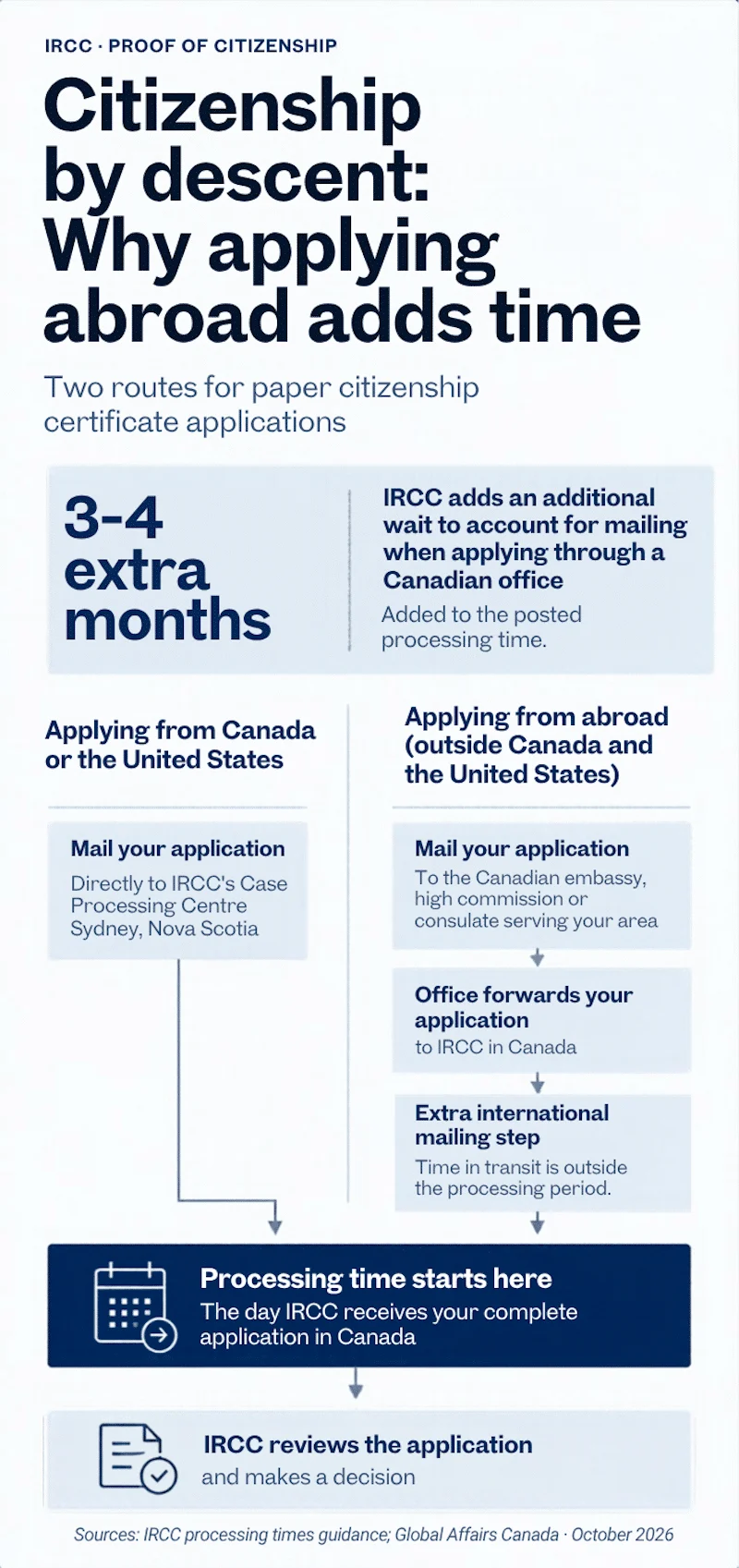
Citizenship by descent applicants residing outside of Canada and the United States have a viable pathway to avoid several months of unnecessary administrative delays. By appointing a representative located within Canada to file their proof of citizenship applications, applicants can bypass the lengthy international mailing routes that currently stall processing times.
Immigration, Refugees and Citizenship Canada (IRCC) advises applicants living abroad—defined in this context as anywhere outside of Canada and the United States—to add an extra three to four months to its officially posted processing times. These additional months account entirely for international transit and mailing logistics. This administrative buffer comes on top of the already extended baseline wait for a citizenship certificate, which is the official legal document proving an individual holds Canadian citizenship. Currently, the processing wait time for these certificates hovers close to three years, making every efficiency vital for families looking to secure their documentation.
The core of the issue stems from the application methods mandated by the Canadian government. The vast majority of individuals claiming citizenship by descent are required to submit their applications on paper. IRCC’s digital online application portal remains restricted to a very narrow segment of applicants, such as individuals whose Canadian parents were born inside Canada on or after February 15, 1977.
For applicants residing within Canada or the United States, the process typically involves mailing a paper application directly to IRCC’s primary Case Processing Centre located in Sydney, Nova Scotia. However, for individuals living anywhere else in the globe, IRCC instructions direct them to mail their files to the local Canadian embassy, high commission, or consulate serving their region. Staff at these overseas diplomatic missions then take on the task of forwarding the physical packages to immigration authorities back in Canada.
A critical detail in this operational pipeline is that formal application processing does not begin the moment an envelope drops into a local mailbox abroad. IRCC officially initiates the processing timeline only on the day a complete application physically arrives at its office in Canada. Consequently, the months a file spends moving through international diplomatic pouches and foreign postal systems do not count toward the processing time.
Furthermore, Global Affairs Canada outlines strict limitations on what its overseas diplomatic missions will and will not do for citizens. These local offices do not perform completeness checks on applications, nor do they verify the authenticity or accuracy of submitted documents. They also do not provide confirmation receipts when files are dropped off, and they cannot supply status updates to anxious applicants. For paper-based applicants, the very first communication from IRCC is an acknowledgement of receipt (AOR)—an official letter confirming that the file has formally entered the processing queue, which itself can take several months to arrive following initial dispatch.
Why Utilizing a Canadian Representative Closes the Gap
By appointing a representative based inside Canada, applicants can effectively neutralize the geographical disadvantage of living overseas. A Canada-based representative can take physical possession of the prepared paper application and mail it directly to the Case Processing Centre in Sydney, Nova Scotia. This direct domestic mailing method allows the file to completely bypass foreign embassies and the complex international mail routes that add months of dead time to the overall procedure.
It is important to note that appointing a representative does not grant special status or accelerate IRCC’s internal review of the file. IRCC explicitly states on its official representative documentation that utilizing a representative brings no special attention, priority, or faster processing speeds from immigration officers. The total duration of an application ultimately depends on the individual visa officer assigned to the file, and timelines can frequently stretch past posted estimates. Nevertheless, eliminating the transit window gives applicants control over the preliminary mailing phase.
Applicants have two primary avenues when selecting someone to act on their behalf: unpaid representatives or paid, authorized professionals.
The unpaid route allows applicants to rely on trusted family members, friends, or other third parties in Canada who do not charge a fee for their assistance. Under this arrangement, the applicant fills out and signs the necessary forms, while the representative submits the physical package from within Canada and manages subsequent correspondence with IRCC. This arrangement must remain strictly uncompensated. IRCC defines anyone who receives money or any form of compensation for their help as a paid representative. Paid representatives must possess formal legal authorization to operate, and IRCC holds the authority to return or outright refuse any application submitted using an unauthorized paid agent.

When utilizing an unpaid representative, that individual will receive IRCC’s physical letters at their Canadian address. Consequently, the chosen friend or relative must be reliable enough to promptly open, read, and forward those critical documents to the applicant abroad.
For those who prefer professional assistance, the Canadian government strictly regulates who is permitted to charge fees for immigration representation. Authorized paid representatives generally include Canadian lawyers in good standing with a provincial or territorial law society, immigration consultants who are members in good standing of the College of Immigration and Citizenship Consultants, and notaries who belong to a provincial or territorial notary public body.
While paid representatives hold no special influence over IRCC officers and do not alter the ultimate adjudication of a file, they offer significant value during the preparatory stages of the application process.
Weighing the Benefits of Paid Immigration Representation
Beyond the obvious advantage of bypassing the three-to-four-month international mailing lag, authorized immigration representatives—such as lawyers specializing in citizenship by descent—provide comprehensive support designed to ensure an application is as robust as possible from the outset.
One key area where professional guidance proves beneficial is in applying for urgent processing. IRCC occasionally prioritizes specific citizenship certificate applications ahead of the standard queue under designated emergency circumstances. Qualifying reasons can include urgent employment requirements, educational commitments, or immediate needs to access pensions or vital health care services. Additionally, a death or serious illness within the immediate family can qualify an applicant for expedited handling, provided they cannot secure a passport through any other nationality they hold. A qualified lawyer can properly assess whether a client’s unique circumstances align with IRCC’s strict criteria and can meticulously prepare the formal request. IRCC requires a detailed explanation letter backed by concrete supporting evidence, such as formal employer letters or paid travel itineraries, though accelerated processing is never formally guaranteed even when criteria are met.
Professional review also addresses application completeness. Because overseas diplomatic offices do not inspect files before they cross the ocean, applicants have historically faced risks of rejection due to missing components. Under IRCC regulations, officers conduct a minimal completeness check on paper applications arriving from outside Canada and the United States. A file is immediately returned as incomplete if it lacks any of four mandatory items. While officers may accept files missing other secondary documentation and request them later, each subsequent request triggers another round of international mail and extended waiting periods. Having a legal professional review the package prior to submission minimizes this risk.
Furthermore, documenting and explaining missing historical records can present a substantial hurdle. Claims originating through a great-grandparent, for instance, frequently require at least four generations of birth certificates issued by original authorities, such as provincial vital statistics offices. If a historical record has been lost or destroyed over time, applicants must provide a thorough written explanation detailing the exhaustive efforts made to locate it. Lawyers specializing in citizenship law can assist in navigating foreign and domestic archives, locating hard-to-find documents, and formally documenting those search efforts when official records are unobtainable.
Regardless of whether a representative is paid or unpaid, applicants are legally required to declare every representative on the Use of a Representative form, designated as IMM 5476. This form must be included directly within the initial paper application package. For individuals who have already submitted their files independently, the form can be transmitted retroactively through IRCC’s online web form. Applicants are restricted to appointing one representative per application at any given time, and failing to declare a representative can result in application refusal. It is also worth noting that individuals who simply check application status on behalf of an applicant do not legally qualify as representatives; IRCC manages status inquiries through a separate document known as the Authority to Release Personal Information to a Designated Individual form, designated as IMM 5475.
As an additional measure to reduce processing times, paper applicants have the option to request an electronic citizenship certificate rather than a physical paper document. By selecting this option on the application form and supplying a current email address, successful applicants receive a downloadable PDF version of their e-certificate directly from IRCC upon approval. Global Affairs Canada notes that electronic delivery avoids the postal delays associated with shipping physical certificates overseas. Furthermore, the e-certificate is fully recognized as valid proof when applying for a Canadian passport. When a representative is on file, IRCC emails the secure download instructions directly to them, though applicants can also establish their own online accounts to retrieve the files independently.
| Source | : | Open Passport |
| Author | : | admin |
| Editor | : | Open Passport Editorial Team |
