
Express Entry Pool Transforms as High-Wage Policies More Than Double Candidates With CRS Scores Over 500
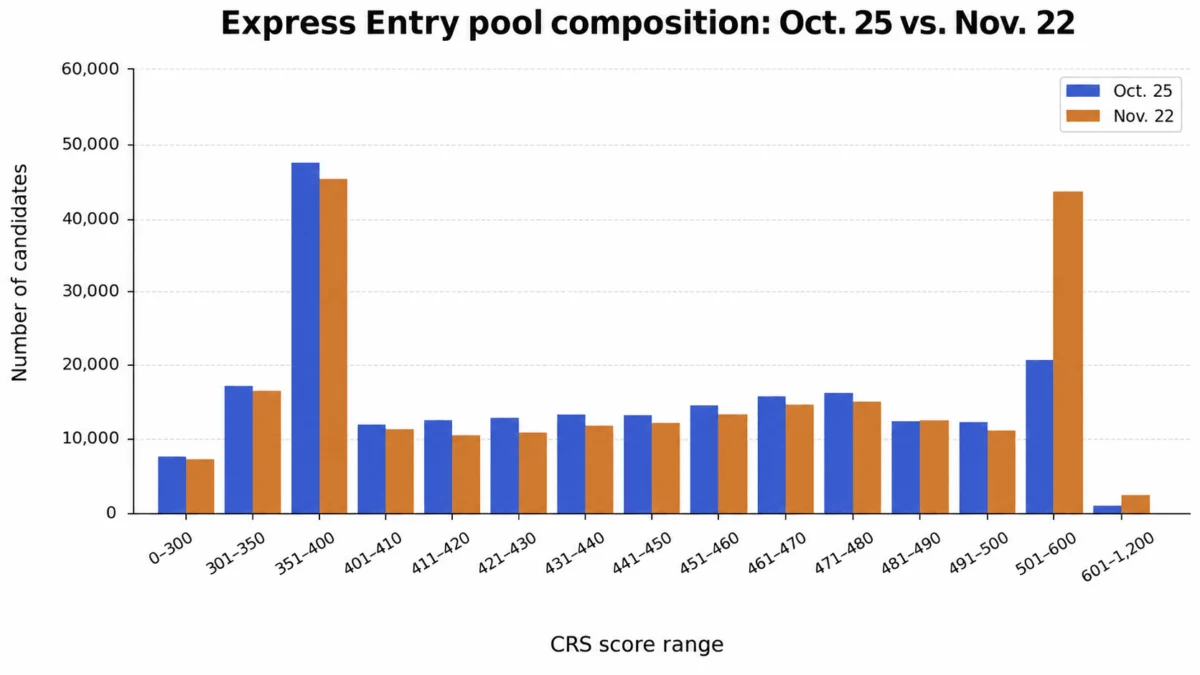
The landscape of Canada’s Express Entry candidate pool has shifted dramatically following the implementation of sweeping regulatory reforms. According to the latest available data published by Immigration, Refugees and Citizenship Canada (IRCC), the number of candidates boasting a Comprehensive Ranking System (CRS) score above 500 more than doubled within weeks of a policy change rewarding high-wage occupations.
The update, which took effect on November 3, immediately altered the mathematical makeup of the federal immigration selection system. Official statistics from the IRCC indicate that as of November 22, a total of 45,822 candidates held scores exceeding the 500-point threshold. This represents a substantial surge from October 25, just prior to the policy implementation, when only 21,322 profiles sat in that elite score bracket.
This dramatic upward shift occurred even as the broader Express Entry candidate pool expanded modestly. Over the same multi-week period, the overall pool grew by nearly 10,000 profiles, moving from a total of 228,724 candidates on October 25 to 238,692 candidates by November 22. A granular analysis of the score distributions reveals that gains in the highest tier heavily outweighed declines across nearly every other score range. In fact, nearly every bracket below 500 experienced a drop in candidate volume, with the solitary exception of the 481 to 490 score range, which saw a modest increase of 122 candidates.
The fundamental driver behind this redistribution of scores is the introduction of the Labour Market Integration factor. Designed to better align Canada’s economic immigration streams with domestic labour market demands, the newly integrated factor awards valuable additional points to candidates who possess established Canadian work experience or a qualifying job offer within a designated high-wage occupation. Because this systemic adjustment functions purely as an additive mechanism, candidates possessing the targeted high-wage experience experienced an automatic recalculation and upward movement of their existing profiles, while candidates without those specific credentials remained unaffected. Consequently, a vast wave of profiles previously sitting in the upper 400s surged past the 500-point mark, resulting in the more than twofold expansion of the 501 to 600 score range.
How competitive is the pool as of the latest data?
To understand the heightened level of competition within the system following these adjustments, the statistical distribution of the pool provides a clear picture of candidate standing. Based on the IRCC dataset reflecting candidate volumes on November 22, the lower score brackets continue to house a considerable proportion of the overall inventory, though their percentage share has shifted downward due to the elevation of high-wage profiles.
At the baseline, candidates with scores ranging from zero to 300 account for 7,238 individuals, representing roughly 3.03 percent of the entire pool, spanning a percentile range from 0 to 3.03 percent. Moving slightly higher, the 301 to 350 bracket holds 16,627 candidates, constituting another 6.97 percent of the inventory and bringing the cumulative total to 23,865 profiles.
The most heavily populated segment of the lower-to-mid tier remains the 351 to 400 score range, which accounts for 45,934 candidates—representing 19.24 percent of the pool and pushing the cumulative total to 69,799 profiles, or nearly 30 percent of all registered applicants.
Progressing through the mid-tier brackets, the distribution shows steady increments. The 401 to 410 range contains 11,265 candidates, while the 411 to 420 range holds 10,522 profiles. The 421 to 430 bracket includes 10,611 candidates, and the 431 to 440 range registers 11,716 individuals. Moving further up, the 441 to 450 score range accounts for 12,147 candidates, followed by 13,416 individuals in the 451 to 460 bracket, and 14,435 candidates in the 461 to 470 range.
As scores approach the upper-middle tiers, candidate concentrations remain dense. The 471 to 480 score range holds 15,296 profiles, representing roughly 6.41 percent of the pool. The 481 to 490 bracket accounts for 12,464 candidates, while the 491 to 500 range holds 11,199 individuals. Combined, these brackets establish that a significant portion of the candidate pool hovers just beneath the prestigious 500-point threshold.

However, the upper echelons of the system have become heavily congested due to the recent policy shifts. The 501 to 600 score range now encompasses an extraordinary 43,754 candidates, representing 18.33 percent of the entire pool and stretching percentile rankings from roughly 80.80 percent up to 99.13 percent. Beyond that, the ultra-competitive tier spanning from 601 to 1,200 points contains 2,068 candidates, accounting for the final 0.87 percent of the inventory and rounding out the total pool of 238,692 active profiles.
What accounted for the changes in Express Entry profiles between Oct. 25 and Nov. 22?
The structural evolution of the Express Entry pool during this period is directly tied to the regulatory overhaul that took effect on November 3. The implementation of the Labour Market Integration factor fundamentally restructured how human capital is evaluated by offering candidates the higher of two possible scoring streams: up to 150 points for accumulated Canadian work experience, or up to 100 points for a qualifying job offer.
The Canadian work experience component integrates traditional points awarded for length of employment with up to 70 supplemental points reserved for candidates who have completed at least one year of work within a curated list of 186 high-wage occupations identified by federal authorities. Simultaneously, qualifying job offers in high-wage fields no longer mandate a traditional Labour Market Impact Assessment to yield points. Instead, these offers are assigned values of 50, 70, or 100 points, scaling upward depending on whether the specific occupation’s median wage reaches at least 1.3, 1.5, or double the national median wage.
In addition to these systemic recalibrations, the pool’s composition during late October and November was influenced by active invitation rounds conducted by the department. Immediately following the October 25 data snapshot, the IRCC administered three distinct invitation rounds, issuing a combined total of 5,942 Invitations to Apply for permanent residence.
The largest of these near-term events was a category-based selection round targeting French-language proficiency on October 27, which saw the issuance of 5,000 invitations with a minimum CRS cutoff score of 407. This was followed shortly thereafter by a targeted Transport occupation draw on October 28. Following these events, federal immigration authorities temporarily paused invitation rounds while administrative systems recalculated existing candidate profiles to incorporate the new high-wage CRS point structures.
Which draws have not been factored into the Nov. 22 distribution?
Because statistical data snapshots capture specific moments in time, the November 22 pool distribution does not account for subsequent selection activity initiated by federal immigration authorities. Notably, the data precedes the IRCC’s November 23 draw, which marked the federal department’s inaugural selection round since the high-wage CRS reforms officially came into force.
That significant selection round resulted in the issuance of 1,999 invitations directed exclusively toward provincial nominee candidates, with a notably high CRS cutoff score of 673. Industry analysts noted that this event represented the largest volume of invitations issued in a single Provincial Nominee Program draw since May 30, 2024, when 2,985 candidates received invitations under similar provincial pathways.
With this latest round accounted for, federal data indicates that the IRCC has issued a cumulative total of 151,408 Express Entry invitations over the course of the year. Throughout this operational cycle, category-based selection rounds emphasizing French-language proficiency have consistently formed the largest share of overall invitation volume, accounting for approximately 40 percent of all ITAs distributed to prospective economic immigrants.
| Source | : | Open Passport |
| Author | : | Iffa Jayyana |
| Editor | : | Open Passport Editorial Team |
