
Greece Aims for Cyprus to Join Schengen on July 1, 2027, as Nicosia Advances Border Security and Technical Readiness
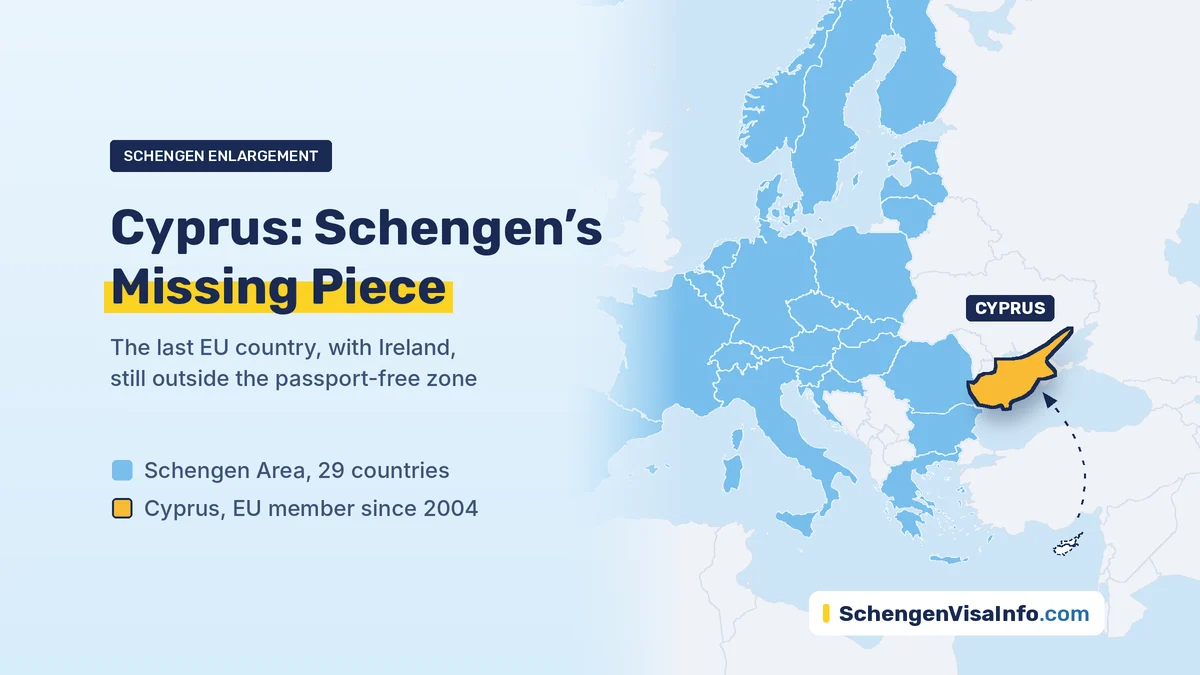
The Greek government has set July 1, 2027, as the target date for Cyprus to become the 30th member of the Schengen Area, according to statements highlighted by President Nikos Christodoulides in late 2026. This ambitious timeline coincides with Greece taking over the rotating presidency of the Council of the European Union on the exact same day.
Cyprus has been a member of the European Union since May 2004, yet it remains outside the passport-free Schengen Area. This exclusion has been primarily due to the island’s ongoing political division and the existence of the Green Line, which separates the areas controlled by the Republic of Cyprus from the north. Following the full integration of Romania and Bulgaria into the zone in January 2025, Cyprus and Ireland stand as the only two EU member states remaining outside the borderless area. However, momentum has steadily built toward full integration following years of technical upgrades, administrative reforms, and high-level diplomatic efforts.
Greece Aims for Cyprus to Join Schengen on July 1, 2027, Christodoulides Says
President Christodoulides noted that initial objections from various EU member states "have been largely overcome," although a few countries remain unconvinced and require further reassurance. Addressing domestic and regional sensitivities, the Cypriot President emphasized that Turkish Cypriots and members of their families who possess the legal right to use the island’s crossing points "will not be affected" by the transition into the Schengen framework.
According to reports outlining the technical preparations, a specialized control mechanism at Larnaca and Paphos airports will be established to handle the implementation of the European Union’s Entry/Exit System. These logistical details form part of Nicosia’s broader strategy to align completely with European border management standards before the target accession date.
Cyprus Says Schengen Entry Will Not Change Who Can Use the Crossing Points
Addressing local concerns, Cyprus’s Foreign Minister Constantinos Kombos informed the House finance committee that joining the Schengen Area will not alter the established rules regarding who is permitted to cross between the two sides of the island. Kombos stressed that crossing regulations are governed by existing EU legislation that will not undergo structural changes simply due to accession. Consequently, anyone currently entitled to pass through the government-controlled areas will retain that right.
Kombos clarified that while certain controls implemented at these points pertain strictly to security and personal identification, "this does not mean that they are border-type controls." He acknowledged that managing the crossing points remains a deeply complex political and administrative issue. Meanwhile, international political backing has continued to grow; the European People’s Party stated at a summit of its leaders that it firmly supports "the timely completion of the remaining steps" required for Cyprus to finalize its integration.
Cyprus’s Schengen Accession Left Off EU Interior Ministers’ Agenda
Despite positive momentum, Cyprus’s formal accession to the Schengen zone was not included on the official agenda for the EU Justice and Home Affairs Council meeting held in Luxembourg. Officials in Brussels noted that while member states are fully aware of the ongoing technical work and substantial progress made by Nicosia, formal advancement requires unanimous agreement among all countries currently participating in the Schengen zone.
Furthermore, political debates persist regarding the government’s position that the EU Entry/Exit System will not apply at the nine crossing points spanning the Green Line. Concurrently, local political figures, including Turkish Cypriot leader Tufan Erhürman, have publicly called for Turkish Cypriots to be meaningfully involved in the broader accession process.
European Commission Gives Positive Assessment of Cyprus’s Schengen Readiness
The European Commission adopted a formal report evaluating Cyprus’s application to join the Schengen Area, delivering a highly positive assessment of the nation’s overall preparedness. The evaluation built directly upon a comprehensive Schengen monitoring visit conducted by EU experts in Cyprus.
While Commission spokespersons reiterated that final decisions regarding the exact timeline and method of accession rest entirely with the Council of the EU, high-ranking officials have offered strong political backing. European Commission President Ursula von der Leyen voiced support for integrating Cyprus into the zone "as soon as possible." The primary unresolved technical discussion continues to center on the operational mechanics of the Entry/Exit System along the Green Line demarcation.
EU’s 2026 State of Schengen Report Calls for Completing Cyprus’s Accession
The European Commission’s State of Schengen report explicitly listed the completion of Cyprus’s accession among the core EU-level priorities for the upcoming period. Highlighting the monitoring activities conducted by Brussels, the report emphasized that "substantial progress was made," with Cypriot authorities successfully implementing rigorous reforms and legislative measures that align closely with strict Schengen benchmarks. The Commission also noted that Cyprus provides a unique and valuable contribution to the collective awareness of security risks in the Eastern Mediterranean region.
Schengen Accession Would Boost Cyprus’s National Security, President Says
Reflecting on the strategic rationale behind the push for integration, President Christodoulides asserted that joining the Schengen zone would significantly enhance the nation’s security architecture. He recalled that when Cyprus initially applied for EU membership and later sought deeper integration, skepticism and warnings were voiced by critics claiming such steps would lead toward permanent partition.
Dismissing these fears, Christodoulides maintained that the government possesses a clear, structured roadmap designed to achieve full Schengen membership without creating a hard internal border. Instead, he argued, participation reinforces the safety and security of the country—an obligation the state owes directly to its citizens.
Cyprus Will Join Schengen in 2026, President Christodoulides Says
Setting an earlier internal target, President Christodoulides previously emphasized the massive national effort dedicated to fulfilling all technical prerequisites. He stated that the state aimed to conclude all technical requirements by the end of 2025 to position the country for formal entry. Describing the initiative as a strategic development for both Cyprus and the wider European Union, Christodoulides stressed the importance of institutional cooperation, including support from the European Parliament following discussions with its leadership.
Schengen Area Membership Path for Cyprus Outlined
Before crossing the threshold into the Schengen zone, Cyprus was tasked with satisfying specific benchmarks outlined by European evaluators. These requirements focused heavily on upgrading information technology systems to connect seamlessly with the Schengen Information System (SIS), strengthening external border surveillance, and maintaining robust international cooperation.

A dedicated central coordination group—comprising representatives from the foreign, justice, defense, transport, and migration ministries—was established within the government to accelerate reforms. Particular emphasis has been placed on the effective supervision of the Green Line to prevent irregular crossings, alongside the rigorous enforcement of the Schengen acquis concerning common visa policies and the return of irregular migrants. Statistical data from national police forces indicated that thousands of irregular migrants were successfully returned to their countries of origin as part of these broader compliance efforts.
Cyprus Advances on Schengen Accession Path Over Past 2 Years
European Commissioner for Internal Affairs Magnus Brunner acknowledged the steady progress demonstrated by Nicosia. Financial support from the European Union played a critical role in these advancements, with over €292 million allocated to Cyprus under funding programs dedicated to border management, migration, and police cooperation. These funds supported the construction of modern reception centers, enhanced maritime surveillance capabilities, and reinforced digital infrastructure.
Foreign Minister Constantinos Kombos characterized Schengen membership as a top political priority, while conceding that the remaining hurdles were among the most delicate. Emphasizing a disciplined and low-profile approach, Kombos noted that the government’s consistent implementation of reform recommendations yielded encouraging evaluations from European authorities.
Cyprus Aims for Schengen Area Accession by End of 2025
As diplomatic and technical preparations accelerated, President Christodoulides reiterated that Nicosia had systematically addressed the political complexities surrounding the ceasefire line while finalizing operational details. Government officials emphasized that joining the passport-free zone would provide a major economic boost, particularly by facilitating tourism, which remains a vital pillar of the Cypriot economy.
Although the Schengen Information System became fully operational in Cyprus in July 2023, the formal evaluation procedure remained subject to the unanimous political will of the Council. With Romania and Bulgaria successfully achieving full Schengen status, Cyprus remained alongside Ireland as the remaining EU states awaiting complete integration into the zone.
Cyprus Aspires to Join Schengen Area in 2024
Earlier in the diplomatic process, Foreign Minister Kombos outlined Schengen accession as a central pillar of the ministry’s annual action plan. While noting that the primary foreign policy objective remained contributing to a comprehensive resolution of the Cyprus problem, the government pursued parallel technical tracks to meet European standards. Although citizens of EU member states and EFTA nations already enjoyed visa-free travel to Cyprus, local authorities viewed full Schengen integration as the logical culmination of the island’s European integration process, alongside pursuing entry into the United States Visa Waiver Program.
Cyprus to Join Schengen Information System From July 25
A major milestone in Cyprus’s security integration occurred when the country officially connected to the Schengen Information System (SIS). The integration allowed Cypriot police, customs, and immigration authorities to share real-time security alerts regarding missing persons, stolen property, and cross-border criminal suspects.
Managed in cooperation with eu-LISA, the integration provided national law enforcement agencies with a vital tool to counter transnational crime. Officials at the Cyprus SIRENE bureau emphasized that access to the database acts as a necessary counterbalance to the security challenges associated with modern mobility, significantly enhancing investigative capabilities well in advance of full territorial membership in the Schengen zone.
Cyprus Wants Access to EU’s Schengen Information System in 2023 in Bid to Strengthen Its Borders
The push for SIS access intensified during meetings of the EU Justice and Home Affairs Council, where Cypriot ministers underscored the necessity of robust border tools in the wake of shifting regional security dynamics. Cypriot officials argued that integrating into major EU security databases not only protected national borders but also strengthened the collective security of all member states by plugging intelligence gaps and improving police cooperation.
EP Approves Cyprus Access to Schengen Information System
The European Parliament formally approved recommendations allowing Cyprus to apply provisions of the Schengen Information System. Lawmakers emphasized that this operational step was legally distinct from full accession to the borderless travel zone. Because of the island’s unique territorial circumstances under Protocol 10 of the 2003 Act of Accession, specific restrictions on SIS usage were maintained along the Green Line until a final Council decision regarding the full application of the Schengen acquis could be reached.
EU: Cyprus Not Ready to Join Schengen Zone
Earlier evaluations by high-ranking European Commission officials underscored the distinct challenges facing the island nation. While neighboring countries advanced through the enlargement pipeline, EU representatives pointed out that the complex realities of the Green Line required a measured and methodical approach. Despite these cautious assessments, Brussels consistently recognized Cyprus as an active candidate progressing through the necessary evaluation stages.
Cyprus Meets Schengen Requirements for Personal Data Protection
The formal evaluation process gained early momentum when independent European experts verified that Cyprus fully complied with strict Schengen requirements regarding personal data protection. The successful assessment of the Personal Data Protection Committee cleared the path for subsequent evaluations covering external border management, police cooperation, visa issuance, and return procedures. Foreign Minister Nikos Christodoulides highlighted at the time that meeting these stringent standards marked an essential step toward securing the administrative and operational framework required for future membership.
Cyprus MFA: We Applied for Schengen Membership in September
The formal journey toward Schengen integration advanced when the government of Cyprus officially submitted its application to the European Union. Presenting the national budget to the House Committee on Finance, Foreign Minister Christodoulides announced that Nicosia had formally declared its readiness to begin the multi-stage evaluation process.
Emphasizing that the decision was driven primarily by national security imperatives, the government sought to integrate fully into the European security architecture. Although historical and territorial divisions stemming from the events of 1974 presented unique obstacles, the submission of the application laid the groundwork for decades of subsequent technical alignment, legislative reform, and diplomatic persistence that now point toward a targeted accession date in July 2027.
| Source | : | Open Passport |
| Author | : | Layla Zulfa |
| Editor | : | Open Passport Editorial Team |
