
EU Council Endorses Procedure to Open Visa-Free Travel Path for Five Gulf States
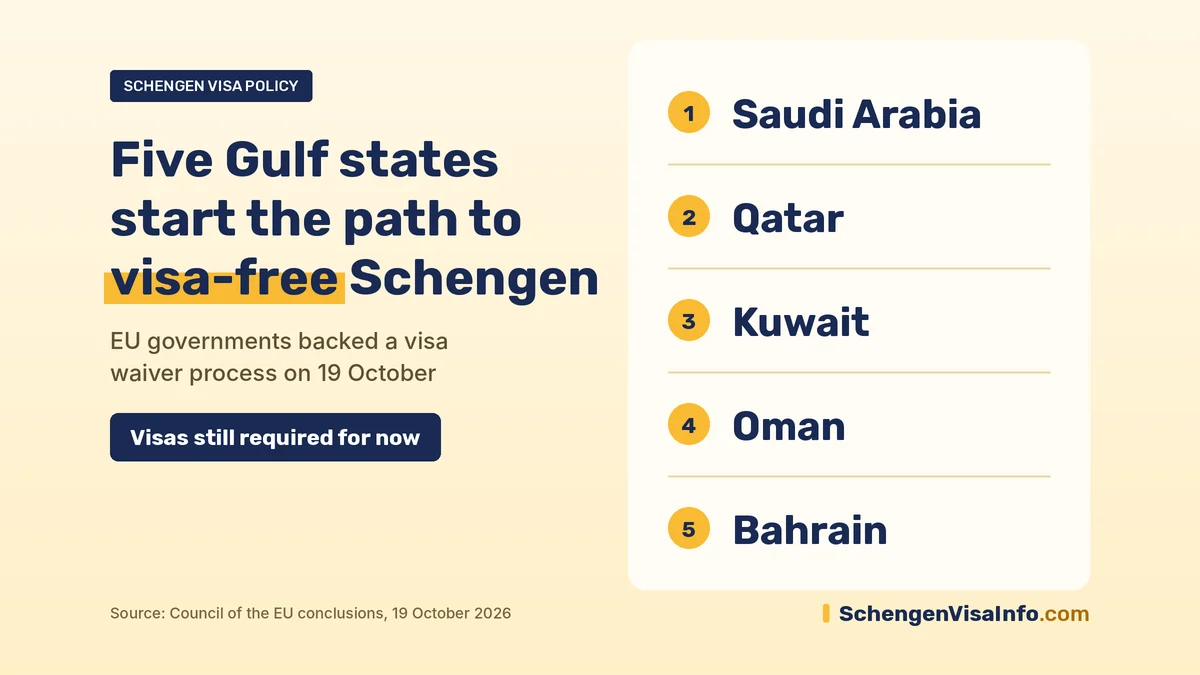
The Council of the European Union has formally endorsed a procedure that could eventually allow citizens of Saudi Arabia, Qatar, Kuwait, Oman, and Bahrain to enjoy visa-free access to the Schengen area.
In a series of five conclusions adopted on October 19, 2026, EU governments welcomed the European Commission’s decision to initiate a dedicated "visa waiver process" with each of the five nations belonging to the Gulf Cooperation Council (GCC). However, the Council made it abundantly clear that no visa obligations will be lifted until every established condition and benchmark is fully met. For the time being, citizens of all five countries remain required to obtain a Schengen visa for short stays in Europe.
What the EU Decided on October 19
The Council approved five nearly identical legal texts, tailored specifically for each participating nation. Each text consists of a concise single paragraph in which the Council welcomes the Commission’s intention to launch the visa waiver process. Crucially, the texts explicitly ask the Commission to "fully associate the Council and the Member States with each step of the process." The overarching condition remains uniform across all five tracks: the possibility of lifting the visa requirement will only be considered upon the complete and verifiable fulfillment of all necessary benchmarks.
While the formal texts omit specific details on how these benchmarks will be determined or a timeline for their completion, the decision aligns all five Gulf states on a synchronized starting block.
"We are starting at the same time, but we will complete the process individually depending on our own progress," GCC Secretary-General Jasem Mohamed Albudaiwi told Arab News in an exclusive interview shortly before the Council’s decision. He added that the region was "very close to reaching the beginning of the process to waive the Schengen visa for GCC citizens."
The milestone was initially slated to take center stage at the second EU-GCC summit scheduled for October 24 in Riyadh. However, the European Council announced on October 15 that the summit had been postponed, with a new date to be determined at an appropriate time. According to The National, the postponement
was requested by the Gulf states following security concerns, specifically Houthi rebel attacks on Saudi Arabia and the temporary disruption of operations at King Khalid International Airport.
What Has Not Changed for Travellers
Despite the forward momentum on diplomatic fronts, day-to-day realities for travellers remain unchanged. Citizens of Saudi Arabia, Qatar, Kuwait, Oman, and Bahrain must still apply for a traditional Schengen visa prior to their journeys. Many of these travellers, however, already benefit from some of the most accommodating visa facilitation rules administered by the European Union anywhere in the world.
Under specific European Commission decisions adopted for Kuwait in September 2023, and subsequently for Saudi Arabia, Oman, and Bahrain in April 2024, eligible nationals applying from within their home countries can receive multiple-entry visas valid for up to five years, even on their first application. Qatari nationals have enjoyed comparable adapted multiple-entry privileges since January 2022.
These facilitative rules apply exclusively to citizens of those specific countries who apply within their home jurisdictions. Third-country nationals residing in the Gulf—including citizens of neighboring GCC countries living outside their home states—continue to fall under standard Schengen visa regulations. Furthermore, all approved travellers remain strictly bound by the statutory 90/180-day rule for short stays and must complete registration in the automated Entry/Exit System (EES) upon crossing the external borders of the Schengen zone.
Demand for Schengen Visas Across the Region
Travel demand from the Gulf has expanded significantly, surpassing pre-pandemic volumes. Consular missions across the five countries received a combined total of 881,901 visa applications in 2025, according to European Commission figures compiled via SchengenVisaInfo. Saudi Arabia accounted for the lion’s share of this demand, driving 553,967 applications, or roughly 62.8 percent of the regional total.
Individual application numbers varied across the other states. Kuwait recorded 146,194 applications in 2025, representing a 10.5 percent decrease compared to 2019 levels, while Qatar saw 102,930 applications, marking an 8.5 percent increase over the same comparative period. Oman registered 53,700 applications, up 33.4 percent since 2019, and Bahrain accounted for 25,110 applications, reflecting a modest 1.7 percent increase.
Refusal rates also showed notable variation across local consulates in 2025. Saudi Arabia recorded a refusal rate of 5.17 percent, while Kuwait stood at 5.69 percent. Higher refusal rates were registered in Oman at 10.53 percent, Bahrain at 10.71 percent, and Qatar at 15.08 percent.
However, immigration analysts emphasize that these consulate-level figures do not accurately reflect the true refusal rates of individual nationalities. Because EU statistics are categorized by the location where an application is lodged rather than the applicant’s citizenship, consulates in major Gulf business and transit hubs frequently process applications from a large volume of foreign resident expatriates. For instance, while citizens of the United Arab Emirates have enjoyed visa-free travel to the Schengen area since 2015, consulates based in the UAE still handled 298,064 visa applications in 2025 from resident foreign nationals, resulting in a 24.17 percent refusal rate for those specific local filings.
France remains by far the single most popular European destination for travellers applying from the region. Its diplomatic missions in Saudi Arabia alone processed 234,331 applications in 2025, accounting for 42.3 percent of all filings in the Kingdom. Across the entire year, consulates located within Saudi Arabia issued 521,996 visas—averaging approximately 1,430 approvals every single day.
As part of its broader EU visa policy strategy, the European Commission has signaled an intent to leverage visa refusal rates as a key benchmark for determining when partner nations are fully prepared for unconditional visa-free travel. Internal policy discussions have pointed toward an indicative threshold of maintaining a refusal rate below three percent for a country’s own nationals applying at domestic consulates, though these specific criteria remain part of ongoing administrative evaluations.
The Unfinished 2022 Proposal and the Path Ahead
This year’s Council endorsement is not the European Union’s first legislative attempt to address travel rules for the region. On April 27, 2022, the European Commission formally proposed granting visa-free travel to citizens of Kuwait and Qatar while initiating exploratory technical talks with the remaining Gulf states. EU member states subsequently agreed on a formal negotiating mandate on June 29, 2022, insisting that any final exemption must be contingent upon reciprocal bilateral agreements for EU citizens and the full operational launch of the European Travel Information and Authorisation System (ETIAS).
That legislative momentum stalled later that year. On December 1, 2022, the European Parliament’s civil liberties committee approved a report that would have expanded the proposed visa-free list to include Oman alongside Ecuador, while attaching specific human rights conditions for Kuwait. Just days later, the "Qatargate" corruption scandal erupted, prompting members of the European Parliament to vote on December 12, 2022, to send the entire legislative file back to committee. The underlying procedure remains officially listed as awaiting the Parliament’s first-reading position.
The October 2026 Council conclusions did not clarify whether the Commission intends to revive, amend, or formally withdraw the stalled 2022 proposal in favor of a unified legislative framework encompassing all five Gulf nations simultaneously.
If and when visa-free travel is eventually granted, Gulf travellers will be subject to the same pre-travel authorization requirements as other visa-exempt visitors to Europe. Once ETIAS becomes operational—a system that has experienced successive delays and currently lacks a confirmed launch date—eligible citizens from the region will be required to obtain an online travel authorization before boarding flights to the Schengen area.
Until the European Commission formally publishes the required benchmarks and individual progress reviews, no definitive timeline can be established for the completion of the waiver process. For now, citizens of Saudi Arabia, Qatar, Kuwait, Oman, and Bahrain are advised to continue following existing travel protocols, ensuring they apply for standard Schengen visas through proper diplomatic channels and requesting five-year multiple-entry permits where eligible.
| Source | : | Open Passport |
| Author | : | Pevita Pearce |
| Editor | : | Open Passport Editorial Team |
