
Eight Schengen Nations Maintain Temporary Internal Border Controls Despite EU Pressure to Phase Them Out
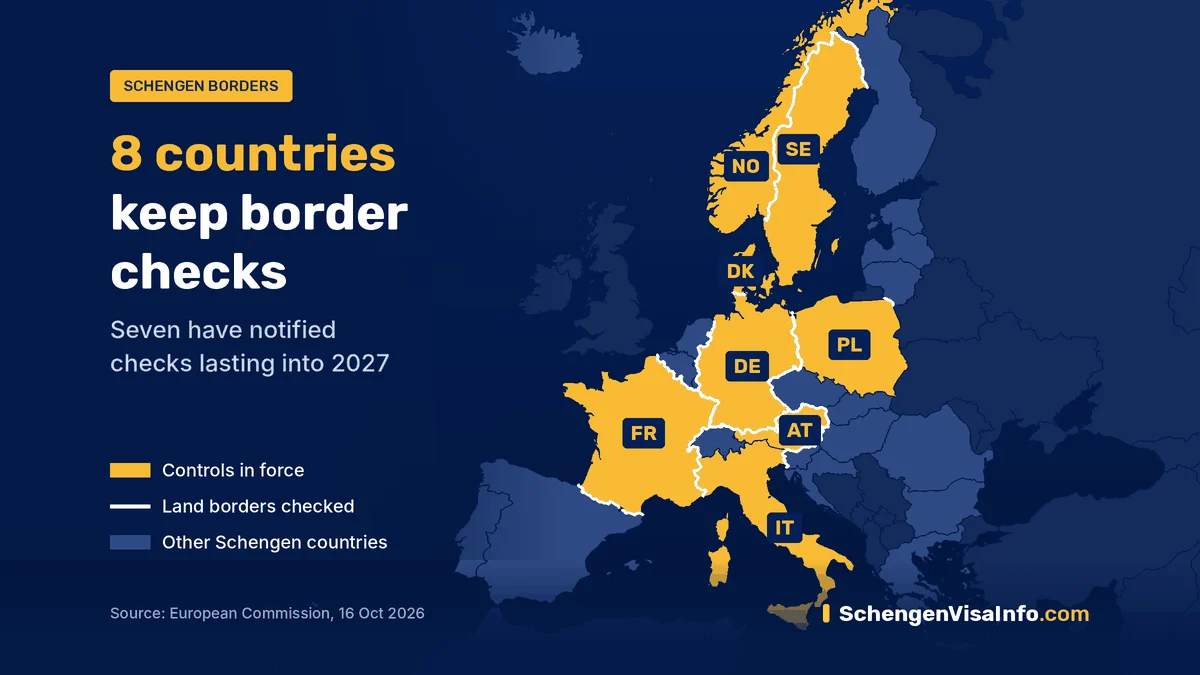
Eight nations within Europe’s passport-free Schengen area are continuing to enforce temporary controls at some or all of their internal borders, defying a push from Brussels to dismantle the checks. Data compiled from the European Commission’s official notifications reveals that while the overall map of restricted crossings is contracting slightly, the majority of participating governments have already locked in extensions that will stretch well into 2027.
The ongoing measures highlight a persistent tension between national security concerns and the foundational European Union principle of free movement. Nordic governments, in particular, have formalized plans to prolong their restrictions, even as the European Commission maintains that alternative policing methods and newly reinforced external EU borders render these internal measures redundant.
According to the latest tracking data, Denmark, Norway, and Sweden have officially notified the European Commission of new six-month extension periods. These renewals will run from 12 November 2026 through 11 May 2027. This data is drawn from official Member State notifications and analyzed via the SchengenVisaInfo Border Controls Checker, a public tracking resource that monitors active restrictions, expiration dates, and upcoming government filings across the bloc.
These renewals come roughly five months after the European Commission issued formal opinions urging this exact group of nations to establish timelines for phasing out internal border checks. Despite Brussels’ admonitions, the list of participating countries remains substantial, though it has seen minor reductions. Notably, the Netherlands allowed its temporary controls to lapse at the end of September. Meanwhile, Italy and Spain have successfully wound down the retaliatory checks on flights and ferries that they had imposed on one another following a diplomatic standoff sparked by the Ceuta crisis during the summer.
Where Travellers Can Expect Border Checks
The geographical scope of these temporary controls varies widely from country to country, a factor that carries immense practical significance for travellers navigating the region.
Austria currently enforces controls along its land and river borders with Slovakia, as well as its land borders with Czechia, Hungary, and Slovenia, with these measures authorized until 15 March 2027. Denmark maintains checks along its land and sea borders with Germany, which are now set to run through 11 May 2027 following the latest Nordic notification.
France has opted for the most comprehensive internal oversight possible, keeping controls active across all of its land, air, and sea borders shared with Belgium, Germany, Luxembourg, Switzerland, Spain, and Italy until 30 April 2027. Germany similarly enforces controls across all nine of its land borders—touching France, Luxembourg, Belgium, the Netherlands, Denmark, Austria, Switzerland, the Czech Republic, and Poland—under authorizations lasting until 15 March 2027.
Other nations have maintained a more targeted approach. Italy restricts its temporary checks exclusively to its land border with Slovenia until 18 December 2026. Poland limits its oversight to land borders shared with Germany and Lithuania until 30 March 2027. Norway restricts its measures entirely to ports featuring ferry connections to the wider Schengen area, meaning a motorist driving across the land border from Sweden into Norway will not encounter Norwegian border personnel. Finally, Sweden mirrors France by enforcing comprehensive controls across all internal air, land, and sea routes, alongside its specific land border with Denmark, with renewals extending to 11 May 2027.
The Nordic Renewals and Changing Rationales
The synchronized filings from Denmark, Norway, and Sweden underscore how the justifications for internal border checks have evolved significantly over the past decade. The initial wave of emergency checks implemented by Sweden and Denmark was largely triggered by the 2015 European refugee crisis. Today, however, the official rationales cited by these Nordic capitals reflect a much broader array of contemporary geopolitical and security anxieties.
Denmark currently points to persistent risks of terrorism, sabotage, and transnational organized crime along its German frontier. Norway justifies its port-based checks by highlighting severe threats to its national energy infrastructure and potential sabotage operations, linking these risks in previous filings to the activities of foreign intelligence services. Sweden’s comprehensive notifications cite a multitude of factors, including organized cross-border criminality, hybrid and Russia-related threats, the instrumentalization of migrants as a political pressure tactic, and fallout from the events in Ceuta.
Despite these articulated threats, Sweden remains a prime target of European Commission scrutiny. In June, the Commission issued a formal opinion evaluating Sweden’s border management strategy. Brussels argued that domestic police checks—enabled by legislation Stockholm passed in 2023—provide a legally sound and potentially more effective mechanism for maintaining internal security without disrupting commerce and travel. The Commission explicitly concluded that Sweden should work toward phasing out controls at its internal borders. Nevertheless, Stockholm has proceeded with a renewal that will keep the restrictions in place until mid-2027.
The European Commission’s Stance on Necessity and Proportionality
Under the governance of the Schengen Borders Code, the European Commission holds the statutory obligation to assess whether internal border controls remain strictly necessary and proportional when a member state maintains them for more than twelve consecutive months on the same legal grounds.
On 2 June 2026, the Commission exercised this authority by releasing official opinions on the controls operated by Austria, Denmark, France, Germany, Italy, the Netherlands, Norway, Slovenia, and Sweden. The assessment directed at Germany highlighted that Berlin’s notifications lacked detailed risk assessments and failed to justify why comprehensive controls were required simultaneously across every single land border, particularly given that overall migration pressure had noticeably subsided. The Commission concluded that German authorities should gradually dismantle internal restrictions and lean instead on non-systematic police operations within border regions.
Magnus Brunner, the EU Commissioner for Internal Affairs and Migration, reinforced this message during a press conference following the release of the opinions. Highlighting the broader security architecture of the bloc, Brunner noted that member states are now fully equipped to begin winding down internal barriers. He pointed specifically to the full operational rollout of the Entry/Exit System at the bloc’s external borders, which reached completion in April, alongside the implementation of the European Union’s sweeping new asylum and migration rules that took effect in June.
While these Commission opinions carry significant political and legal weight, they are not legally binding. Consequently, member states retain the autonomy to disregard the recommendations. Germany capitalized on this flexibility by notifying the Commission of another six-month extension in August, pushing its end date to March 2027. France, Austria, and Poland have similarly pushed ahead with renewals despite the Commission’s cautionary stance.
Historical Context and Regulatory Frameworks
The Schengen Borders Code explicitly frames internal border controls as an extraordinary measure of last resort that must remain strictly temporary. Following the comprehensive 2024 reform of the code, governments responding to a foreseeable threat are permitted to notify controls for initial periods of up to six months, with the understanding that such measures should not exceed a cumulative duration of two years.
In extraordinary circumstances defined by the amending regulation as "a major exceptional situation," a country may be granted additional extensions totaling up to one year. Despite these statutory guardrails, several member states have effectively bypassed the spirit of the two-year limit by continuously submitting new notifications tied to newly emerging security threats or shifting geopolitical justifications.
Historical data compiled from the European Commission’s registry indicates that member states have transmitted a total of 515 notifications since the very first filing was submitted by France in October 2006. The vast majority of these actions—all but 35—date from 2015 onward, illustrating a structural shift toward normalized emergency management within the passport-free zone.
What It Means for Travellers
For the average traveller, the existence of these controls does not equate to a return to full-scale, systematic passport inspections at every frontier. Instead, authorities generally rely on targeted spot checks and intelligence-led profiling. The vast majority of motorists and train passengers cross internal borders without interruption, though anyone can be pulled aside and legally required to present valid identification.
It is also important to distinguish these internal border measures from the bloc’s broader technological upgrades. Internal border checks operate independently of the Entry/Exit System. Travellers are registered in the EES exclusively when crossing external Schengen borders—such as arriving from outside the EU—rather than when moving freely between participating internal countries.
Looking Ahead
The coming months will present a series of critical regulatory test cases for the future of the Schengen area. The immediate deadline arrives on 18 December 2026, when Italy’s long-standing controls at the Slovenian border are scheduled to expire. Italy has maintained these specific checks without interruption since October 2023, and as of the publication of the Commission’s latest tracking list, Rome had not yet filed an official extension.
As the calendar turns to the spring of 2027, a substantial cluster of authorization end dates will converge. Austria and Germany face expiration deadlines on 15 March, followed by Poland on 30 March, France on 30 April, and the Nordic coalition of Denmark, Norway, and Sweden on 11 May.
For each of these governments, the impending deadlines will force a formal legal and political reckoning. Officials will be required to decide whether to push for further renewals and, in cases where controls have stretched past the one-year mark, provide the European Commission with renewed justifications as to why routine domestic police operations remain insufficient to guarantee national security.
| Source | : | Open Passport |
| Author | : | Siti Muinah |
| Editor | : | Open Passport Editorial Team |
