
Schengen Visas Issued in Russia Rise for Second Consecutive Year Despite Post-Invasion Restrictions
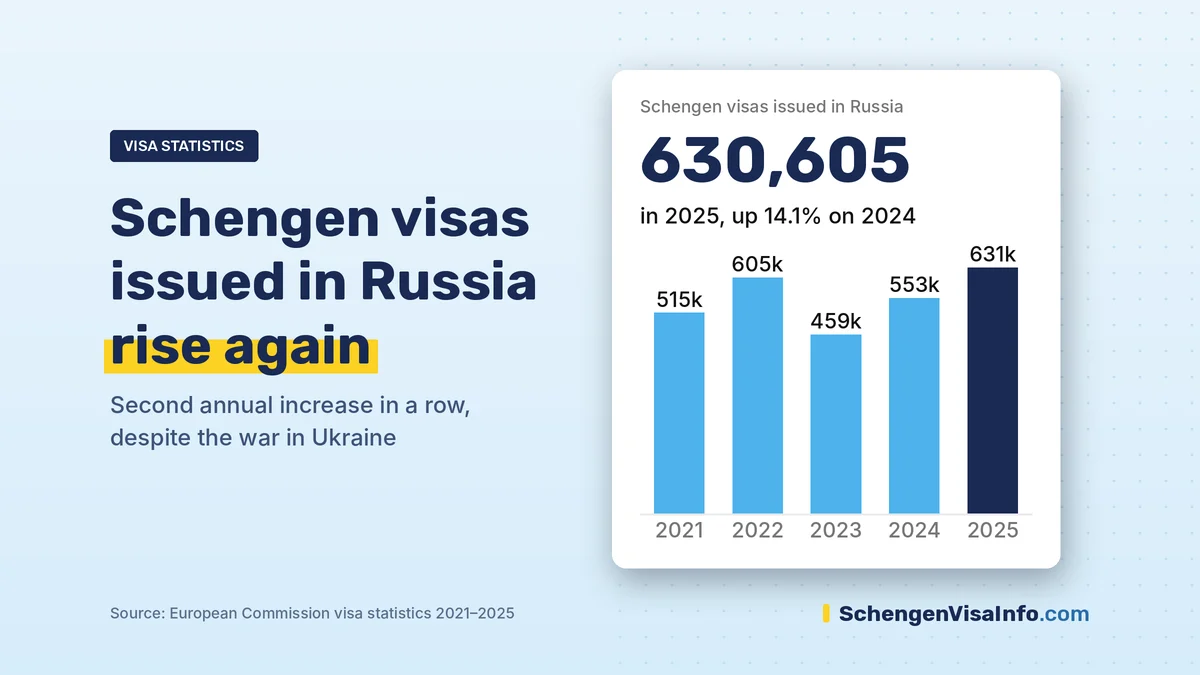
Schengen area countries issued 630,605 short-stay visas at their diplomatic missions and consulates across Russia over the course of 2025, marking a 14.1 per cent increase compared to the previous year. According to European Commission figures analyzed by SchengenVisaInfo.com, this represents the second annual increase in a row, highlighting a steady upward trajectory in visa issuance nearly four years after Moscow launched its full-scale invasion of Ukraine.
Despite the geopolitical fallout, economic sanctions, and sweeping travel restrictions enacted since early 2022, Russian citizens managed to secure more Schengen visas last year than they did in 2021, which was the final full calendar year before the outbreak of the war. A handful of nations—specifically Italy, France, Spain, and Greece—dominated the processing landscape, issuing roughly four out of every five short-stay permits granted in the country.
How Many Schengen Visas Were Issued in Russia in 2025?
During 2025, Schengen consulates operating within Russia received a total of 679,425 applications for short-stay visas, representing a 12 per cent increase in demand compared to the preceding year. Out of these submissions, authorities approved 630,605 visas while formally refusing 42,953 applications, based on the European Commission’s official visa statistics published on May 28, 2026. This translates to an average of approximately 1,700 visas approved for every single day of the year.
Global historical data from the SchengenVisaInfo.com statistics hub, which tracks European Commission metrics dating back to 2014, reveals that only three countries globally lodged more Schengen applications than Russia in 2025. This maintains Russia’s historical standing as a major source of visa demand, even though it has fallen considerably from its pre-pandemic peak. For context, throughout 2019, 2020, and 2021, Russia stood as the single largest source of Schengen visa applications anywhere in the world.
Industry analysts emphasize that these figures measure individual application events and consular decisions rather than unique individual travelers. A single applicant may submit multiple requests within the same 12-month period, and the possession of an approved visa does not automatically guarantee that the holder completed a journey. Furthermore, the total tally of issued permits includes documents with limited territorial validity, which restrict the traveler’s movement to only a specific subset of Schengen member states.
How Visa Issuance Has Changed Since Russia Invaded Ukraine
The landscape of European travel for Russian citizens has shifted dramatically, moving in two distinct directions depending on the baseline year used for comparison. Measured against 2019—the final normal travel year prior to the global health crisis and the war—the number of Schengen visas issued within Russia has plunged by 84.5 per cent. However, when measured against the post-invasion low point recorded in 2023, issuance figures have rebounded by 37.3 per cent over a span of two years.
Contextualizing these milestones requires careful consideration of historical disruptions. Travel volumes throughout 2021 remained heavily suppressed by lingering public health restrictions stemming from the COVID-19 pandemic. Consequently, the fact that 2025 issuance numbers surpassed 2021 levels speaks more to a steady recovery from a profoundly depressed base than to any genuine return to pre-war diplomatic and operational normality. Similarly, the 2022 data reflects a hybrid reality, combining the period of normalcy before the February 24 invasion with the subsequent months leading up to September 2022, when the European Union officially suspended its landmark visa facilitation agreement with Moscow.
The most telling trend emerges from the trajectory established after 2023. Following the initial wave of punitive restrictions and tightening measures, annual visa issuance dropped to a trough of 459,198. From that point, figures climbed by 20.3 per cent in 2024 before registering the subsequent 14.1 per cent growth in 2025, driven by a surge in demand that outpaced the rate of official refusals.
Which Schengen Countries Issue the Most Visas in Russia?
Southern European destinations have firmly taken the lead in processing and granting travel permissions for applicants in Russia. Italy emerged as the top issuer of Schengen visas in the country for 2025, closely followed by France and Spain. Alongside Greece, these four Mediterranean and Southern European nations accounted for a staggering 79.9 per cent of all short-stay visas granted across Russian consular posts.
Among the major players, France experienced the most notable shift in market share. In 2019, France captured 12.1 per cent of all applications lodged in Russia; by 2025, that share had surged to 24.7 per cent, placing it nearly neck-and-neck with Italy. France also maintained the lowest rejection rate among the prominent trio of issuing nations at 3.47 per cent, marking a 3.6 percentage point decrease from 2024. In contrast, Spain maintained a significantly stricter posture, refusing more than twice as many applicants with a rejection rate of 9.29 per cent.
Meanwhile, Bulgaria entered the statistical rankings as a newcomer following its integration into the broader Schengen architecture. Having begun issuing Schengen visas upon joining the open-borders zone in March 2024 before becoming a full member on January 1, 2025, Bulgarian consulates in Russia issued 26,025 visas during the year. This volume outpaced traditional heavyweights such as Germany, which issued 23,618 visas.
The Countries That Almost Stopped Issuing Visas
At the opposite end of the diplomatic spectrum, Russia’s immediate European neighbors have drastically curtailed or effectively halted consular processing for tourists. Prior to the pandemic, Finland’s consular network in Russia handled more Schengen applications than any other nation, pulling in an astonishing 786,425 applications in 2019, which accounted for 19.0 per cent of the global total originating in Russia. By 2025, that figure had cratered to just 4,148 applications.
A similar collapse occurred across the Baltic states. Estonia, Latvia, and Lithuania combined received over 290,000 applications in 2019; by 2025, their collective intake dwindled to a fraction of that volume. Countries such as Poland, Czechia, Sweden, and Norway each processed fewer than 200 applications inside Russia throughout the entirety of 2025.
This drastic reduction stems from sovereign national policy decisions rather than direct EU-wide legislation. Estonia, Latvia, Lithuania, and Poland collectively closed their external borders to Russian leisure travelers beginning September 19, 2022, denying entry even to individuals holding valid Schengen visas issued by other member states. Finland implemented a parallel national restriction on September 30, 2022. Consequently, while a visa issued by Italy or France remains formally valid across the broader Schengen space, frontline states refuse to honor land border crossings for Russian tourists.
How Many Russian Applications Are Being Rejected?
Consular rejection rates for applications filed within Russia spiked dramatically in the immediate aftermath of the 2022 invasion before entering a gradual decline. Having stood at 1.50 per cent in 2019 and 3.16 per cent in 2021, the rejection rate jumped to 10.21 per cent in 2022 and peaked at 10.57 per cent in 2023. It subsequently eased downward to 7.51 per cent in 2024 and further decreased to 6.38 per cent in 2025.
Despite this post-war elevation, the 2025 rejection rate for Russia remains less than half of the worldwide average for Schengen visa applications, which stood at 14.65 per cent during the same period. Rejection metrics varied widely depending on the specific consular post handling the paperwork. Malta recorded a refusal rate of 19.84 per cent in Russia for 2025, while Estonia stood at 17.36 per cent. Conversely, the Netherlands maintained a minimal refusal rate of just 0.86 per cent, and Luxembourg registered 3.10 per cent. Austria’s rejection rate experienced a sharp downward correction, falling from 22.8 per cent in 2024 to 9.8 per cent in 2025.
What Restrictions Has the EU Introduced for Russian Travellers?
No comprehensive, EU-wide ban exists prohibiting the issuance of Schengen visas to Russian nationals. Legal and structural limitations prevent the European Union from enacting a total prohibition under its current legislative framework. Instead, Brussels has systematically tightened administrative conditions through incremental policy updates.
Announcing a series of stricter multiple-entry visa regulations, Henna Virkkunen, the European Commission’s Executive Vice-President for Tech Sovereignty, Security and Democracy, noted that the bloc has consistently increased entry barriers for Russian citizens since the onset of the conflict. Because these updated multiple-entry rules took effect less than two months before the close of 2025, their operational impact was only marginally reflected in the year’s closing statistics. The full ramifications of these regulatory adjustments are anticipated to surface more visibly in the 2026 data.
A Growing Split Among Schengen Countries
Discrepancies in how national consulates interpret and apply the 2022 guidelines have fostered an ongoing policy debate within Europe. In June 2026, ministers from 11 European nations—comprising nine EU member states alongside Norway and Iceland—signed a joint letter initiated by Sweden. The communique advocated for stringent controls on tourist visas for Russian nationals and urged an end to practices described as "visa shopping," where applicants target more lenient consulates. Estonia’s interior minister, Igor Taro, summarized the sentiment by stating that the Schengen door needs to be closed more tightly.
The coalition, which also includes Denmark, Finland, the Netherlands, and Poland, voiced support for an Estonian proposal to bar individuals who have actively fought in Ukraine from entering the Schengen zone. Although regional ministers previously championed this concept in mid-2025, it has yet to be formally adopted into law.
The European Commission responded to the ministerial push shortly thereafter. Markus Lammert, a migration spokesperson for the Commission, told reporters that Brussels intends to propose targeted restrictive visa measures aimed at further mitigating security risks as part of an upcoming revision of the EU Visa Code. At the same time, the Commission has defended its broader administrative record, emphasizing to media outlets that the absolute volume of Schengen visas granted to Russians remains significantly lower than pre-war baselines, even as year-on-year issuance numbers show a modest post-trough recovery.
What the Figures Do Not Show
Published European Commission datasets categorize visa metrics by the geographical location of the consulate rather than the nationality of the applicant. While guidelines dictate that Russian citizens should normally submit applications from within Russia, these statistics also capture non-Russian nationals applying locally, while failing to account for Russian citizens who travel to third countries such as Turkey, Serbia, or Kazakhstan to file their paperwork.
This methodological distinction explains occasional discrepancies reported across international media. Alternative reporting based on leaked government data estimated total visas issued to Russian nationals globally at over 620,000 for 2025—marking a 10.2 per cent increase—while placing France in the top position rather than Italy. Nevertheless, the Commission’s publicly accessible dataset remains the benchmark for standardized tracking.
What Happens Next
The European Commission’s upcoming Visa Code proposal will determine whether the bloc transitions from non-binding guidance to legally enforced uniform restrictions. Until those regulatory reforms take shape, a Russian traveler’s ability to secure a short-stay Schengen visa continues to depend heavily on the discretionary policies of individual member state consulates.
| Source | : | Open Passport |
| Author | : | Pevita Pearce |
| Editor | : | Open Passport Editorial Team |
