
One Year After Military Coup, Rising Authoritarianism Dashes Madagascar’s Hopes for Reform
By Nciko wa Nciko
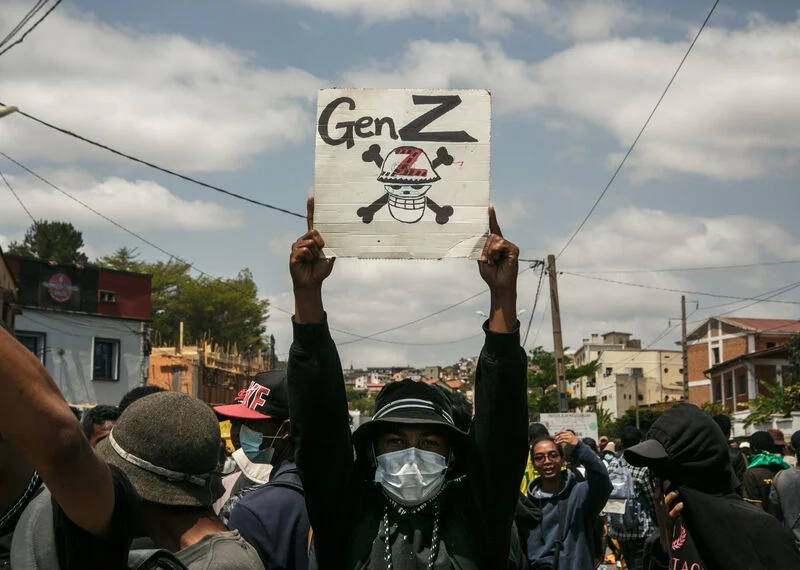
One year has passed since Colonel Michael Randrianirina seized power in a dramatic military coup, yet Madagascar finds itself remarkably far from the systemic refoundation that he once promised the nation. Instead, his inaugural year in office has been defined by the military’s aggressive consolidation of political power and a sweeping expansion of authoritarian practices that have left citizens disillusioned. News outlets and political observers alike have spent the past few weeks assessing Randrianirina’s turbulent first twelve months at the helm. Crucially, the deep-seated grievances and urgent demands that drove thousands of Gen Z protesters into the streets—most notably chronic, debilitating water and electricity shortages, alongside endemic, crippling corruption—remain entirely unresolved.
Just like his predecessor, Andry Rajoelina, Colonel Randrianirina has quickly and aggressively turned to the legal system to unduly consolidate power, suppress political dissent, and instrumentalize anti-corruption efforts as a weapon against his political opponents. Furthermore, his administration has actively utilized the law to shield itself from accountability regarding the lethal use of force against protesters, where security personnel killed and maimed citizens, as well as for ongoing state corruption. He has systematically weaponized the law to restrict fundamental civic space, frequently characterizing the right to freedom of association as a criminal conspiracy. Concurrently, his regime has attempted to secure sweeping online mass surveillance powers targeting dissenting voices, a move designed to make it exceedingly difficult for citizens and activists to critique the government’s profound mismanagement of public affairs.
Indeed, Randrianirina’s first year in office has been thoroughly characterized by the strategic deployment of state and legal institutions to target political opponents and critics while simultaneously fortifying his own grip on the nation. He has gone significantly further by invoking outdated “public security” laws alongside the national constitution to grant his regime sweeping, unchecked powers to conduct illegal searches and arbitrarily detain political opponents and critics alike. These unlawful, heavy-handed acts have almost exclusively been carried out under the convenient guise of a national anti-corruption campaign.
Yet, this heavily publicized fight against corruption has been applied with glaring selectivity, functioning primarily as a political weapon against those who challenge the regime. Former government officials, prominent political figures from the previous administration, and even their family members have faced relentless intimidation, illegal property searches, arbitrary detentions, and prolonged pretrial confinements. Today, dozens of these individuals have been forced into exile to escape persecution. At least twenty individuals remain arbitrarily detained today for transparently politically motivated reasons, a list that includes former presidential candidates Sylvain Rabetsaroana and Paul Rabary Andrianirina.
Randrianirina’s overarching pledge to tackle corruption—which was among the core demands raised by the Gen Z protesters—has been profoundly contradictory from its inception. Upon taking power, in a move that was initially welcomed by the public and international observers alike, he ordered the Court of Accounts to conduct a comprehensive audit of the management of public funds. However, he strategically limited this auditing exercise to public finances covering the period from 2022 to 2025. This deliberate restriction effectively shielded his own administration from accountability, as he came to power toward the very end of this targeted audit period.
The resulting audits successfully identified that hundreds of millions of United States dollars in public funds had been lost to grand corruption and institutional mismanagement. Tragically, rather than initiating transparent, independent investigations into these staggering losses, Randrianirina’s administration appears to be weaponizing the audit findings exclusively against political opponents in a calculated attempt to control and silence them. Meanwhile, total impunity for public security officials has remained another defining hallmark of Randrianirina’s administration. Extensive video footage clearly shows soldiers, police officers, and gendarmes shooting directly at peaceful protesters and innocent bystanders, killing and severely injuring them during the mass Gen Z demonstrations of September and October 2025.
To date, no meaningful investigations have followed these violent crackdowns. By failing to hold anyone accountable, the administration is sending an unmistakable message to public security officers that they remain entirely above the law, a strategy designed to ensure the unwavering loyalty of the security apparatus to the government. Demonstrating this alliance, Randrianirina elevated four highly ranked officials from the gendarmerie and the army to the political level of “head of state,” despite the complete lack of constitutional grounds to justify such a move. He has similarly populated key government positions with a network of present and former public security officials.
Moreover, the administration has consistently ignored core constitutional values and foundational principles of good governance in the appointment of government ministers, including individuals who are actively facing serious corruption allegations. In some astonishing instances, these official appointments have been determined by the results of polygraph examinations rather than through transparent, institutional processes rooted in the law that could otherwise guarantee accountability, integrity, and transparency.
The exorbitant salaries of these appointees, alongside the maintenance of the broader bureaucratic machinery, have swallowed the vast majority of the 2026 national budget. This massive expenditure has come at the direct expense of critical public investments into essential service delivery, such as reliable water, electricity, and public health infrastructure—the very issues that mobilized an entire nation to take to the streets last year. To put this severe misallocation into perspective, the public health sector received a mere six percent of the national budget. This equates to about five US dollars per person for an entire year—an allocation significantly lower than what was provided under the Rajoelina administration and roughly fifty times less than established international standards. Conversely, investment in Randrianirina’s personal security is estimated to run into millions of dollars, with the regime going so far as to deploy Russian security agents to personally safeguard Randrianirina and other high-ranking government officials.
Crackdown on Dissenting Voices
On the other side of this heavy-handed governance, civil society activists and other critical voices have found themselves directly in the crosshairs of the state. Gen Z activists have faced absurd accusations of criminal conspiracy to assassinate the President simply for communicating with opposition figures or discussing the government’s manifest failure to address pressing national grievances.
At least nine prominent Gen Z leaders were arbitrarily arrested in April for the benign act of participating in a WhatsApp group or for exchanging messages with a political opponent or whistleblower. Public security officers subjected several of these detained youths to acts that may amount to torture or other cruel, inhuman, and degrading treatment, including having revolvers forced down their throats. Today, three of these activists remain arbitrarily held in prolonged pretrial detention. Among them is Rakotoarijaona Mahery, who is currently being kept in deplorable conditions within one of the most overcrowded prison facilities in the entire country.
As a direct precondition for the potential release of their children, Randrianirina has personally pressured the parents of detained activists, demanding that they force their children to promise never to participate in protests again. These systematic efforts to punish peaceful protesters and severely restrict the fundamental right to freedom of peaceful assembly are working to shrink Madagascar’s civic space at an alarming rate.
Government critics are also facing routine harassment and targeted restrictions on their freedom to travel abroad, particularly those individuals who have attempted to engage with regional and international human rights organizations. This heavy-handed approach was clearly demonstrated in the case of Gabriella Ranjamalalasoa, the wife of one of the detained activists. She was arbitrarily detained by the Malagasy Police d’Enquetes Speciales at Ivato International Airport in the capital, Antananarivo, where officers confiscated her passport specifically to prevent her from boarding a flight to attend the 89th Ordinary Session of the African Commission on Human and Peoples’ Rights.
Techno-Authoritarianism
To further empower their efforts to unduly entrench political power and evade public accountability, the government is actively expanding its legal capabilities for surveillance and state repression. In August, the administration proposed a restrictive cybercrime law that would grant the state sweeping new powers to monitor all forms of online activity while simultaneously curtailing media freedom. Under this proposed legislation, anyone publicly criticizing the government would be legally required to back such opinions with actual and solid proof. Paradoxically, the authorities have flatly refused to pass a freedom of information law, which would not only facilitate the verification of facts but also enable vital public scrutiny and institutional transparency.
Even more troubling is that the proposed cybercrime law would grant the state permanent, unchecked access to the telecommunications data of individual citizens, completely bypassing judicial oversight and directly contravening the fundamental right to privacy.
Without clear, concerted regional and international pressure, Madagascar faces the grave risk of falling yet again into a familiar, destructive cycle of authoritarian practices. These tactics, deployed primarily to silence dissent and entrench a ruling elite, leave the genuine aspirations that originally fueled the historic Gen Z protests entirely unfulfilled.
Nciko wa Nciko is the Madagascar researcher for Amnesty International.
This opinion piece first ran in The Africa Report.
| Source | : | Open Passport |
| Author | : | Jia Lissa |
| Editor | : | Open Passport Editorial Team |
