
UK Foreign Office Issues Strict Travel Warnings for Cameroon Amid Escalating Regional Security Risks
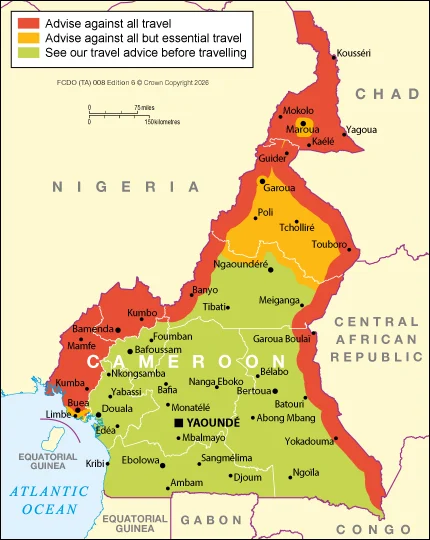
British travelers and expatriates planning trips to Cameroon are facing severe warnings from the UK government, with officials emphasizing that ignoring official guidance could completely invalidate travel insurance policies. The Foreign, Commonwealth & Development Office (FCDO) has updated its comprehensive advisory regarding the Central African nation, outlining specific regions and border zones where security risks are deemed critical. The updated directives highlight multiple areas where all travel, or all but essential travel, is strongly discouraged due to ongoing safety concerns, armed conflict, and localized security threats.
The updated advisory serves as a stark reminder to holidaymakers, business travelers, and individuals visiting family that venturing into high-risk territories carries profound personal and financial risks. Chief among these warnings is the status of insurance coverage. British citizens who choose to travel against the explicit advice of the FCDO will likely find their travel insurance policies invalidated, leaving them entirely financially exposed should they require medical evacuation, emergency healthcare, or rescue assistance while abroad.
Areas Where FCDO Advises Against Travel
The FCDO has instituted a blanket warning against all travel to several specific zones within Cameroon, citing high levels of danger.
At the top of the list is the Bakassi Peninsula, a historically contested and geographically complex region where the British government advises against all travel. Similarly, strict no-travel zones have been established along major international borders. The FCDO warns against all travel to any location within a 40-kilometer radius of Cameroon’s border with the Central African Republic (CAR) and its border with Chad.
Border regions shared with Nigeria are subjected to similarly rigorous restrictions. The FCDO advises against all travel to any area within 40 kilometers of the Nigerian border, with one notable exception: the city of Garoua, which is located in the North Region.
In the northern and western parts of the country, the security landscape remains deeply concerning. The Far-North Region is placed under a complete advisory against all travel, with very few exceptions. Likewise, the North-West Region and the South-West Region—including major urban centers such as Buea, Muyuka, and Tiko located within the Fako Division—are subject to a total ban on all travel by British government officials, reflecting prolonged local instability and violent incidents.
Exceptions and Zones for Essential Travel Only
While the restrictions are extensive, the FCDO distinguishes between total travel bans and areas where essential travel may still be considered, provided individuals exercise extreme caution.
In the South-West Region, the coastal city of Limbé and the 35-kilometer stretch of the N3 road connecting Limbé to the Littoral Region within the Fako Division are placed under an "all but essential travel" warning rather than a total prohibition.
A similar designation applies to broader northern territories. The FCDO advises against all but essential travel to the wider North Region, which includes the aforementioned city of Garoua. In the Far-North Region, specific security perimeters are marked around Maroua, where the advisory covers a 20-kilometer radius to the north, east, and west of the city, alongside a 30-kilometer zone extending to the south.
Meanwhile, the Adamawa Region presents a mixed security picture. The FCDO warns against all but essential travel within 20 kilometers of the border shared with Cameroon’s North region. However, the restrictions tighten significantly closer to international borders, with all travel prohibited within 40 kilometers of the borders with both the Central African Republic and Nigeria. Travelers are encouraged to consult the detailed regional risk pages provided by the FCDO to understand the nuanced security dynamics driving these classifications.
Support from the UK Government
Navigating these hazardous regions is further complicated by the limited diplomatic and consular assistance available to British nationals on the ground. The British High Commission in Cameroon operates under significant operational constraints in areas where official travel is discouraged.
Government officials have made it clear that the British High Commission can only offer extremely limited support for British nationals who find themselves in distress within zones where travel is advised against. Consular staff may be physically unable to deploy, rescue, or provide standard in-person assistance in active conflict zones or remote border areas. This reality underscores the critical importance of adhering to official government guidance before embarking on any journey within the country.
Before You Travel and Insurance Considerations
The FCDO routinely reiterates that no international travel can ever be guaranteed completely safe, making thorough preparation essential for anyone planning a trip abroad. Before setting out, travelers are strongly urged to read all available country guidance and evaluate their itineraries against current geopolitical and security realities.
Securing appropriate, comprehensive travel insurance is a cornerstone of responsible travel, particularly when visiting destinations with complex risk profiles. Officials stress that if individuals ultimately choose to travel despite official warnings, they must thoroughly research their destinations and obtain specialized travel insurance policies. Crucially, any acquired policy must explicitly cover the traveler’s specific itinerary, all planned activities, and potential emergency expenses, such as medical treatment and repatriation. However, travelers are reminded that standard commercial insurance policies generally become null and void if an insured individual travels to a destination explicitly covered by an FCDO "against all travel" or "against all but essential travel" directive.
About FCDO Travel Advice and Staying Updated
The travel advisories issued by the Foreign, Commonwealth & Development Office are designed to provide objective, up-to-date assessments of foreign security risks, empowering British citizens to make informed decisions about their safety and mobility abroad. Because security conditions on the ground in regions like Cameroon can fluctuate rapidly, the government encourages all travelers and expatriates to stay informed of ongoing developments.
Individuals planning to visit the region can sign up for direct email notifications through official government channels to receive immediate alerts whenever Cameroon’s travel advice page is updated. By maintaining continuous awareness of changing security protocols and respecting official government warnings, travelers can better protect themselves against unforeseen emergencies while navigating an increasingly unpredictable global travel environment.
| Source | : | Open Passport |
| Author | : | Neng Nana |
| Editor | : | Open Passport Editorial Team |
