
UK Foreign Office Issues New Travel Warnings for Peru Amid Security Risks and Upcoming Papal Visit
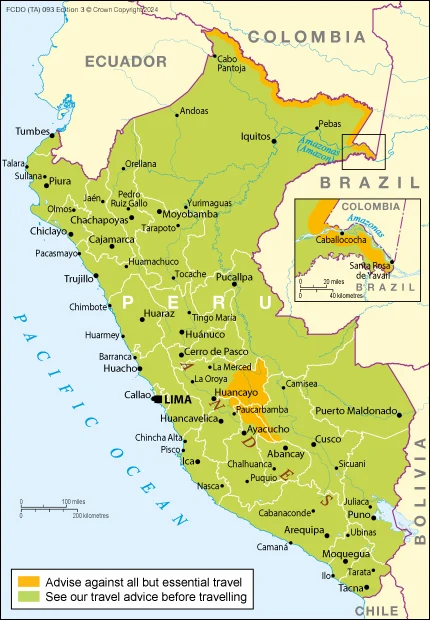
The United Kingdom’s Foreign, Commonwealth and Development Office (FCDO) has issued a fresh set of travel advisories for citizens planning journeys to Peru, cautioning against all but essential travel to specific high-risk regions within the South American nation. The updated guidance highlights persistent safety and security concerns in remote border territories and the country’s central jungle, while also alerting travellers to upcoming nationwide disruptions tied to a high-profile international visit.
According to the latest official update, British nationals are being strongly urged to avoid non-essential trips to designated zones where the local security environment remains volatile. The FCDO has underscored that disregarding official government travel warnings carries significant personal risks and can potentially invalidate a traveller’s comprehensive travel insurance policy, leaving individuals financially vulnerable in the event of medical emergencies, evacuations, or unexpected disruptions abroad.
Warnings and Insurance Implications for Travellers
The foundation of the FCDO’s advisory network is built upon continuous assessments of global geopolitical stability, crime rates, local law enforcement capabilities, and regional conflicts. When the government department advises against all but essential travel to a specific territory, it signals a level of danger that exceeds standard tourist precautions.
For travellers heading to Peru, the government’s stance serves as a critical checkpoint before purchasing flights, booking accommodations, or finalizing itineraries. Insurance experts and government officials consistently remind the public that standard travel insurance policies routinely contain clauses excluding coverage for incidents occurring in regions explicitly flagged by the Foreign Office. Consequently, anyone choosing to ignore the warnings and venture into restricted areas does so at their own financial and personal risk, as emergency medical treatment, rescue operations, or repatriation services may not be covered under their provider’s terms.
Specific Areas Where the FCDO Advises Against All But Essential Travel
The current restrictions issued by the UK government focus heavily on two distinct geographical zones within Peru, both of which have historically presented complex security challenges due to illicit activities, remote terrain, and limited state control.
The first restricted area encompasses lands situated within twenty kilometres south of the Peru-Colombia border. Specifically, the FCDO advises against all but essential travel to territories lying south of the Putumayo River within the northeastern Loreto region. This remote border zone has long been characterized by sparse infrastructure, challenging jungle topography, and significant transnational illicit trafficking routes. The proximity to volatile borderlands creates a security landscape that local authorities and international diplomatic missions monitor closely, resulting in the standing recommendation to avoid the area unless travel is entirely unavoidable.
The second major area of concern is the Valley of the Apurímac, Ene, and Mantaro Rivers, widely recognized by its regional acronym, the VRAEM. Situated in the central-southern jungle of Peru, the VRAEM is a vast, rugged expanse known for its complex socio-economic dynamics and historical security vulnerabilities. The FCDO maintains its restriction against all non-essential travel to the VRAEM region for fundamental safety and security reasons, advising citizens to steer clear of the valley entirely. Comprehensive details regarding the specific threat factors and regional risk assessments that led to these designations can be reviewed through official government channels dedicated to foreign travel guidance.
Upcoming Visit by Pope Leo XIV Expected to Cause Disruption
Beyond the permanent regional security warnings, the FCDO has incorporated urgent operational notices regarding an upcoming high-profile international event that will impact travel logistics across multiple parts of Peru.
Pope Leo XIV is scheduled to visit Peru from November 11 to November 16, a landmark itinerary that is expected to draw immense crowds, generate national media attention, and prompt significant logistical adjustments across the country. The presence of the pontiff will necessitate heightened security measures implemented by local authorities, which will inevitably translate into widespread road closures, unexpected traffic disruptions, and large public gatherings in major cities and transit hubs.
Travellers navigating Peru during this five-day period are advised to exercise heightened patience and flexibility. The logistical footprint of the papal visit will touch various regions, requiring visitors to anticipate delays when moving between destinations, attending appointments, or commuting to transit terminals.
Of particular note for tourists and regional travellers is the scheduled temporary closure of Cusco Airport. The aviation hub, which serves as the primary gateway for international and domestic visitors journeying to iconic historical sites such as Machu Picchu and the Sacred Valley, will be completely closed to air traffic on November 15 from 7:00 AM to 3:00 PM local time. The temporary suspension of flights is expected to cause a ripple effect across airline schedules, connecting flights, and ground transportation arrangements. The FCDO strongly encourages all affected passengers to verify their flight statuses directly with their respective airlines well in advance of their travel dates to mitigate the impact of the closure.
Before You Travel: Preparation and Insurance Guidance
In light of the combined security advisories and the operational challenges presented by the upcoming papal visit, the FCDO reiterates that no international travel can ever be guaranteed completely safe. Citizens planning a trip to Peru are encouraged to read the entirety of the official country guide to gain a comprehensive understanding of local laws, customs, health precautions, and regional conditions.
For individuals whose itineraries involve multi-destination travel through South America, the government emphasizes the importance of reviewing the specific travel advisories for every country included in their journey. Cross-border transit often introduces shifting regulatory frameworks, varying health requirements, and diverse security landscapes that require thorough advance preparation.
Regarding financial protection, the government’s guidance remains unequivocal. Travellers who elect to proceed with their journeys despite regional warnings are urged to conduct exhaustive research into their destinations and secure robust, appropriate travel insurance. Policies should be carefully selected to match the precise details of the traveller’s itinerary, encompassing all planned activities, adventure sports, cultural excursions, and potential emergency expenses that may arise while abroad. Ensuring that a policy provides adequate coverage for medical repatriation and emergency assistance is considered an essential safeguard for anyone visiting regions with complex terrain and varying healthcare infrastructure.
The Foreign, Commonwealth and Development Office continues to monitor the situation in Peru closely, providing objective information designed to help British nationals make well-informed decisions regarding their safety. Travellers seeking to stay informed of shifting conditions can utilize official government notification systems to receive direct email alerts whenever travel advice for Peru is modified. Additionally, monitoring official diplomatic channels offers ongoing insights into local developments, ensuring that visitors remain connected and prepared throughout their travels.
| Source | : | Open Passport |
| Author | : | Ammar Sabilarrohman |
| Editor | : | Open Passport Editorial Team |
