
Navigating Tokyo’s Internet Cafés: Access, ID, Prices, and Work Limits for Travelers
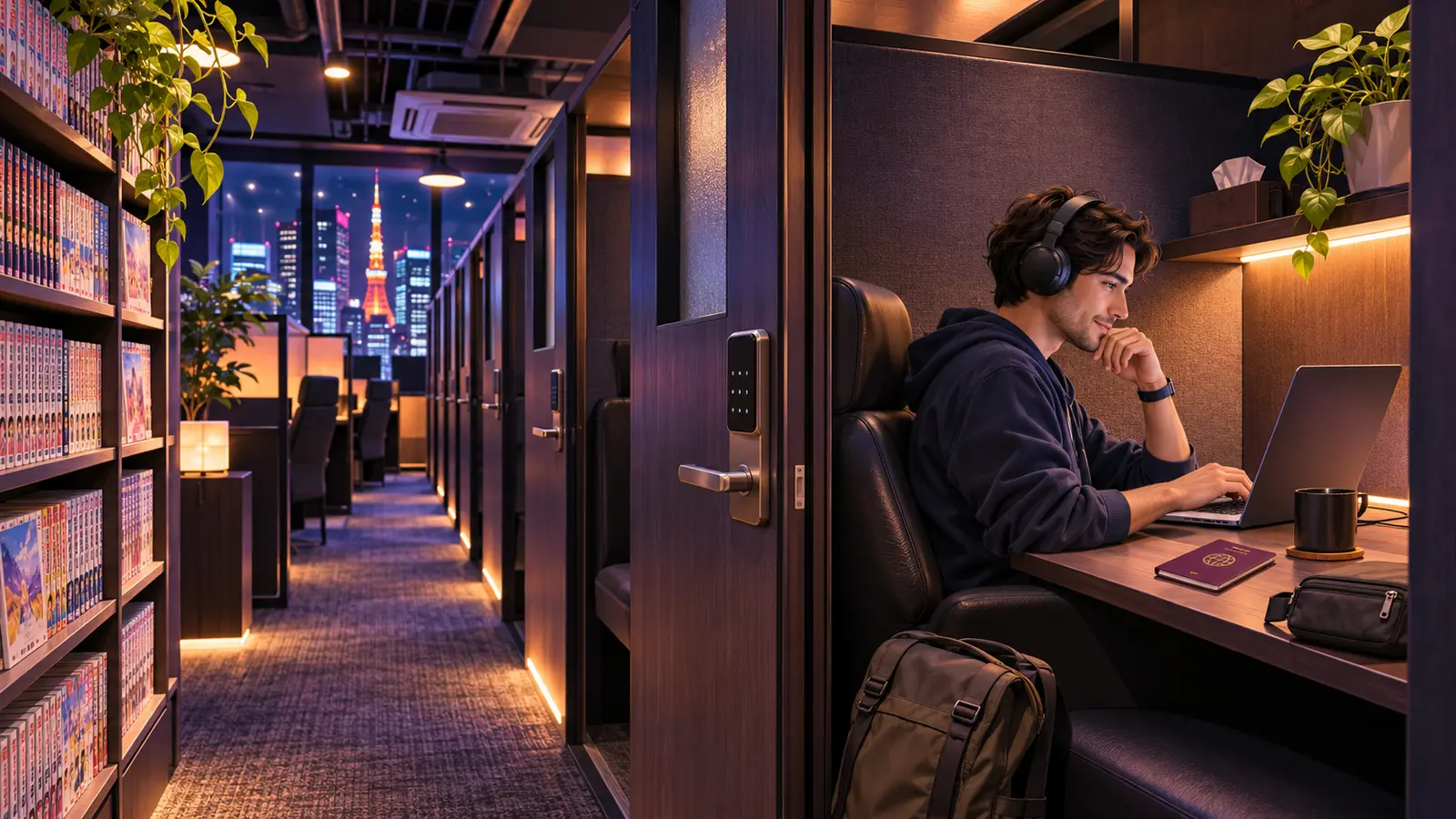
Tokyo internet cafés can provide a desk, computer, Wi-Fi, and a private booth at short notice, but they are not interchangeable with coworking spaces or hotels. Registration rules, seating, call privacy, and prices vary significantly by chain and individual branch. A comprehensive review of official operational guidelines from major chains such as Kaikatsu CLUB and Gran Cyber Cafe Bagus highlights the complexities that international travelers and digital nomads face when attempting to utilize these popular Japanese establishments for remote work or short-term connectivity needs.
For travelers caught in an emergency connection scenario, facing a gap between public transport arrivals and hotel check-in times, or needing a quiet desk for a few hours of solo computer work, an internet or manga café can serve as a viable temporary solution. However, experts and operators advise careful planning. Choosing a locked private room is essential if the visitor needs to make phone calls, and guests must explicitly confirm that voice calls are permitted in their specific zone. Furthermore, travelers are strongly encouraged to use their own devices for sensitive professional work whenever possible, rather than relying on shared terminal hardware.
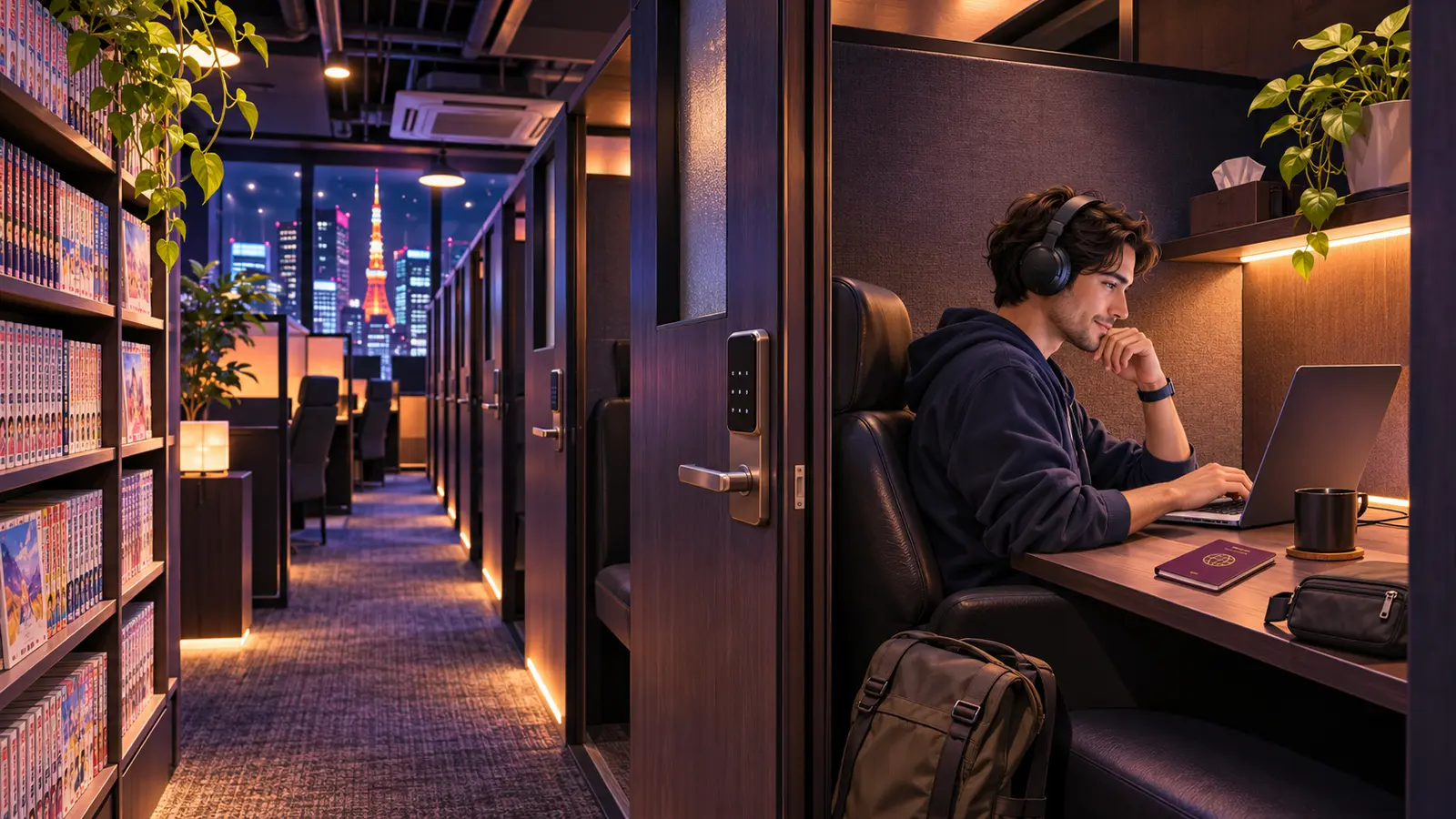
Bringing original identity documents that match the exact information required by the specific branch is another critical step. Officials note that a foreign passport without a current Japanese address may not satisfy a Tokyo branch’s strict membership registration rules. While a standard working week is usually better served by a traditional coworking day pass—which offers repeated meeting access, ergonomic seating, and dedicated business support—internet cafés remain heavily utilized facilities across the metropolis. Despite some branches promoting telework features, these venues are primarily designed as leisure and short-stay spaces rather than corporate offices.
Understanding what constitutes an internet café in Tokyo requires recognizing their dual identity as manga cafés. Depending on the specific branch and franchise, customers are given choices that range from open public seats and semi-enclosed cubicles to reclining or fully flat floor seats and lockable private rooms. Standard amenities often include desktop computers, high-speed Wi-Fi, continuous power access, printing services, soft drink bars, and shower facilities, with many prominent locations operating on a 24-hour schedule.
However, these features are by no means uniform across the city. A 24-hour opening schedule does not imply that every room can be reserved in advance, that every seat allows voice and video calls, or that the venue should be treated as a registered accommodation provider. Travelers are advised to check the exact branch page before traveling across the city.

Identity verification and membership rules present the most common hurdles for foreign travelers attempting to access Tokyo internet cafés. Major chains enforce these policies strictly to comply with local regulations and prevent unauthorized use.
At Kaikatsu CLUB, official guidelines state that there are no joining fees or annual membership fees. The chain lists original passports among accepted identity documents for verification. Nevertheless, Tokyo branches enforce a stricter mandate, requiring a single identity document that explicitly displays the member’s full name, date of birth, and current residential address. For Japanese passports issued from February 20, 2020, onward, the chain specifies that an additional supplementary document showing the current address must also be presented.
The vital takeaway for international visitors is that a standard passport may successfully identify the individual without displaying a current Japanese address. Travelers should never assume a passport will be sufficient on its own. Contacting the exact Tokyo branch in advance to inquire about acceptable documentation for non-resident visitors is crucial before relying on the venue for work or shelter during an overnight gap.
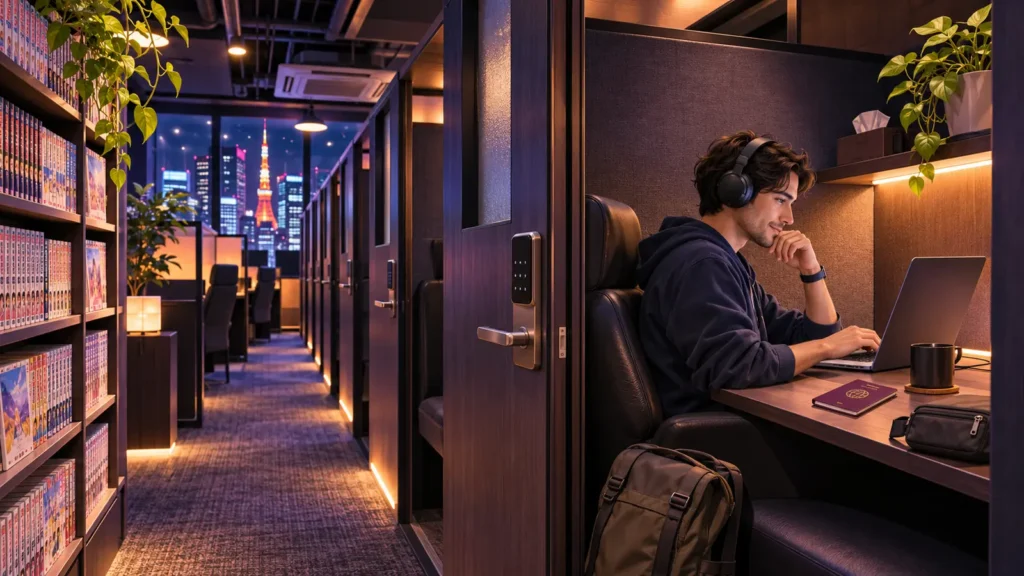
Similarly, Gran Cyber Cafe Bagus mandates membership registration for customers requesting internet access, aligning with local compliance rules. Its introductory and FAQ materials request identity documentation displaying a current residential address. While first-visit guidelines list passports and foreign-resident identification cards as acceptable examples, the underlying address requirement remains a potential obstacle. Bagus offers free mobile membership alongside a physical card membership option that carries a nominal registration fee with no subsequent annual or renewal fees. While the chain notes that individuals who bypass internet usage entirely may occasionally enter without formal registration, this exemption is useless for travelers whose primary purpose is online work.
Because front-desk interpretation can vary depending on the specific document presented and the staff on duty at a given branch, visitors must carry physical original documents. Digital photographs or photocopies of identification are not accepted; Kaikatsu explicitly notes that photographed originals are invalid for identity verification purposes.
Pricing structures at Tokyo internet cafés fluctuate widely depending on the location, day of the week, selected seat type, entry time, holiday periods, and active promotions. Official branch data from late 2026 illustrates these variations. For instance, rates listed for the Kaikatsu CLUB Akihabara branch featured a standard three-hour booth pack alongside a slightly higher rate for a lockable private room, with longer packages extending up to 24 hours and requiring formal settlement upon completion of that period. Meanwhile, the Gran Cyber Cafe Bagus Shinjuku location displayed non-member surcharges alongside distinct weekend pricing tiers. Because these figures represent branch-specific snapshots rather than a unified citywide tariff, customers must recheck live pricing pages on the exact day of their visit, particularly around national holidays when demand surges.

When evaluating these venues for remote work, professionals find a distinct mix of advantages and limitations. On the positive side, certain locations—such as Bagus Shinjuku—provide robust amenities including reliable Wi-Fi, power accessories, Microsoft Office software installations, printing capabilities, and PDF conversion tools. Their advertised locked private rooms are frequently described as soundproof, catering well to focused individual tasks.
Conversely, drawbacks become apparent during extended professional use. Internet cafés can be surprisingly noisy despite strict quiet policies, with disruptions stemming from neighboring gaming terminals, sliding doors, food service delivery, and fellow patrons. While a private room provides a degree of physical separation, remote workers must still verify ventilation quality, active call permissions, and room availability.
Security limits on shared networks also demand caution from digital nomads. Public or shared network environments necessitate heightened vigilance. Travelers should utilize personal laptops whenever possible, keep operating systems updated, engage a trusted virtual private network if permitted by their organization, avoid unknown USB peripherals, and refrain from leaving equipment unattended. When utilizing venue-provided computers, users must avoid logging into sensitive personal or corporate accounts. If such usage is unavoidable, passwords should never be saved, all services must be manually signed out, and users should assume that any downloaded files will remain on the machine until the venue’s automated system purge executes its regular reset process.
Furthermore, the physical presence of Wi-Fi infrastructure does not guarantee exceptional connection speeds. Neither major chain provides a formal performance guarantee for a specific seat at a designated hour. Maintaining a mobile data backup is essential for professionals facing tight deadlines or important calls.
Regarding calls, meetings, and privacy, digital nomads are cautioned against conducting business calls from open booths merely because headphone use is permitted. Professionals should select lockable rooms explicitly advertised as suitable for telework or online conferences, followed by direct verification with staff regarding normal speaking volume and video call policies. If meeting a colleague in person, the worker must confirm that the room is cleared for multi-person occupancy. For highly confidential tasks, traditional coworking phone booth facilities or dedicated meeting rooms remain the safer default option.
Reservations and walk-in risks represent another operational challenge. Kaikatsu CLUB maintains a policy where reservations are restricted exclusively to lockable private rooms and specific karaoke room configurations at selected branches. Web reservations generally open up to two months in advance and require a minimum booking duration of three hours, while standard seating remains strictly prioritized for walk-in clientele. Bagus applies automatic package pricing shifts based on elapsed time, though certain reservation-only plans operate differently. Because individual branches frequently sell out of specific seat types during peak hours, travelers relying on walk-in access should secure an alternative coworking space or hotel lobby nearby.
Ultimately, choosing between an internet café, a dedicated coworking space, or a traditional hotel depends heavily on the traveler’s immediate operational needs. Before committing to a Tokyo internet café, visitors should verify their membership eligibility, confirm address documentation requirements, check call policies, and ensure that backup connectivity options are readily available to maintain productivity throughout their stay in Japan.
| Source | : | Open Passport |
| Author | : | Rifan Muazin |
| Editor | : | Open Passport Editorial Team |
