The passport card was designed to meet the specific needs of border communities and frequent travelers who cross land and sea borders regularly. Since its introduction, it has become a popular choice for those who do not require air travel authorization but still need a federally recognized, secure form of citizenship and identity. Understanding the nuances of this document is the first step in deciding if it is the right choice for your upcoming itinerary.
What Exactly is a Passport Card?
A passport card is a credit-card-sized ID issued by the U.S. Department of State. It serves as official proof of your U.S. citizenship and identity. Because it fits easily into a standard wallet, many travelers find it less cumbersome than carrying a thick passport book. However, its utility is strictly defined by the Western Hemisphere Travel Initiative (WHTI).
It is crucial to understand the limitations of the passport card before applying. The passport card is valid only for entry into the United States at land border crossings and sea ports-of-entry from Canada, Mexico, the Caribbean, and Bermuda. It cannot be used for international air travel. Even if you are flying from Canada to the United States, you must possess a passport book. Attempting to fly internationally with only a passport card will result in being denied boarding.
The Benefits of Choosing a Passport Card
One of the primary advantages of the passport card is its cost. It is significantly cheaper than the passport book. For a first-time adult applicant, the card is a fraction of the price of the book, making it an attractive option for large families planning a road trip to Canada or Mexico. If you already have a book and just want the card as a secondary ID, the cost is even lower.
Additionally, the passport card is REAL ID compliant. This means it can be used for domestic air travel within the United States. If you do not have a REAL ID-compliant driver’s license and do not wish to upgrade it, carrying your passport card is a valid alternative for passing through TSA checkpoints at domestic airports.
Who is Eligible to Apply?
Eligibility for a passport card is identical to that of a passport book. You must be a U.S. citizen or a non-citizen national. If you have never had a passport before, or if your previous passport was lost, stolen, or issued when you were a minor (and you are now an adult), you must apply in person. However, if you currently hold a valid passport book, you may be eligible to apply for the card by mail as a renewal.
Step-by-Step Guide: First-Time Applicants
1. Complete Form DS-11
The first step is filling out Form DS-11: Application for a U.S. Passport. This form is available on the Department of State website. You can either fill it out online and print it, or print a blank PDF and fill it out by hand using black ink. Do not sign the form until you are in the presence of an acceptance agent. Signing it prematurely will void the form, and you will have to start over.
2. Provide Evidence of U.S. Citizenship
You must submit an original or certified copy of a document proving your citizenship. The most common documents accepted are a certified U.S. birth certificate, a Consular Report of Birth Abroad, a Certificate of Naturalization, or a Certificate of Citizenship. Note that a standard hospital birth certificate is usually not acceptable; it must be a certified copy from the registrar’s office containing a seal.
You will also need to submit a photocopy of the front and back of this citizenship evidence. This photocopy will be sent to the Department of State with your application, while the original will be returned to you (usually separately from the new card).
3. Present Valid Identification
When you go to the acceptance facility, you must present a valid government-issued photo ID to prove your identity. Acceptable forms of ID include a valid driver’s license, a current or expired U.S. passport book, a military ID, or a federal, state, or municipal government employee ID. If you present an out-of-state ID, you will likely be asked to present a second form of identification.
Just like with your citizenship evidence, you must provide a photocopy of the front and back of your ID. The copy must be on plain white, 8.5 x 11″ standard paper. Ensure the image is clear and that you do not write on the copy.
4. Provide a Passport Photo
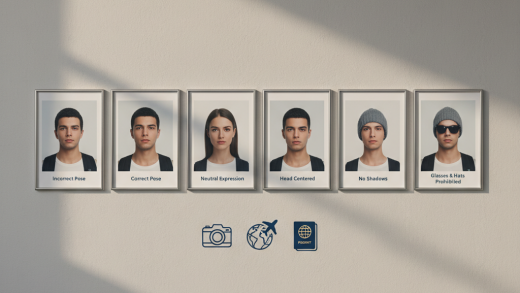
Your application must include one recent color photograph. The requirements for U.S. passport photos are strict. The photo must have been taken within the last six months and must reflect your current appearance. The background must be plain white or off-white. You must face the camera directly with a neutral facial expression or a natural smile, and both eyes must be open.
Important: You cannot wear glasses in your passport photo. If you wear glasses for medical reasons, you must include a signed note from your doctor. Additionally, no uniforms or camouflage clothing are allowed, and hats or head coverings are only permitted if you submit a signed statement verifying that the covering is part of recognized, traditional religious attire that is worn continuously in public.
Understanding the Costs
As of recent fee structures, the application fee for a passport card is significantly lower than that of the book, usually under $50 for adults, while the execution fee remains standard (typically $35). It is important to check the current fee schedule on the Department of State website before you go, as fees are subject to change. Note that the two fees often need to be paid separately; the State Department fee usually requires a check or money order, while the facility fee might accept credit cards.
Applying for Minors (Under 16)
The process for children under the age of 16 is more stringent due to laws designed to prevent parental abduction. Children must appear in person with both parents or legal guardians. Both parents must present their own IDs and sign the application form (DS-11) in front of the agent.
If one parent cannot appear, the applying parent must submit a notarized Form DS-3053 (Statement of Consent) from the non-applying parent, along with a photocopy of the front and back of the non-applying parent’s ID. If the other parent is not involved or cannot be located, the applying parent must provide legal documentation regarding sole custody or other specific evidence as outlined by the State Department.
Furthermore, unlike adult passports which are valid for 10 years, passport cards for children under 16 are only valid for 5 years. This shorter validity period ensures that the photo remains a recognizable likeness of the growing child.
Renewing an Existing Passport
If you already have a passport book or card that was issued within the last 15 years, and you were at least 16 years old when it was issued, you may not need to visit an acceptance facility. You can likely use Form DS-82 to apply by mail. This is a much simpler process.
To renew by mail or to apply for a card using your existing book as proof, you simply fill out the form, include your most recent passport, provide a new photo, and calculate the fee. You mail these documents via a trackable delivery method to the address listed on the form. Your old passport will be returned to you, cancelled, along with your new card.
Processing Times and Expediting
Patience is often required when applying for travel documents. Routine processing times can fluctuate depending on the time of year and the volume of applications. Generally, it takes several weeks (often 6 to 8 weeks or more) to receive your card. It is highly recommended that you apply well in advance of your planned travel dates.
If you are in a rush, you can pay an additional fee for expedited service. Expediting usually cuts the processing time down significantly. However, keep in mind that mailing times are not always included in the processing estimate. For the fastest service, consider paying for 1-2 day delivery for the return of your documents, though this applies more often to passport books than cards, which are typically sent via First Class Mail.
Using the Card at the Border
Once you receive your passport card, using it is straightforward. The card contains a radio frequency identification (RFID) chip. When you approach a U.S. land border, particularly those with “Ready Lanes,” the RFID technology allows border agents to access your information before you even reach the inspection booth, helping to speed up the process.
Remember to keep the card in its protective sleeve when not in use to prevent unauthorized scanning (skimming) of the RFID chip, although the risk is generally considered low due to the encryption used. The card is durable and water-resistant, making it ideal for the wear and tear of travel.
Common Mistakes to Avoid
To ensure your application is not delayed or rejected, avoid these common pitfalls: submitting a photo with glasses, forgetting to sign the check, using the wrong fee amount, or failing to include photocopies of your citizenship evidence and ID. Double-checking your application packet before heading to the acceptance facility or mailbox can save you weeks of frustration.
Conclusion
Applying for a U.S. passport card is a smart investment for travelers who enjoy cruises or road trips to neighboring countries. It offers a convenient, low-cost, and portable way to prove your citizenship and identity. By following the steps outlined above—gathering the correct documents, taking a compliant photo, and submitting the proper forms—you can navigate the bureaucracy with ease and focus on what matters most: your upcoming adventure.