
Türkiye Remains Second-Largest Source of Schengen Visa Applications Amid Ongoing Diplomatic Friction and Reforms
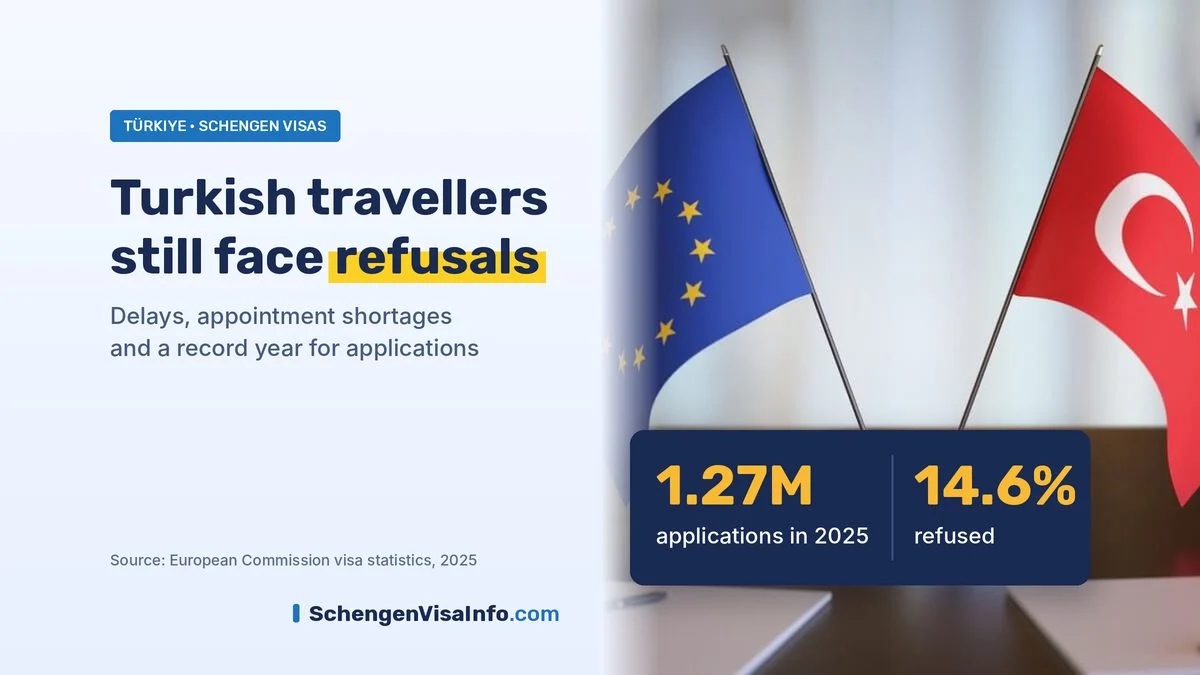
Turkish citizens continue to navigate one of the world’s most complex and scrutinized visa landscapes, remaining the second-largest group of Schengen visa applicants globally. Official statistics show that Schengen consulates in Türkiye received a record 1,268,376 applications in 2025, marking an 8.0 per cent increase compared to the previous year. While millions of Turkish nationals seek to travel to the European Union for tourism, business, education, and family visits, the long-standing grievances regarding appointment shortages, slow processing times, high rejection rates, and short visa validity periods have intensified economic and political debates across Ankara and European capitals.
Türkiye Remains Second-Largest Source of Schengen Visa Applications in 2025
According to European Commission visa statistics published in May 2026, the 1,268,376 applications submitted in Türkiye during 2025 represent the highest volume recorded since 2014. Out of this total,
1,072,328 visas were issued, while 183,196 applications were refused, bringing the rejection rate to 14.6 per cent. This figure aligns closely with the worldwide Schengen rejection rate of 14.6 per cent, though it reflects a slight increase from the 14.5 per cent refusal rate recorded in 2024. Long-term comparisons highlight a dramatic shift over the past decade; the rejection rate for Turkish applicants stood at just 4.4 per cent in 2014 before climbing steadily to a peak of 16.9 per cent in 2021.
Rejection rates varied significantly across individual Schengen member states. Among countries receiving at least 500 applications from Türkiye, Lithuania and Malta recorded the highest refusal rates at 35.5 per cent and 34.9 per cent, respectively. Conversely, Portugal, Slovakia, and Romania maintained much lower refusal rates of 3.5 per cent, 6.5 per cent, and 7.4 per cent. Greece remained the primary destination for Turkish applicants for the third consecutive year, capturing 24.5 per cent of all visa requests submitted within the country. Financial analyses indicate that Turkish applicants forfeited an estimated €16.5 million in non-refundable visa fees for applications that were ultimately rejected in 2025 alone.
EU and Türkiye Discuss Visa Liberalisation Dialogue at Ankara Meeting
Against the backdrop of high application volumes and recurring administrative bottlenecks, diplomatic engagement between Ankara and Brussels has persisted. On June 30, 2026, Türkiye’s Foreign Minister Hakan Fidan met with the EU’s High Representative Kaja Kallas and EU Commissioners Marta Kos and Magnus Brunner in Ankara. According to a joint press statement issued by the EU’s diplomatic service, the discussions addressed the current state of the long-stalled visa liberalisation dialogue, alongside a comprehensive exchange of views regarding the practical challenges faced by Turkish citizens during the application process.
The high-level meeting also explored broader bilateral priorities, including the modernization of the Customs Union, enhanced cooperation on border management and the suppression of migrant smuggling, and preparations for future high-level dialogue meetings expected to take place before the end of 2026. Turkish officials have consistently emphasized that visa facilitation and eventual liberalisation remain critical benchmarks for restoring normal economic and social exchanges between Türkiye and the European Union.
EU Adopts More Favourable Schengen Visa Rules for Turkish Citizens
In an effort to alleviate systemic pressures and reward compliant travelers, the European Union implemented a more favorable regulatory framework for Turkish nationals in July 2025. Known as the "cascade" rule, this policy applies to Turkish residents applying for short-stay visas within Türkiye who possess a demonstrated record of lawful travel. However, professional truck drivers are excluded from this specific mechanism.
Under the cascade system, applicants who have successfully obtained and lawfully utilized two Schengen visas within the preceding three years become eligible for a multiple-entry visa valid for one year. Continued lawful usage can subsequently unlock a three-year multiple-entry visa, followed eventually by a five-year validity visa, provided passport validity requirements are met. The EU Delegation to Türkiye noted that the initiative is designed to facilitate people-to-people contacts and operates in tandem with ongoing bilateral cooperation on migration management and readmission agreements.
Turkish Nationals Struggling to Secure Schengen Visa Appointments as Black Market Thrives
Despite the introduction of multi-year visa provisions, ordinary applicants continue to face severe logistical hurdles in booking initial appointment slots through official channels. The overwhelming demand for Schengen visas has fueled a lucrative black market, where commercial intermediaries and third-party actors exploit appointment systems.
Industry reports highlight that intermediaries deploy automated software and bots to continuously monitor appointment availability. As soon as consular slots are released, the bots secure and block them, effectively shutting out genuine applicants. These blocked slots are subsequently resold on the black market for exorbitant sums. Travel industry professionals have reported that intermediaries frequently demand between €500 and €1,000 for a single appointment slot, with prices occasionally reaching as high as €3,000.
VFS Global, a major external service provider handling visa logistics in the region, has introduced several countermeasures to combat these fraudulent practices. Sertan Aslantürk, VFS Global’s Deputy Regional Head for Türkiye and Azerbaijan, explained that the company has rolled out virtual point-of-sale systems, virtual keyboards, strict IP address restrictions, and blockades against VPN-based access. Additionally, a digital waiting room mechanism has been implemented to dismantle the automated monopolies held by unauthorized intermediaries.
Germany to Issue More Long-Validity Schengen Visas to Turkish Nationals
Consular authorities have similarly urged applicants to bypass commercial consultants while expressing commitments to expand the application of the cascade regime. During a seminar at Yaşar University in İzmir, German Consul General Ralf Schröer stated that Germany intends to issue long-validity multiple-entry Schengen visas more extensively to qualified Turkish applicants. Schröer noted that under agreements reached between Turkish and German authorities, priority in appointment scheduling and processing speeds is intentionally allocated to businesspeople and students.
Conversely, the German Consul General acknowledged that high seasonal demand often forces leisure travelers and general tourists to endure waiting periods spanning several months. Schröer strongly advised Turkish nationals against utilizing commercial visa consultancy firms, asserting that third-party intermediaries do not expedite the administrative process and may inadvertently introduce delays or vulnerabilities into the application file.
Turkish Businesses Complain Over EU Demanding Company Financial Records for Schengen Visas
The business community in Türkiye has voiced mounting frustration over evolving administrative requirements mandated by various Schengen member states. Business leaders and industrial associations have criticized EU consulates for enforcing a requirement that compels Turkish companies to submit mandatory three-month financial records and sensitive operational data for employees traveling for corporate purposes.
Exporters and trade representatives argue that demanding detailed corporate records—which often include confidential trade secrets—represents an unjustified barrier to commerce. Legal experts have similarly pointed out potential conflicts between these consular demands and Türkiye’s Personal Data Protection Law, as well as broader international data regulations. Turkish business leaders contend that the additional disclosure requirements disproportionately penalize small and medium-sized enterprises, hindering their capacity to participate in European trade fairs, negotiate contracts, and meet with prospective clients.
Türkiye’s Main Opposition Party Leader Criticises EU Over Strict Schengen Visa Rules
Political figures across Türkiye’s political spectrum have condemned the persistence of restrictive visa policies. Ozgur Ozel, leader of the Republican People’s Party (CHP), addressed the Socialists and Democrats Group in the European Parliament, characterizing the ongoing visa barriers faced by Turkish academics, businesspeople, and youth as profoundly unjust. Ozel argued that strict consular restrictions actively undermine long-term diplomatic and societal relations between Türkiye and the European Union, while noting that recent domestic polls indicate 66 per cent of Turkish citizens remain supportive of eventual EU membership.
Tourism Agencies Are Selling Fake Schengen Visa Appointments to Turkish Citizens, EU Ambassador Warns
Diplomatic representatives in Ankara have openly acknowledged the severity of the administrative crisis. Thomas Ossowski, the EU Ambassador to Türkiye, highlighted that unscrupulous tourism agencies have capitalized on appointment scarcity by selling free official appointments and circulating fraudulent documentation. In media interviews, Ambassador Ossowski confirmed that numerous consular applications are compromised by forged documents, which directly contributes to higher denial rates. While emphasizing that the European Union remains committed to addressing logistical bottlenecks and cooperating with Turkish authorities to suppress fraudulent intermediary networks, Ossowski maintained that Türkiye has yet to satisfy all necessary criteria required to achieve full visa-free travel.
Turkish Minister Calls for Visa Liberalisation as Schengen Rejection Rates Soar
Turkish Foreign Minister Hakan Fidan has repeatedly pressed European counterparts to accelerate visa liberalisation talks and address soaring rejection figures. Addressing budget deliberations and parliamentary inquiries, Minister Fidan attributed the prolonged processing times and elevated denial rates to structural staff shortages within European consulates and broader political sensitivities surrounding migration across the EU. Highlighting that application volumes from Turkish nationals had surged by over a third compared to previous years, Fidan stressed that Ankara views predictable, streamlined travel access as an indispensable component of bilateral cooperation and the modernization of the long-standing Customs Union framework.
Efforts to reform transit and transport regulations have also been a central focus for logistics operators. Şerefettin Aras, President of the International Transporters Association (UND), warned that persistent visa denials and appointment delays for Turkish truck drivers generate severe operational bottlenecks, inflate freight costs, and disrupt supply chains critical to European manufacturers. Because professional drivers form an integral component of the commercial transit ecosystem between Türkiye and the EU, industry groups have continuously lobbied for dedicated exemptions and expedited consular processing to protect bilateral trade relationships.
As diplomatic dialogues continue between Ankara and Brussels, millions of Turkish citizens and commercial enterprises await tangible administrative relief. While the introduction of the multi-year cascade visa regime signals a potential pathway toward reduced bureaucracy for frequent travelers, the immediate challenges of appointment scarcity, high rejection rates, and digital exploitation underscore a deeply strained consular relationship that continues to impact travel, commerce, and diplomacy across the region.
| Source | : | Open Passport |
| Author | : | Iffa Jayyana |
| Editor | : | Open Passport Editorial Team |
