
Digital Nomad Visa Income Requirements: What Remote Workers Need to Check Before 2027
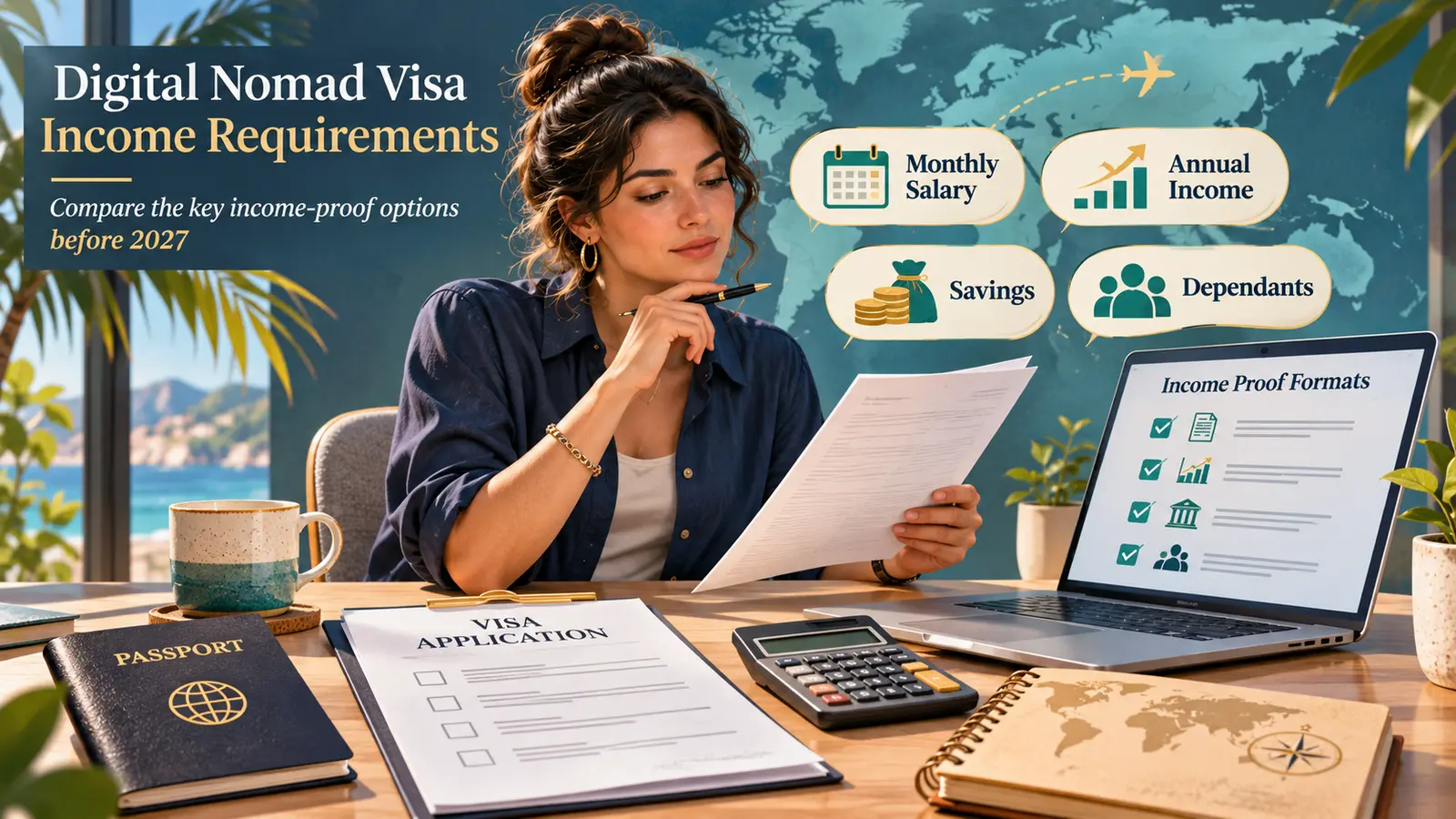
Navigating the financial prerequisites for international remote work has become an increasingly complex undertaking, as immigration authorities across the globe adopt varied and dynamic metrics to vet applicants. For location-independent professionals eyeing relocations or visa renewals, understanding that digital nomad visa income requirements are rarely a single, static number is paramount. Programs differ significantly in how they measure financial stability, utilizing gross annual income thresholds, multiple-based net salary calculations, or automated national minimum-wage formulas that shift independently of official visa documentation pages. Beyond headline financial figures, verifying acceptable proof periods, dependent additions, and exact documentation standards can mean the difference between a successful application and a costly denial.
Recent policy updates and administrative shifts underline the volatility of these financial baselines. A primary development involves transitional frameworks in popular host nations, exemplified by Malaysia’s transition to an enhanced DE Rantau framework. The Malaysia Digital Economy Corporation announced that new applications under the program were temporarily closed to pave the way for the updated framework, highlighting how reliance on outdated screenshots, cached search results, or legacy blog posts can render an application obsolete overnight.
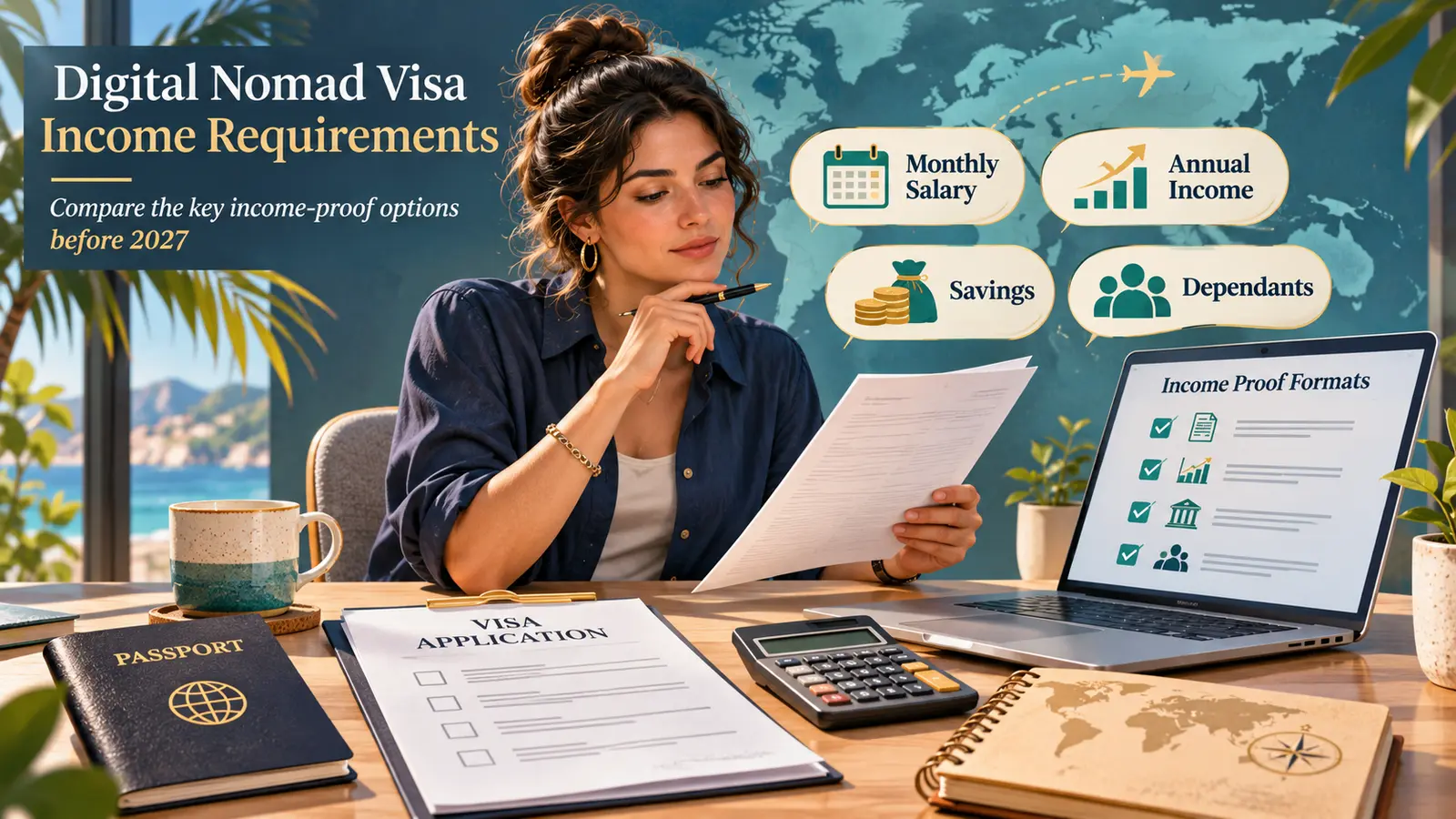
Simultaneously, structural indexation poses a persistent risk for applicants across Europe. Countries such as Croatia publish euro thresholds anchored directly to the previous year’s average net salary statistics. Slovenia implements salary-linked formulas, while Spain ties statutory financial requirements directly to a percentage of the national minimum wage. Because these macroeconomic inputs fluctuate regularly, a financial threshold copied in late 2026 may be entirely inaccurate for an application formally submitted in 2027.
A comparative examination of official rules across jurisdictions like Slovenia, Croatia, Spain, Malta, and Malaysia demonstrates that direct cross-border comparisons are inherently misleading. Malta structures its financial test around gross annual income figures. Croatia evaluates generalized means of subsistence, granting applicants the flexibility to provide either regular monthly proof of earnings or an equivalent lump sum. Spain explicitly anchors its threshold to statutory wage metrics, whereas Slovenia relies on a targeted salary multiplier. Malaysia separates applicants into distinct professional categories while periodically updating its operational guidelines through active transition phases.

Establishing whether a published figure represents gross income, net earnings, or freely available liquid funds is a critical initial step for applicants. Converting every foreign threshold into a generalized salary target without checking the exact legal definition can result in critical miscalculations. When official government portals prove ambiguous, applicants are advised to seek direct clarification from responsible authorities regarding whether contract values, gross payslips, bank deposits, or post-tax income represent the mandatory benchmark.
Calculating financial requirements for accompanying dependents introduces another layer of complexity, as a single applicant’s threshold rarely translates into a family baseline. In Croatia, regulations require an additional ten percent of the official average monthly net salary for each recognized partner or family member. Spain’s official framework asks for an additional seventy-five percent of the statutory minimum wage for the first accompanying family member, alongside twenty-five percent for each subsequent individual. Other international programs may conduct holistic assessments regarding whether a primary income remains sufficient for a household without publishing rigid arithmetic formulas. Writing out these financial equations prior to collecting evidence ensures that applicants do not fall victim to borderline discrepancies caused by bank conversion methods or payment timing issues.
The required duration of financial proof also varies considerably, with immigration authorities increasingly looking for sustained economic patterns rather than isolated high account balances. Croatia accepts bank statements demonstrating full coverage of the required amount, records of regular income, or continuous payslips spanning at least six months at the mandatory level. Malta’s administrative guidelines mandate that applicants prove a guaranteed source of qualifying income for a minimum of five cumulative months running from the application date. Meanwhile, Malaysia’s remote-worker document checklists require recent bank statements that align seamlessly with active foreign employment contracts. Possessing a substantial lump-sum balance without matching employment verification often fails to satisfy a program’s underlying purpose test, just as a strong corporate contract may prove insufficient if regulators explicitly demand months of deposited income history.
Building a cohesive evidence trail is essential for satisfying case officers who review these submissions. Applicants must ensure absolute consistency across personal names, currency designations, and payment records. Guidance from Malaysian authorities, which mandates that names and income details match across all files and that foreign documents be submitted in English or accompanied by certified translations, serves as a practical standard for applications worldwide. Relying on optimistic, unverified currency conversions can also jeopardize a filing; if an immigration authority fails to publish a standardized conversion methodology, applicants should retain documentation of the specific exchange rate used and maintain a safe financial margin above the official threshold.

Meeting a financial threshold does not automatically confer eligibility, as remote work qualifications must be evaluated independently of income tests. Slovenia explicitly defines a digital nomad as a non-EU or EEA foreigner performing remote work for a business entity based outside Slovenian borders, or operating as a self-employed individual abroad, without accessing the domestic labor market. Croatia enforces similar stipulations, requiring remote work to originate from a foreign employer or a foreign-owned business while barring services rendered to domestic Croatian entities. Malta maintains parallel restrictions, requiring foreign employment, self-employment, or international client portfolios while strictly excluding work performed for Malta-based companies or individuals. Consequently, the physical location of clients, employers, and corporate subsidiaries matters just as much as an applicant’s bank balance.
Monitoring index-linked thresholds is vital for avoiding unexpected compliance hurdles. Fixed figures, such as Malta’s gross annual income requirement, can still be revised through administrative updates. Salary-linked formulas utilized by Slovenia and Spain fluctuate whenever underlying national economic statistics are adjusted. Annually recalculated amounts, such as Croatia’s monthly subsistence figure derived from national average net salaries, change dynamically whenever reference-year data is published by state statistical offices. Prospective applicants planning submissions for early 2027 must systematically re-verify official portals following the release of updated wage data or government announcements.

Evaluating announced policy shifts requires careful adherence to published administrative instructions rather than speculation. Regulatory updates, such as Malaysia’s implementation of its enhanced DE Rantau framework and associated renewal pathways of up to four years, emphasize the necessity of relying exclusively on current official application materials. News reports, budget speeches, and legislative proposals often signal forthcoming adjustments long before final thresholds, evidentiary rules, or effective dates are codified.
Ultimately, maintaining a comprehensive pre-application record—including dated PDFs or screenshots of official requirements utilized during calculations—provides a reliable reference point for prospective residents. While archived guidelines cannot override active legislation, documenting the specific published instructions followed during preparation helps clarify compliance efforts as global digital nomad visa frameworks continue to evolve.
| Source | : | Open Passport |
| Author | : | Siti Muinah |
| Editor | : | Open Passport Editorial Team |
