
Global Treaty on Autonomous Weapons Blocked at UN Convention, Sparking Outrage from Human Rights Groups
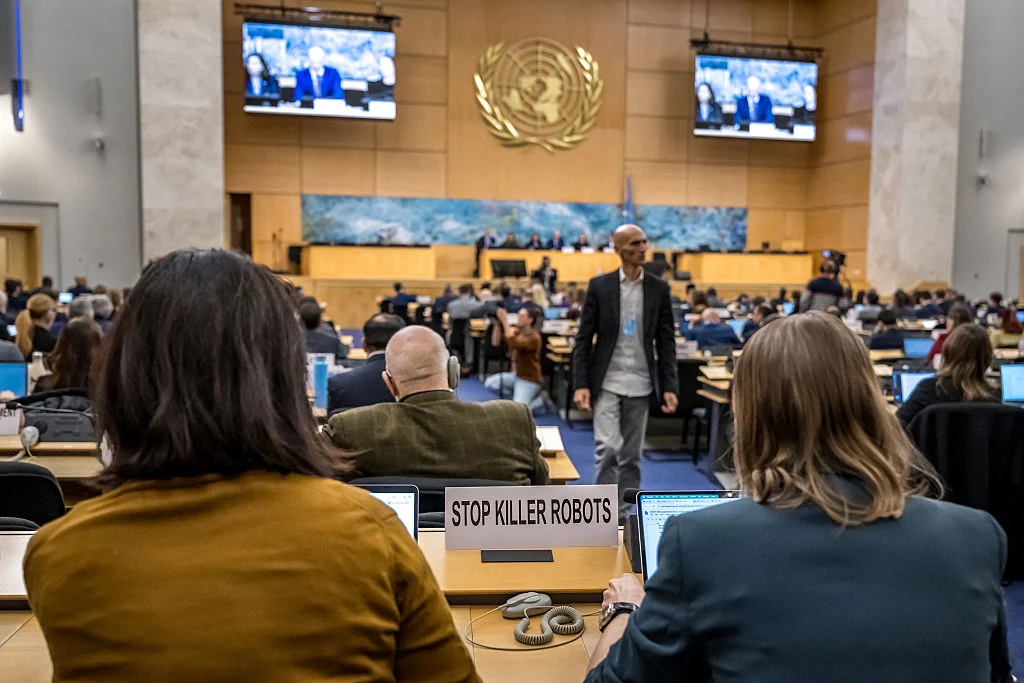
The international community has suffered a profound setback in efforts to regulate the rapid militarization of artificial intelligence, after delegates at the seventh Review Conference of High Contracting Parties to the Convention on Certain Conventional Weapons (CCW) failed to agree on negotiating a global treaty to address the escalating threat of autonomous weapons systems. Instead of committing to binding international law, member states opted to adopt a watered-down mandate that merely provides for the development of an instrument with an ambiguous legal status.
The decision has drawn immediate and fierce condemnation from humanitarian and human rights organizations. Responding to the outcome of the high-stakes conference, Erika Guevara Rosas, Senior Director of Research Advocacy, Policy and Campaigns at Amnesty International, issued a searing critique of the diplomatic failure.
“Agreement to continue discussions for a further two years without a clear legal objective on the regulation of autonomous weapon systems falls shamefully short of what is the reality of the moment,” Guevara Rosas said. “If states are truly committed to tackling the risks of increasing autonomy in warfare, they must redouble their efforts to ensure that agreed norms are integrated into a robust, global legally binding treaty, probably outside the CCW. In addition to ensuring meaningful human control over the use of these weapon systems, states must also push for a ban on autonomous weapons systems that target humans.”
For more than a decade, diplomats, technical experts, and civil society advocates have gathered under the auspices of the CCW to debate the profound ethical, legal, and humanitarian implications of machines empowered to make life-and-death decisions on the battlefield. However, this week’s meeting was widely viewed by human rights defenders as a final, decisive test of whether the traditional consensus-based forum was capable of confronting one of the most consequential technological and moral challenges of the modern era. According to Amnesty International and its partners, the forum failed its ultimate test.
The core obstacle to meaningful progress within the CCW framework remains its rigid adherence to a consensus-based decision-making model. During the review conference, a clear majority of participating states voiced their support for initiating formal negotiations toward a comprehensive global treaty governing autonomous weapon systems. Despite this broad coalition of backing, the system allowed a small minority of resistant spoiler states to block any substantive forward movement, resulting in an outcome that advocates warn will carry catastrophic consequences for civilian populations caught in the crossfire of armed conflicts around the world.
Autonomous weapon systems, often colloquially referred to as "killer robots," represent a radical departure from traditional military hardware. Unlike remotely piloted drones or computerized defense systems that still rely on direct human oversight for targeting and firing, these advanced machines are programmed to independently select, engage, and strike targets once they are activated, operating entirely without subsequent human intervention.
This technology is currently being researched, developed, and tested at a breathtaking speed by various military powers. Human rights experts warn that ceding the ultimate control of lethal force to algorithms and machines on the battlefield threatens to usher in a dystopian and deeply dehumanizing future. The unrestricted deployment and proliferation of such systems could easily trigger a disastrous escalation in automated warfare, generating untold human suffering while fundamentally undermining the core principles of human rights, international humanitarian law, and inherent human dignity.
The structural limitations of the CCW have frustrated human rights advocates for years. After 13 years of protracted talks, working groups, and informal consultations within the forum, the inability of the seventh Review Conference to produce a concrete legal mechanism has cemented fears that legacy disarmament frameworks are ill-equipped to govern rapidly evolving military technologies.
Despite this institutional roadblock, civil society organizations remain deeply mobilized. Amnesty International is a prominent member of the Stop Killer Robots campaign, a vast international coalition comprising more than 330 civil society organizations operating across 78 countries. This global network is united in demanding urgent political action to negotiate and implement a robust global treaty specifically targeting autonomous weapons systems before the technology outpaces international law entirely.
History offers a potential roadmap for how nations can bypass entrenched diplomatic stalemates when dealing with exceptionally dangerous military technology. In previous decades, when multilateral negotiations regarding certain inhumane weapons stalled within the confines of the CCW, concerned governments and civil society actors successfully pivoted to alternative diplomatic pathways.
Notable precedents include the creation of the Anti-Personnel Mine Ban Convention and the Cluster Munitions Convention. Both of these landmark international agreements were rapidly negotiated through dedicated multilateral diplomatic processes outside the traditional CCW framework after institutional progress ground to a halt.
Those treaties ultimately succeeded in establishing strong, enduring international norms against the production, stockpiling, transfer, and use of indiscriminate munitions. By stigmatizing these weapons and establishing rigorous legal frameworks, they have greatly curtailed their deployment over the years, shielding countless civilians from death, dismemberment, and long-term injury.
As the diplomatic dust settles from the latest CCW review conference, international pressure is mounting on progressive states to abandon the paralyzed forum and pursue a standalone, legally binding treaty. For human rights advocates and the broader coalition of nations seeking to preserve human control over warfare, the message from Geneva is clear: while the CCW has failed to meet the moment, the global campaign to regulate and ban autonomous weapons will continue outside its walls.
| Source | : | Open Passport |
| Author | : | Basiran |
| Editor | : | Open Passport Editorial Team |
