
UK Foreign Office Updates Nigeria Travel Advisory: Strict Warnings Issued Across Multiple Regions
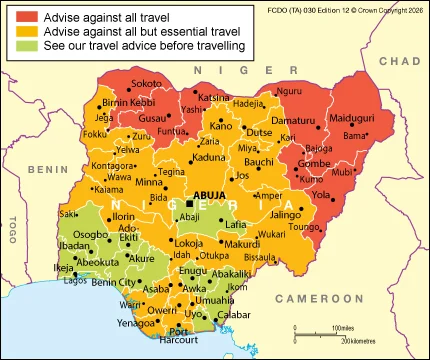
The United Kingdom’s Foreign, Commonwealth & Development Office (FCDO) has issued updated travel guidance for British citizens considering trips to Nigeria, outlining severe security risks that affect multiple regions across the West African nation. The newly revised advisory highlights locations where the government warns against all travel, as well as areas where authorities advise against all but essential travel.
The updated guidance serves as a critical alert for travelers, business professionals, and expatriates, emphasizing that ignoring official government warnings carries substantial personal risks and could have serious financial consequences. According to the FCDO, traveling to regions designated as high-risk can directly invalidate a person’s travel insurance policy, leaving individuals entirely unprotected financially in the event of a medical emergency, evacuation, or other unforeseen crises.
Warnings and Insurance Implications
Navigating international travel safely requires constant vigilance, and government advisories play a foundational role in helping citizens make informed choices about their safety abroad. The FCDO formulates its travel guidance based on continuous assessments of local security conditions, political stability, crime rates, and the terrorist threat level in various parts of the world.
When the British government advises against all travel or all but essential travel to a specific destination, the implications extend far beyond safety. Standard travel insurance policies almost universally contain clauses stating that coverage becomes null and void if the policyholder travels to a destination explicitly flagged by the FCDO against travel advice. Consequently, anyone choosing to visit these regions in Nigeria against official guidance would likely be forced to shoulder the entire financial burden of emergency medical treatment, hospital stays, repatriation, or rescue operations out of pocket.
To help travelers visualize and understand the complex security landscape, the FCDO has provided a detailed regional map alongside the updated text. This cartographic resource allows individuals to examine the specific boundaries of high-risk zones, helping them plan safer itineraries or reconsider journeys altogether.
Areas Where the FCDO Advises Against Travel
The security situation in Nigeria varies dramatically by region, presenting distinct challenges across the country’s northern and southern sectors. The FCDO’s updated advisory breaks down these regional risks meticulously, starting with the North East.
In North East Nigeria, the security environment has long been shaped by insurgent activity and armed conflict. The FCDO maintains stringent warnings for this part of the country, cautioning citizens against all travel to certain areas, while designating other zones as places where only essential travel should be considered. These measures reflect the persistent threat of violence and instability that continues to challenge local security forces in the region.
Moving westward, North West Nigeria presents a separate set of security concerns, including armed banditry, kidnapping, and localized communal clashes. The FCDO has outlined specific territories within the north-west where all travel is strictly discouraged, alongside wider areas where non-essential travel is strongly advised against. The complexity of managing security across expansive rural and semi-urban landscapes in the north-west has contributed to the heightened risk profile maintained by British authorities.
The security dynamics shift again as one examines North Central Nigeria and the Federal Capital Territory, a region that includes the nation’s capital, Abuja. While Abuja serves as the political heart of the country and a major hub for international diplomacy and commerce, the broader north-central zone has experienced periodic security incidents, including civil unrest and localized violence. Consequently, the FCDO advises against all but essential travel to specific parts of this region, including areas within the Federal Capital Territory, signaling that even major administrative centers require heightened caution.
In the southern portions of the country, the landscape shifts from savannah and scrubland to dense river networks and coastal environments. In South East and South South Nigeria, the FCDO’s advisory places special emphasis on aquatic geography. The updated guidance explicitly advises against all travel to the riverine areas of Delta, Bayelsa, Rivers, Akwa Ibom, and Cross River states. These specific zones—characterized by intricate river and swamp locations that remain accessible by boat but cannot be reached by road—pose distinct logistical and security challenges. Additionally, the FCDO advises against all but essential travel to other designated parts of the southern region, reflecting ongoing concerns regarding localized criminality and public safety.
Before You Travel
The FCDO routinely underscores a fundamental reality of international mobility: no travel can ever be guaranteed completely safe. Before embarking on a journey to Nigeria, or any other complex international destination, officials recommend that travelers thoroughly read all available guidance, study regional risk reports, and familiarize themselves with local laws and customs.
Thorough preparation involves researching the specific legal, cultural, and security context of the destination. Travelers are encouraged to utilize resources provided by their home governments to stay informed about evolving situations on the ground. By keeping abreast of political developments, local curfews, and transportation disruptions, visitors can better navigate unforeseen challenges.
Securing Adequate Travel Insurance
For those who ultimately decide that travel to Nigeria is necessary, obtaining appropriate and comprehensive travel insurance is paramount. Because standard policies may exclude high-risk destinations, travelers must actively seek out specialized insurers who offer coverage for countries under FCDO advisories.
Proper insurance coverage should be tailored to the traveler’s exact itinerary, planned activities, and duration of stay. It is vital that policies explicitly cover emergency medical expenses, medical evacuation, and potential crisis response services. Relying on generic or low-tier insurance policies without verifying whether they apply to regions flagged by the FCDO can leave travelers dangerously exposed. Taking the time to read the fine print of an insurance contract before departure can prevent catastrophic financial losses if an emergency occurs while abroad.
About FCDO Travel Advice and Staying Updated
The Foreign, Commonwealth & Development Office provides comprehensive travel advice not to restrict movement arbitrarily, but to equip British citizens with accurate, up-to-date assessments of foreign risks. These assessments are designed to empower individuals to make well-informed decisions regarding their personal safety and security when operating outside the United Kingdom.
Because security conditions can change rapidly in dynamic environments like Nigeria, static information quickly becomes outdated. The FCDO encourages all travelers and expatriates to sign up for direct email notifications regarding the Nigeria travel advice page. This ensures that any modifications to the advisory—whether an escalation of risk levels or an easing of restrictions—reach interested parties immediately.
Additionally, travelers can follow official FCDO communication channels on digital and social media platforms to receive real-time updates and emergency alerts. Maintaining open lines of communication with consular services and registering travel plans with the relevant embassy or high commission remain standard best practices for anyone navigating complex international environments.
| Source | : | Open Passport |
| Author | : | Nana Muazin |
| Editor | : | Open Passport Editorial Team |
